
The NAACP urges Black athletes to think deeply about where their talent, money, influence, and future should go as the fight over voting rights moves into college sports. Through its new “Out of Bounds” campaign, the civil rights organization is calling on Black athletes, recruits, families, alumni, fans, and consumers to withhold athletic and financial support from public universities in states it says are weakening Black voting power. The campaign also encourages athletes to consider HBCUs as a powerful alternative.
NAACP urges Black athletes to look at the bigger picture
NAACP launched the campaign on May 19, 2026, naming eight priority states: Tennessee, Louisiana, Alabama, Florida, Mississippi, South Carolina, Texas, and Georgia. The organization says these states have moved to limit or erase Black voting representation following the Supreme Court’s 6-3 ruling in Louisiana v. Callais.
At the center of the campaign is a direct message to Black athletes: your power is bigger than the field, the court, or the scoreboard.
The NAACP is asking top football and basketball recruits to withhold commitments from targeted public universities until affected states restore fair congressional maps and meaningful Black representation. It is also asking current athletes to use their platforms, NIL influence, and public visibility to speak up for voting rights and fair maps.
This is not a small request. College decisions can shape an athlete’s future, family stability, professional development, and earning potential. But the NAACP is arguing that Black athletes should not be expected to generate wealth, attention, and prestige for institutions while the states around those institutions weaken Black political power.
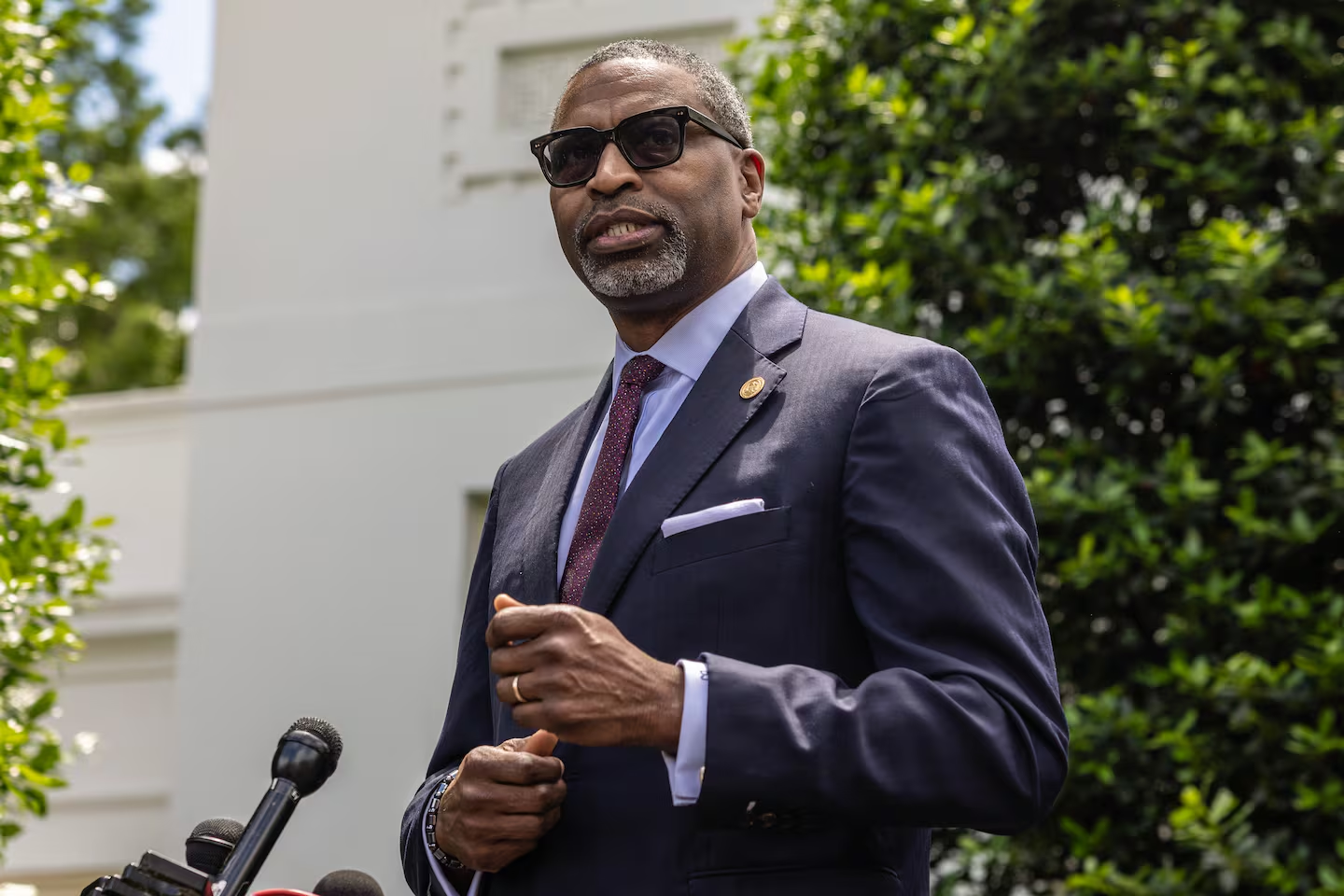
NAACP President and CEO Derrick Johnson framed the issue as one of both economics and representation.
“Black athletes should not be asked to generate wealth, prestige, and power for state institutions while those same states strip political power from Black communities,” Johnson said.
The quote was reported by the Associated Press and matches the core message of the campaign.
HBCUs enter the national sports conversation
The campaign places HBCUs in the middle of a larger national conversation about race, sports, money, and power.
For decades, Black athletes have helped build the identity and revenue of major college sports programs. They have filled stadiums, lifted television ratings, driven merchandise sales, energized alumni bases, and shaped the culture of entire athletic conferences. Now the NAACP is asking what would happen if more of that talent and attention flowed toward HBCUs.
That question matters.
HBCUs have always been central to Black excellence. They have produced leaders, athletes, artists, doctors, lawyers, educators, entrepreneurs, and culture-shapers across generations. In sports, HBCUs have produced legends while building some of the richest traditions in college athletics. From football classics and marching bands to basketball rivalries and homecoming culture, HBCU athletics has never lacked meaning. It has often lacked the same level of investment and exposure given to larger public universities.
The NAACP’s call challenges athletes, families, donors, and fans to rethink where value is created and where value should be returned.
The campaign also targets fans, alumni, and donors
The NAACP’s message is not only for athletes. It is also calling on fans, alumni, donors, and consumers to stop buying tickets, merchandise, and licensed apparel tied to public universities in the targeted states. The organization wants that support redirected to HBCU athletic programs, scholarship funds, alumni foundations, NIL collectives, and bands.
That part of the campaign may be where the HBCU community can move quickly.
Every ticket sold matters. Every donation matters. Every NIL contribution matters. Every piece of merchandise purchased helps shape which institutions gain power, visibility, and financial strength.
If fans are serious about supporting Black athletes, the NAACP is pushing them to look beyond slogans and make financial choices that reflect that support. For HBCUs, that could mean more donations to athletic departments, more support for student-athletes, more media attention for games, and more investment in the full student experience.
Voting rights and college sports are now connected
The campaign comes as voting rights and redistricting fights continue across the South. Reuters reported that the NAACP is focusing on public universities in states where it says lawmakers are undermining Black voting power, especially at flagship athletic programs that continue to recruit Black athletes and generate major sports revenue.
The Associated Press also reported that the NAACP and Congressional Black Caucus are calling for a boycott of certain public university athletic programs in states they say are restricting Black voting rights. According to AP, the campaign connects college athletics, redistricting, and the influence of Black athletes in a direct way.
That connection may feel new to some fans, but Black athletes have always been part of larger social and political movements. From college campuses to professional leagues, athletes have used their visibility to challenge unfair systems, support their communities, and push public conversations forward.
The difference now is NIL. Athletes have more public-facing power than ever. They can build their own brands, speak directly to fans, and shape conversations without waiting for a school, conference, or network to give them permission.
Why this moment could matter for recruits
For recruits, the NAACP’s message adds another layer to an already complicated decision.
Athletes already consider scholarship offers, coaching staffs, playing time, facilities, exposure, academic support, family needs, and professional opportunities. Now the campaign is asking them to also consider whether the states and institutions recruiting them are protecting Black political power.
That does not mean every athlete will make the same choice. It does mean the conversation around recruiting may become bigger than uniforms, stadiums, and TV games.
HBCUs can be part of that bigger conversation if they are supported with the resources needed to compete. That includes better facilities, stronger NIL infrastructure, media investment, travel budgets, academic support, nutrition programs, sports medicine, marketing, and alumni giving.
It is not enough to tell athletes to choose HBCUs. The broader community must help build the systems that allow those athletes to thrive once they arrive.
HBCU support has to move beyond the moment
The NAACP urges Black athletes to consider HBCUs, but the responsibility cannot fall only on teenagers and college students. Adults, alumni, brands, donors, media companies, and community leaders also have work to do.
If people want HBCUs to benefit from this moment, support has to be consistent. That means buying tickets before the big rivalry game. It means donating outside of homecoming season. It means watching HBCU games, sharing HBCU stories, supporting HBCU athletes with NIL deals, and pushing brands to invest in HBCU platforms year-round.
It also means respecting HBCUs as first-choice institutions, not symbolic alternatives.
The conversation around this campaign should not reduce HBCUs to a response to what is happening elsewhere. HBCUs stand on their own legacy. They have their own value, their own culture, their own excellence, and their own future.
Black athletic power is bigger than sports
The NAACP’s campaign is bold because it connects athletic power to political power.
Black athletes help drive college sports. They help build brands, raise school profiles, and create unforgettable moments that fuel billion-dollar ecosystems. The NAACP is now asking whether that power can be used to protect Black communities beyond the game.
That question will not be answered by one campaign alone. It will be answered by athletes, families, fans, alumni, universities, conferences, media platforms, and brands deciding what they are willing to support.
For HBCUs, this is a moment of visibility. It is also a call for deeper investment.
The NAACP urges Black athletes to think about where their power goes next. If that power is redirected toward HBCUs, the impact could reach far beyond sports.