
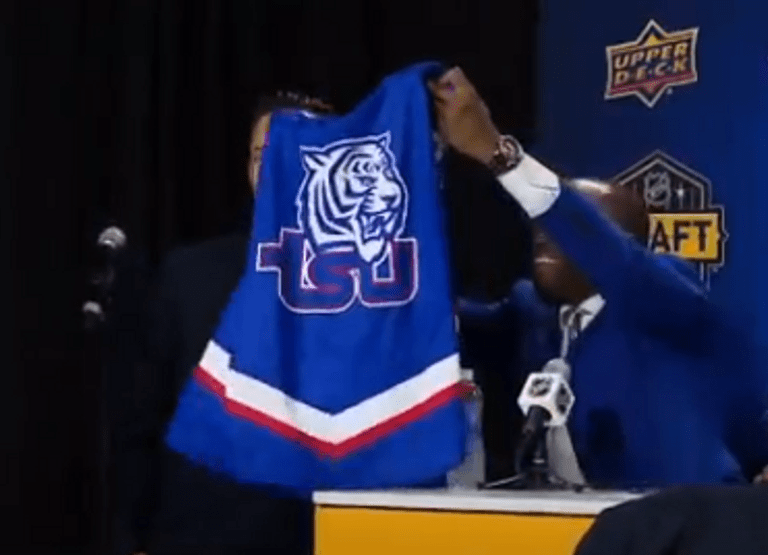
The Tennessee State hockey program was supposed to make history. Instead, it may not happen at all.
TSU Interim President Dwayne Tucker told The Athletic this week that the university is evaluating whether it can move forward with its Division I men’s hockey program, a project first announced in June 2023 in partnership with the NHL’s Nashville Predators. A final decision could come within the next month if the school can’t secure sustainable funding.
A Program Already on Shaky Ground
This wouldn’t be the program’s first setback. The Tigers’ hockey team was originally scheduled to debut as a club team during the 2024-25 season but got pushed back to 2026-27 due to a lack of funding. Now, even that delayed timeline is in jeopardy.
Tucker didn’t soften the message. “I can tell you we’re not going to move forward with a hockey program if the sustainable funding is not there,” he said. “Unfortunately, there’s no funds through 2030 that we can provide to a start-up program.”
That’s a striking admission. Launching a Division I hockey program from scratch is expensive, and Tucker said the university needs funding commitments covering operational costs and scholarships for at least five years before it can consider the program viable long-term.
Competing Priorities on Campus
Part of what’s driving the decision is where Tennessee State’s broader financial priorities sit right now. Tucker pointed to aging residence halls and a needed renovation of Hale Stadium as more pressing needs. Consequently, the university is preparing to launch a two-year, $100 million fundraising campaign specifically to address those improvements.
“We need that money to help fix some of the modernization that needs to take place on the campus, not another sport that couldn’t be standing on its own,” Tucker said.
That framing matters. Tennessee State isn’t rejecting the idea of a hockey program outright — the university simply can’t justify funding a new, unproven sport while existing campus infrastructure needs urgent attention. Hockey, unlike most college sports, also carries unusually high overhead. Head coach Duante’ Abercrombie noted that annual operating costs for NCAA Division I hockey programs can run between $900,000 and $3 million, not including scholarships.
Coach and League Partners Remain Hopeful
Despite the uncertainty, the people closest to the project haven’t given up. Abercrombie, who was hired specifically to lead the program, struck an optimistic tone. “I have faith in the Nashville Predators, I have faith in the NHL,” he said. “And, more importantly, I have faith in my institution that they will find a path forward that is positive for the hockey program.”
The Nashville Predators echoed that sentiment. Chief Marketing Officer Bill Wickett said the team has stayed in close contact with university leadership throughout the process. “We’ve had very informative and productive conversations with the president and others at the university,” Wickett said. “We understand all of the priorities and opportunities in front of Tennessee State, but we remain hopeful that Division I hockey will still be played in Nashville in the future.”

What Happens Next
Tucker said he remains committed to pursuing fundraising opportunities and engaging potential donors, but he was firm that any path forward requires the program to be financially self-sustaining. “I’d love to have the hockey program and make history,” he said. “But it has to be a stand-alone program in terms of the funding to make it work, because of the bigger financial challenges that the university has.”
The next month will determine whether Tennessee State becomes the first HBCU to field a Division I hockey program, or whether the partnership with the Predators ends before a single puck ever drops. Either outcome says something important about the financial tightrope HBCUs walk when trying to expand into new, high-cost athletic territory.
Ambition and sustainability don’t always arrive on the same timeline. Right now, Tennessee State is being forced to choose between them, and the answer will likely shape how other HBCUs approach similarly ambitious athletic ventures going forward.