
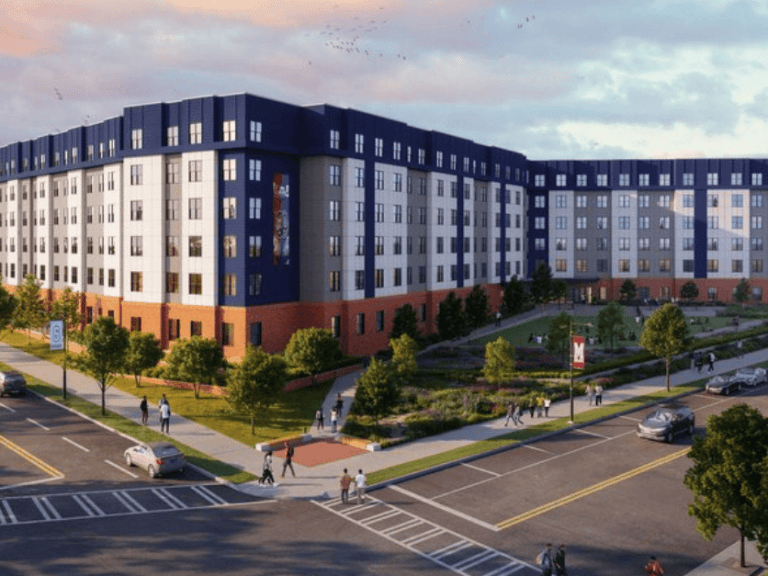
Morehouse Spelman $147 million student housing has officially reached financial close. That clears the way for construction on a shared residence hall years in the making. Radnor Property Group and the Madrone Community Development Foundation closed the deal on July 1, 2026. They sold roughly $146.8 million in tax-exempt and taxable bonds through the Development Authority of Fulton County. Consequently, ground is already breaking on the West End Avenue project, with students expected to move in by fall 2028.
Morehouse Spelman $147 Million Student Housing: What’s Being Built
The development sits at 850 West End Avenue. It’s directly across from Morehouse’s B.T. Harvey Stadium. Once complete, it will offer 305 units and 793 beds in studio, one-, two-, and four-bedroom layouts. That matters, because it marks the first time Morehouse and Spelman will share a jointly designed residential community. Both are single-gender HBCUs that sit side by side. Amenities will include a 24-hour staffed lobby and a fitness room. There will also be community lounges on every floor, bike storage, a dog run, and a central green space.
Rents are expected to land around $1,200 per bed monthly. That’s about 3 percent below off-campus averages nearby. Meanwhile, the two schools formed a joint venture called West End Avenue P3. It signed a 50-year lease with Madrone as part of the deal. That structure lets both colleges add housing capacity without carrying the debt directly on their own books.
Black-Owned Firms Anchor the Development Team
Beyond the dollar figure, what’s drawing attention is who’s actually building it. Clark Construction and CD Moody Construction are serving as construction manager in a joint venture. CD Moody is one of the most established Black-owned construction firms in the Southeast. Moody Nolan, the architect on the project, is likewise Black-owned. It ranks among the largest Black-owned architecture firms in the country. Because of that lineup, this project stands out. It’s a rare case where a nine-figure HBCU capital project is being physically built and designed by Black-owned firms, not just financed on behalf of Black students.
Loop Capital Markets, a Black-owned investment bank, also served alongside Raymond James as underwriter on the bond financing. Brailsford & Dunlavey advised the colleges on the project. Kutak Rock served as bond counsel, and Hilltop Securities served as financial advisor. Together, that mix of Black-owned firms spans construction, architecture, and finance. As a result, the project’s economic impact goes well past the housing itself.
Why the Colleges Needed This
Enrollment growth is driving the project. Both schools have seen a wave of new applicants since the Supreme Court’s 2023 decision ending affirmative action, and campus housing simply hasn’t kept pace. Morehouse and Spelman enrollment combined has grown by roughly 25 percent over the past five years. That’s added about 1,100 students across both campuses. As a result, students have increasingly had to seek off-campus options, often at higher cost and farther from campus resources.
“Our steadily growing student enrollment fuels our collective need for affordable, near-campus housing,” said Undria Stalling, Morehouse’s chief financial officer, in a statement on the closing. Dawn Alston, Spelman’s CFO, echoed that sentiment. She called the partnership proof of “what is possible when mission-driven partners” work together. Similarly, Nick Waugh, president of Madrone, said the project will help students “live next to campus, focus on their education, and fully engage in campus life.”
Part of a Bigger Atlanta HBCU Building Boom
This project doesn’t stand alone. It follows a broader wave of capital investment across the Atlanta University Center. A separate 700-bed Spelman residence hall is planned near the campus Oval. Morehouse’s own Campus of the Future initiative has already raised more than $320 million toward a new residence hall and campus center. Together, these projects signal that Atlanta’s HBCU corridor is entering one of its biggest infrastructure stretches in decades.
Housing isn’t the only piece of that momentum, either. Spelman and Morehouse have also leaned into brand and business initiatives lately, from trademarking the “SpelHouse” name to expanding the Center for Black Entrepreneurship on Spelman’s campus. Taken together, the pattern suggests both schools are treating infrastructure and identity as connected priorities, not separate tracks.
According to Connect CRE’s coverage of the closing, construction is already underway. Delivery is targeted for fall 2028. That timeline lines up with continued enrollment growth at Spelman, which recently welcomed Dr. Ayanna Howard as its new president and remains the top-ranked HBCU in the country by graduation rate.
For now, Morehouse Spelman $147 million student housing offers a blueprint other HBCU pairs might follow: shared risk, shared cost, and a development team that reflects the community it’s meant to serve. Expect more details on leasing timelines and pricing tiers as the buildings rise over the next two years.