

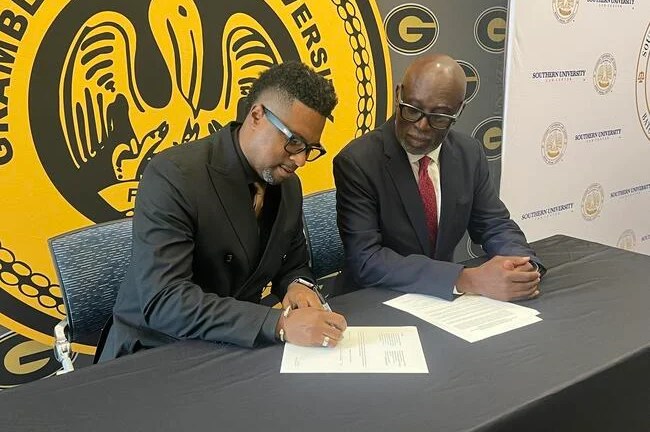
A new partnership between two Louisiana HBCUs is about to change how students get into the legal profession.
Grambling State University and Southern University Law Center announced a new 3+3 Accelerated Law Program on June 25, 2026, allowing eligible students to earn both a bachelor’s degree and a law degree in six years instead of the traditional seven. The Grambling State law program partnership was approved by the Louisiana Board of Regents and is designed to strengthen the pipeline of attorneys across the state while removing financial and structural barriers that often discourage students from pursuing law school.
How the Program Actually Works
The structure is straightforward. Students complete their bachelor’s degree at Grambling State in three years instead of four, then move directly into Southern University Law Center for the remaining three years of legal education. The result is a guaranteed admissions pathway for students who meet program requirements, paired with structured advising designed to keep them on track from day one.
That structure matters because the traditional path to law school often involves uncertainty. Students apply to multiple schools, wait through admissions cycles, and frequently end up taking a gap year between undergraduate study and law school. The 3+3 model removes much of that uncertainty by building the pathway directly into the curriculum.
The Real Savings Behind This Partnership
Grambling State President Martin Lemelle said students are expected to save between $16,000 and $18,000 in tuition and fees alone by completing both degrees in six years rather than seven.
Connie Walton, Grambling State’s provost and vice president for academic affairs, said the total savings climb even higher once housing, meals, and other educational expenses are factored in. “That’s a huge savings,” Walton said. She added that students will also likely apply to fewer law schools under this model, which means additional savings on application fees. University officials estimate the total financial benefit could reach roughly $100,000 when every cost is considered.
For students at HBCUs, where financial barriers often determine whether someone pursues an advanced degree at all, that kind of savings can be the difference between attending law school and walking away from the dream entirely.
Built-In Support From Day One
The 3+3 program is not just about speed. Walton emphasized that student success supports are built into both campuses from the very beginning.
At Southern University Law Center, undergraduates participating in the program will take part in prelaw programming, workshops, and mentoring well before they officially enroll in law school. At Grambling State, students will receive targeted advising from a designated faculty adviser, along with structured LSAT preparation built directly into their undergraduate coursework.
That LSAT preparation carries extra weight given recent changes to the exam itself. “The LSAT has two components now: the multiple-choice logical reasoning part, and the other one is the student has to be able to write and make an argument,” Walton said. “That’s going to force us at Grambling State University to make sure that the writing that we require of our students who’ve been selected for the program will develop the skills that are needed in making a good argument.”
Part of a Bigger Accelerated Pathway Strategy
The Grambling State law program is not an isolated initiative. Walton noted that the 3+3 structure is one of several accelerated pathways the university now offers across different disciplines. Grambling State also has a partnership with Logan University’s College of Chiropractic that allows biology majors to earn both a bachelor’s degree and a doctor of chiropractic in six years.
That pattern reflects a broader trend across higher education, where institutions are increasingly building accelerated pathways to address rising concerns about college affordability and student debt. For HBCUs specifically, these partnerships offer a way to compete directly with the kind of fast-track programs that wealthier institutions have offered for years.
Why This Matters for Louisiana and Beyond
Southern University Law Center has long played a critical role in producing Black attorneys in Louisiana and across the South. Pairing it directly with Grambling State’s undergraduate pipeline creates a more direct, less financially burdensome route into that profession.
For prospective students weighing whether law school is realistic for them, a guaranteed pathway with built-in mentoring, LSAT preparation, and tens of thousands of dollars in savings changes the calculation significantly. This partnership gives students at two historically Black institutions a faster, more affordable, and more supported route into a profession that desperately needs more diverse representation.
The first cohort of students will move through this new pathway with a level of structure and support that simply did not exist before. For Louisiana’s legal community, and for the students who choose this path, that could make all the difference.