

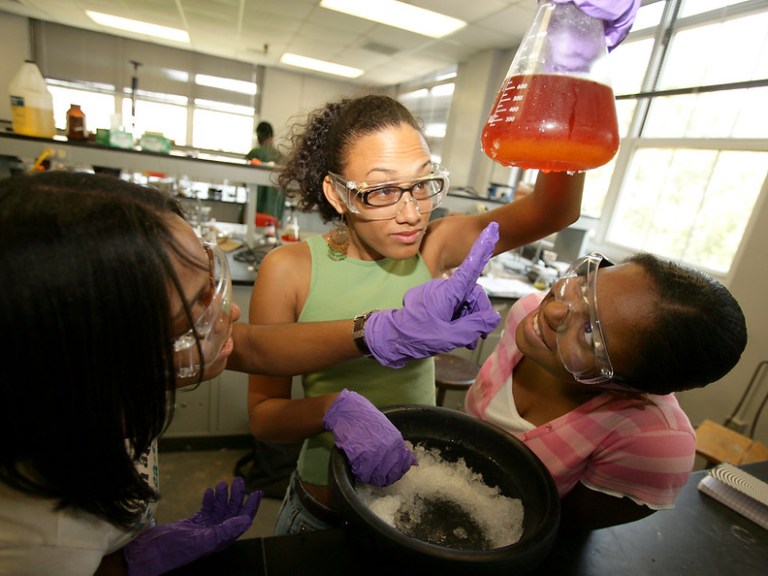
Tuskegee cosmetic science is officially here — and it is about to change who leads the beauty industry.
Tuskegee University announced on June 30, 2026, that it will launch a new cosmetic science program beginning in Fall 2026. The interdisciplinary concentration draws from both the College of Agriculture, Environment, and Nutrition Sciences and the College of Arts and Sciences. Enrollment will be capped at 25 students per cohort. In addition, Tuskegee will join Spelman College — the first HBCU to establish a cosmetic chemistry program — in launching a joint HBCU Cosmetic Science Consortium in early 2027.
What Tuskegee Cosmetic Science Students Will Actually Learn
This is not a beauty school. Instead, it is a rigorous, hands-on concentration built to prepare students across every part of the beauty and personal care industry.
The curriculum covers product research and formulation, ethical sourcing, packaging design, marketing, brand development, and business planning. Students must also complete at least one industry internship, one business course, and two animal science courses. Each requirement reflects the same goal: graduating students who understand what goes into a product and who that product serves.
“As the beauty industry continues to expand, so too does the demand for professionals who understand both science and culture,” said Olga Bolden-Tiller, dean of Tuskegee’s College of Agriculture, Environment, and Nutrition Sciences. “Our new cosmetic science program will equip graduates to innovate in ways that reflect the diversity of the consumers they serve — in roles from laboratories to board rooms.”
Why Tuskegee Is the Right School for This
Tuskegee’s decision to launch this program is not random. For 140 years, the university has prepared Black students to lead in agriculture, engineering, science, and health. Moreover, cosmetic science fits directly into that tradition.
Research shows that Black consumers spend significantly more on beauty and personal care products than other groups. However, Black-owned beauty brands still make up a small fraction of the overall market. That gap between consumer spending and market representation is both a cultural problem and a real economic opportunity. Furthermore, it is exactly the kind of gap Tuskegee has always worked to close.
Dr. Channapatna Prakash, dean of Tuskegee’s College of Arts and Sciences, put it plainly. “This program is about more than beauty,” he said. “It is a specific response to an industry need. We are building a pathway for students who will widen the pipeline of scientists, entrepreneurs, and executives who understand both the science and cultural relevance of the products they create.”
Spelman and Tuskegee Are Building Something Bigger Together
The most important part of this announcement may not be the Tuskegee cosmetic science program itself. Rather, it is what comes next.
Tuskegee and Spelman plan to launch an HBCU Cosmetic Science Consortium together in early 2027. Spelman launched the first-ever HBCU cosmetic science program in January 2023 as an online certificate. It then expanded to a full undergraduate concentration and minor in Fall 2024. Now, with Tuskegee joining, two of the most respected HBCUs in the country are aligning to reshape Black representation in the beauty industry.
A consortium means shared research and shared resources. It also means a coordinated pipeline of Black scientists, formulators, and executives entering the industry together. As a result, students at both schools gain broader networks and more career doors.
What This Means for the Beauty Industry
The beauty and personal care industry generates hundreds of billions of dollars globally each year. Furthermore, Black women are among its most significant consumers. However, the scientists formulating the products and the executives running the companies have not historically reflected that reality.
Programs like Tuskegee cosmetic science and Spelman’s pioneering curriculum exist to change that. By training Black students in product science and connecting it to cultural knowledge, entrepreneurship, and industry access, these HBCUs are doing what they have always done best. Therefore, their graduates go out and fill the gaps their communities need filled.
Enrollment opens this fall. The consortium launches in 2027. As a result, the beauty industry will never look quite the same.