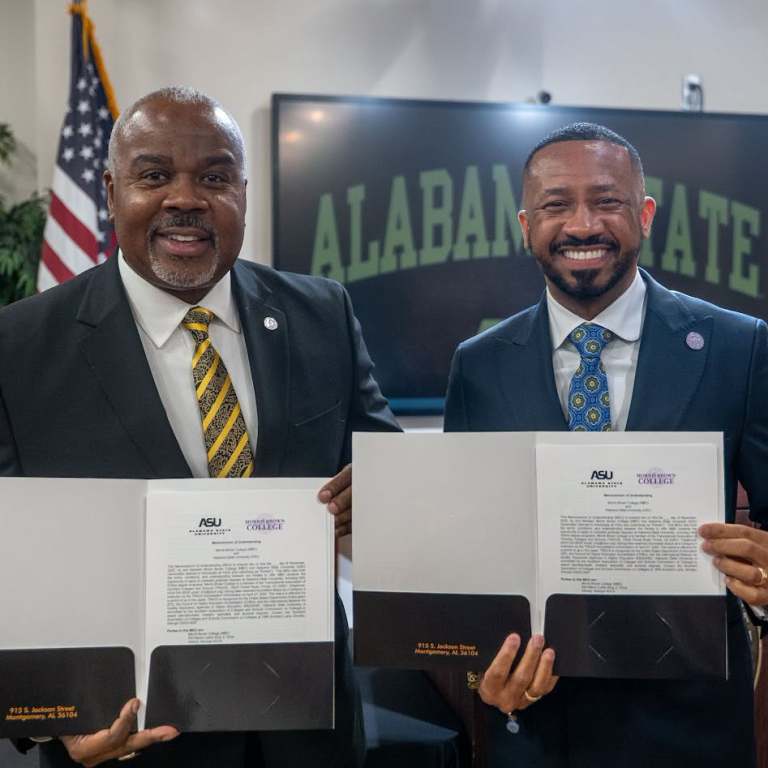


Dr. Joycelyn Hill Alabama State dissertation dissertation win is more than an academic honor — it is the foundation of a new educational pathway connecting two historically Black institutions.
Hill, a Valley, Alabama native and double Alabama State University alumna, won the 2026 Dissertation of the Year award in the Qualitative-Based Method track at Alabama State for her doctoral research on Black women leaders working in institutional research, assessment, and accreditation at HBCUs. Her win directly inspired a formal memorandum of understanding between Alabama State and Morris Brown College in Atlanta — where Hill now serves as director of institutional effectiveness — creating a streamlined graduate school pipeline between the two HBCU institutions. That pipeline is already open and accepting students.
A Journey That Started at Alabama State
Hill’s academic story is one of persistence, reinvention, and homecoming.
She graduated from Valley High School in 2009, then earned her bachelor’s degree in psychology and social work from Alabama State in 2013. Moreover, she continued her family’s legacy at ASU — her mother graduated from the university back in 1986. After earning a master’s degree in counseling and psychology from Troy University in 2018, Hill found herself working at the Alabama State Bar and contemplating law school.
Then, someone gave her advice that changed her trajectory entirely. Rather than starting over in a new field, she was encouraged to build higher in the one she already knew. As a result, she returned to Alabama State in 2022 to pursue her doctorate in educational leadership, policy, and law — completing the degree online while working full-time in Atlanta.
That return brought Hill full circle. The same institution that shaped her undergraduate years became the place where she produced the most significant academic work of her career.
The Research That Won the Award
Hill’s dissertation focused on the lived experiences of Black women working in institutional research, assessment, and accreditation at HBCUs — a subject that grew directly from her own professional life.
The research was both personal and urgent. Black women in higher education administration often navigate spaces with little formal research documenting their experiences. Furthermore, institutional research and accreditation roles sit at the structural heart of what keeps an HBCU functioning and compliant. Hill’s work shed light on the people doing that critical work while largely operating out of the public eye.
Her dissertation earned the Dissertation of the Year recognition in the Qualitative-Based Method track at Alabama State University for 2026 — a distinction that validates not just her academic rigor but the importance of the subject matter itself.
Building a Bridge Between Two HBCUs
The most tangible outcome of Hill’s work is the partnership it helped create. Her success at Morris Brown College — combined with her doctoral achievement at Alabama State — positioned her to connect the two institutions in a meaningful way.
The memorandum of understanding between Alabama State and Morris Brown establishes a direct pipeline allowing Morris Brown undergraduates to enroll in Alabama State graduate programs. Many of those courses are offered online, meaning students can stay in Atlanta while earning a graduate degree from a nationally recognized HBCU doctoral program. The pathway gives Morris Brown students access to master’s programs they might not otherwise have been able to pursue.
“I think the program, Alabama State, allows them to get a quality education as well as stay where they want to be and be in the city of Atlanta,” Hill said. “Knowing that they have a community with them at Alabama State University that’s going to support them educationally as well as socially — it helps the students transition between different states for programs. I think it’s just the start of something very new and very transformative.”
Why This Partnership Matters for HBCU Education
For the HBCU community, this kind of inter-institutional partnership represents exactly the kind of collaboration that strengthens the ecosystem as a whole. Morris Brown has spent the last several years rebuilding after losing and regaining accreditation. Alabama State brings a robust doctoral program with a 100% employment rate for graduates within six months of completing their degrees. Together, they offer something neither could build alone.
“Bridging the gap is why this partnership is so important,” Hill said. “It eliminates barriers. It demonstrates the impact of creating clear pathways for Morris Brown students to continue their educational journeys.”
Additionally, the partnership carries a personal dimension that makes it more than a bureaucratic agreement. Hill is a product of both worlds — an ASU alumna now serving Morris Brown. Her dissertation examined the very kind of leadership work she does every day. Consequently, the pipeline she helped build is not a theoretical construct. It is a direct extension of her own story.
A Valley Girl Who Never Forgot Home
Throughout all of it, Hill has remained grounded in where she started. She credits her hometown of Valley, Alabama for shaping everything she became professionally.
“It shaped me in every single way,” Hill said. “I always come home. Everything that I started with in Valley made me the professional that I am, so I can’t ever forget Valley.”
That rootedness — combined with academic excellence, professional impact, and a commitment to building pathways for others — makes Dr. Joycelyn Hill’s story one worth telling across every HBCU campus in the country.