
Fayetteville State AI research just got its biggest boost ever. The university landed a $10 million federal award to build an applied artificial intelligence program focused on national defense.
The five-year award comes from the Department of War, the secondary name the Pentagon adopted by executive order in September 2025. It’s the largest research grant in Fayetteville State history. And it puts the Broncos in elite company.
According to ABC11, FSU is one of just five institutions nationwide selected for the competitive grant.
One of Five Schools in the Country
The money flows through the Pentagon’s fiscal year 2026 Research and Education Program for HBCUs and Minority-Serving Institutions. Specifically, it’s part of a pilot program designed to increase research capacity at those schools.
That last part matters. Federal research dollars have long skewed away from HBCUs and toward predominantly white institutions. Programs like this one aim to close that gap by building infrastructure, not just funding one-off projects.
For FSU, that means more than a single grant. It means a foundation for years of defense work.
What Fayetteville State AI Research Will Focus On
The program centers on three areas, according to Chancellor Darrell Allison: applied air defense systems, logistics technology, and biomanufacturing. Allison has led FSU since 2020.
“We’re really excited about the three critical areas here,” Allison told ABC11.
The Defense Post reports the work will tackle defense challenges like contested logistics. In plain terms, that’s figuring out how to move troops, fuel, and supplies when an enemy is actively trying to disrupt them.
The program will also build infrastructure to develop and test new defense technologies on campus. Projects will span AI, data science, advanced manufacturing, and biotechnology.
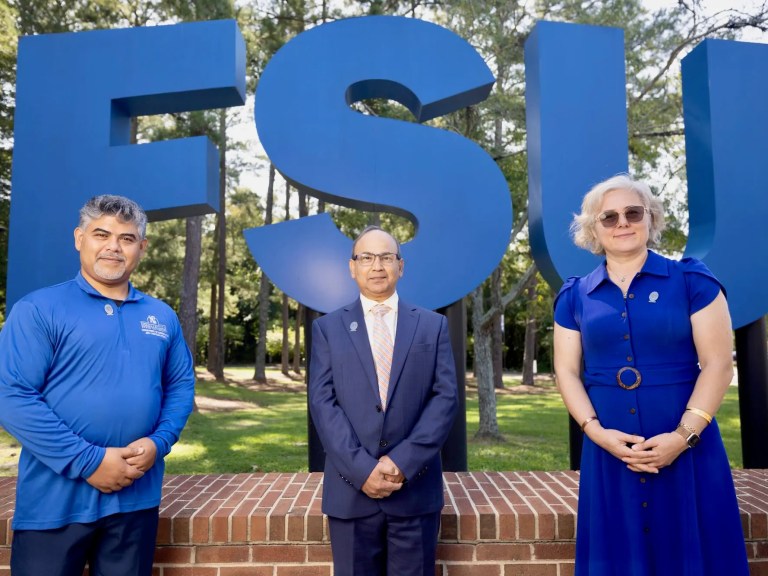
Three faculty members will lead the effort. They are Ganesh C. Bora, Sambit Bhattacharya, and Burcu Adivar. Their job is to turn a big check into working labs, published research, and real tools the military can use.
Built Next Door to Fort Bragg
Location is everything here. Fayetteville sits right beside Fort Bragg, the largest military installation in the country by population. Allison made that point directly.
“There’s no reason why we can’t be the defense innovation hub where you have the largest military installation in the nation here,” he said.
That connection runs deep at FSU. The university was the first in the UNC System designated a Purple Heart University. It also offers full rides to qualifying service members, veterans, and their families. Many of its students are active-duty soldiers, veterans, or military spouses.
So defense research isn’t a stretch for this campus. If anything, it’s overdue.
Students Get Hands-On Experience
The award isn’t just for faculty labs. Undergraduate and graduate students will work directly on the projects.
Some are already doing it. Computer science senior Bridgit Graddy, a military spouse, described the work as a chance to “test and design software that will benefit the military.”
Junior Jayden Bates was just as eager. “It is really a big opportunity that I want to take on,” he said.
Another student, Paul Rodriguez, is working on a project that estimates damage to combat vehicles from photos. That kind of tool could help commanders make faster decisions in the field.
Meanwhile, ABC11 reports the funding will support a new Ph.D. program tied to the research areas. For students who want to stay in Fayetteville for graduate school, that’s a big deal. Doctoral programs also tend to attract more federal grants over time, which compounds the value of this first award.
A Boost for the Local Economy
Local leaders see a bigger picture. Fayetteville Mayor Mitch Colvin and Cumberland County Commissioners Chairman Kirk DeViere both pointed to the award as a recruiting tool.
Their pitch is simple, and it’s one plenty of mid-sized cities would love to make. If FSU trains skilled AI and data workers, defense contractors have a reason to set up shop nearby. Those jobs, in turn, keep graduates in the region instead of sending them to Raleigh, Charlotte, or Northern Virginia.
That pipeline matters in a city where the economy already leans heavily on Fort Bragg. Diversifying into tech and research would give Fayetteville a stronger footing when military budgets shift.
Why This Matters Beyond Fayetteville
Fayetteville State has been on a steady climb. It became a regional hub for NCInnovation in recent years. Now it has a record research award on top of it.
That momentum matters for recruiting. Top students and faculty want to go where the funding and the big projects are. With Fayetteville State AI research now backed by the Pentagon, the Broncos have a sharper pitch for both.
The bigger story, though, is about where defense innovation can happen. For decades, the Pentagon’s biggest research dollars have gone to a short list of elite universities. This award signals that HBCUs can compete in AI and national security, too.
Plenty of HBCUs sit near major military bases. Think Hampton and Norfolk State near the naval and air bases of Hampton Roads. Or Alabama A&M, just down the road from Huntsville’s Redstone Arsenal. Fayetteville State AI research could become a model for how those schools turn proximity into partnerships.
For now, the Broncos have five years and $10 million to prove it. Expect other HBCU research offices to watch closely. Given the location and the talent on campus, the odds look pretty good.