

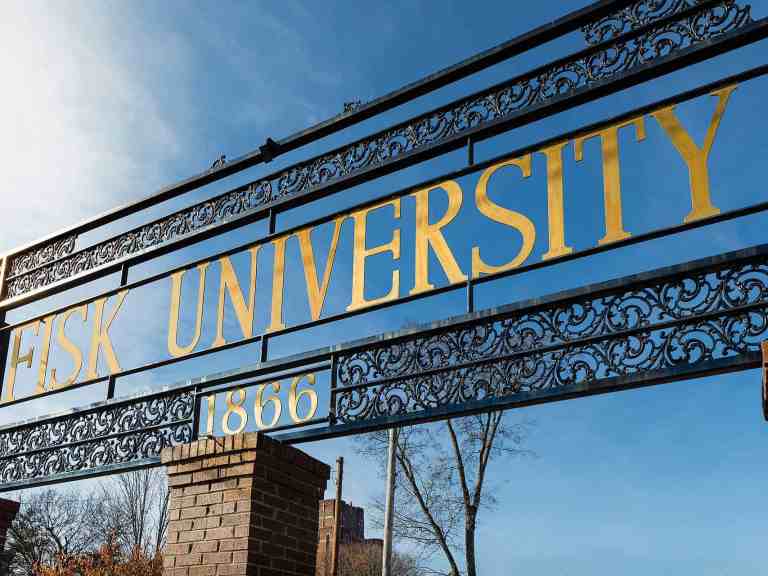
The Fisk University data center proposal is forcing a painful conversation about HBCU survival — and a Nashville community is refusing to stay quiet.
On June 29, 2026, Fisk University President Dr. Agenia Clark faced a packed sanctuary at Lee Chapel A.M.E. Church in North Nashville for the school’s first public town hall on the issue. The proposal is part of Fisk’s $1 billion “Quantum Leap” campus master plan. It includes a new academic center, revamped dormitories, and a 30-megawatt data center on campus. However, the community’s response has been sharp, sustained, and growing fast.
What Fisk Is Actually Proposing
The data center sits inside a broader $400 million, 100,000-square-foot Innovation Center. Fisk describes it as a hub for academic growth and workforce development. University officials have been careful to separate the project from the kind of industrial data centers drawing criticism elsewhere in Nashville — most notably a proposed facility near the Nashville Zoo.
Clark addressed the crowd directly and tried to clear up misconceptions. “Does everyone really know what a data center is?” she asked. She also made a key promise: Fisk will not sell any land. That statement drew applause from the audience.
She also addressed questions about the university’s finances head-on. Clark told more than 100 attendees that Fisk is “woefully under-resourced.” She shared that on her first day on the job in 2023, she had to use a personal hotspot just to access the internet. “Here we are in what I would say is one of the best institutions in this country, that’s been right here in 37208 since 1866, but the digital age-born student that we’re trying to recruit now, they need a hot spot, too?” Clark said.
That financial context is important. Like many HBCUs, Fisk has spent decades doing generational work on starvation-level funding. Supporters argue the data center is a path toward the revenue generation the school has never had.
A Community That Has Been Through This Before
The opposition is not simply anti-technology sentiment. Instead, it is rooted in a specific geography with a specific history.
The zip code surrounding Fisk — 37208 — consistently ranks among the highest in Nashville for asthma-related emergency department visits. Moreover, North Nashville has absorbed decades of harmful infrastructure decisions. Those decisions include the construction of Interstate 40 through the community, landfills, and industrial projects. Residents know what it looks like when their neighborhood gets treated as available land for someone else’s vision.
State Sen. Charlane Oliver opened the town hall by acknowledging that history directly. “This is a community that has been hurting for decades,” she said. Furthermore, she said she could not support the project at this time because she does not yet know enough about its impact on her constituents.
Fisk alumnus and state Rep. Justin Jones, who joined earlier protests at the university gates, was more direct. “If AI data centers are not good for a zoo, then it’s not good for an HBCU,” Jones said. “If this project was so amazing for universities, it would be at Vanderbilt. But instead they’re coming to Fisk University, using this tactic of extraction and preying on our HBCU.”
16,000 Signatures and Growing
The opposition has organized quickly. Fisk alumnus Winston Wright launched an online petition against the Fisk University data center proposal that has now collected more than 16,000 signatures. Wright drew a direct comparison to the construction of I-40, which decades ago cut through North Nashville and displaced thousands of residents and businesses.
At a June 10 protest at the university gates, the concerns were consistent: noise, energy consumption, water demand, diesel pollution, rising utility costs, and a lack of transparency about corporate partners. A Fisk student named Eriqua Martin put it plainly. “This campus is not just property,” Martin said. “It is not raw acreage waiting to be leveraged.”
Additionally, the Black Mental Health Village this week announced it is suspending its partnership with Meharry Medical College over that institution’s support for Fisk’s plan — adding another layer of fallout to a debate that continues to grow.
The Deeper Question Behind This Story
The Fisk University data center proposal is not really just about one building on one campus. Rather, it raises a harder question the entire HBCU community is being forced to confront: what happens when financial desperation makes an institution vulnerable to deals that may harm the very community it was built to serve?
Sen. Oliver framed it with unusual candor. “Here we see how the crisis of underfunded historically Black colleges and universities can leave communities — and students — vulnerable to exploitation,” she said. That framing does not assume bad intent on Fisk’s part. Nevertheless, it acknowledges that financial pressure can push institutions toward decisions the community ends up bearing the cost of.
The NAACP has also weighed in through its “Stop Dirty Data Centers” initiative, siding with critics of the plan. Meanwhile, Metro Council is reviewing proposed legislation that would require large data centers to sit at least half a mile from homes, schools, parks, and community centers. Based on its proximity to Greater Zion Primitive Baptist Church, Andrew Jackson Park, and Andrew Jackson Boys & Girls Club, the current Fisk site would likely not meet that threshold. Clark has said the university will comply with whatever regulations Metro Council ultimately adopts.
What Comes Next
A public hearing on data centers is scheduled for July 7. Additional community town halls are also planned. Furthermore, Metro Council continues to debate two separate data center bills — one establishing zoning rules and one proposing a temporary moratorium on new permits.
For now, the debate continues — and so does the deeper conversation about what Fisk University owes its campus community, what Nashville owes its oldest institution, and what the country owes its HBCUs.