
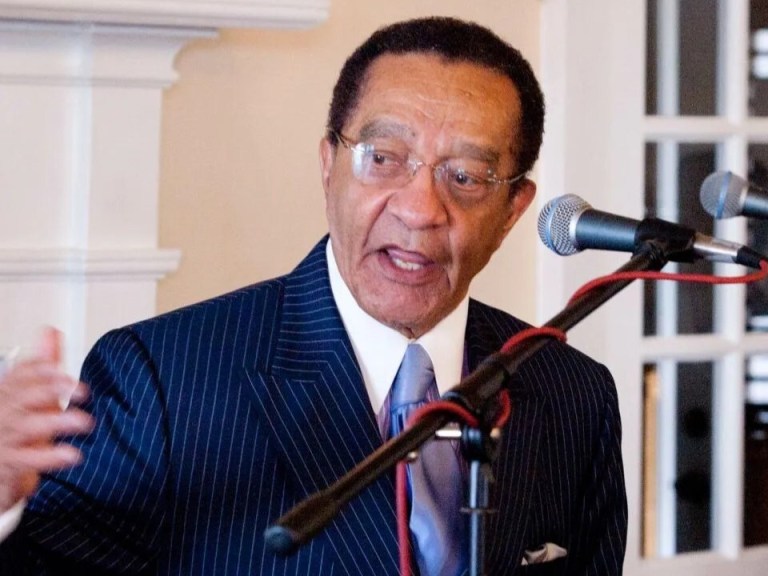
Tony Brown’s Hampton University legacy defines one of the most important careers in the history of Black media — and the HBCU world has lost one of its greatest champions.
Brown, the host and executive producer of Tony Brown’s Journal — the longest-running series in PBS history — died on June 17, 2026, at his home in Newport News, Virginia. He was 93. Coronary heart disease caused his death. For more than five decades, Hampton University and Howard University served as the academic homes where Brown poured his vision into the next generation of Black journalists. Together, those two institutions reflect the full arc of a career built not just on television — but on legacy.
A Voice That Changed American Television
Tony Brown was born on April 11, 1933, in Charleston, West Virginia. He grew up in poverty and under segregation. Those experiences shaped everything he would later build. He started his journalism career at the Detroit Courier before moving to Detroit’s WTVS public television station in 1968.
In 1970, Brown became executive producer and host of “Black Journal” on PBS. That program later became “Tony Brown’s Journal” and remained on the air until 2008. Over 40 years, he produced nearly 1,000 episodes. The show earned the 1991 NAACP Image Award for Outstanding News, Talk or Information Series. Moreover, the New York Daily News recognized it as one of television’s greatest programs for its presentation of positive Black images. At its peak in 1979, Nielsen ranked it the number one syndicated talk and educational series in the country.
Brown’s motto drove every broadcast: “No Black Lies. No White Lies. Only the Truth.”
Tony Brown’s Hampton University Legacy Began at Howard
Television was never enough for Tony Brown. Furthermore, he believed representation in front of the camera meant nothing without Black people owning the skills, pipelines, and institutions behind it.
In 1971, Brown founded the School of Communications at Howard University — the first of its kind at an HBCU. He served as its founding dean until 1974. That program became one of the most important pipelines for Black journalism talent in the country. Its alumni include former NFL Network reporter Jim Trotter, the first Black president of the Pro Football Writers of America, and Steve Wyche, a senior national reporter inducted into the Black College Football Hall of Fame in June 2026.
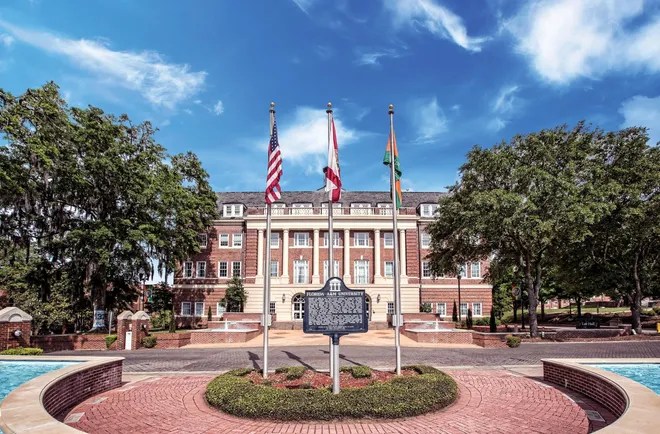
Decades later, Brown returned to HBCU academia. In 2004, he became the inaugural dean of the Scripps Howard School of Journalism and Communications at Hampton University — a position he held until 2009. In 2012, Hampton inducted him into that school’s Hall of Fame.
Current Dean Julia Wilson captured his impact directly. “Tony Brown was more than an award-winning journalist; he was a visionary who expanded the role of journalism as a force for education, empowerment, and social progress,” Wilson said. “Through his groundbreaking work in the media, he challenged generations to think critically, pursue truth with courage, and tell stories that elevated the Black experience with dignity and excellence.”
Black College Day and the Fight for HBCU Survival
Brown’s commitment to HBCUs extended well beyond the classroom. In 1980, he founded Black College Day — a national effort to encourage students to choose historically Black colleges and universities. Congress later recognized the effort by designating the last Monday in September as the official Black College Day observance.
That initiative reflects something Brown understood deeply. HBCUs needed more than funding. They needed cultural investment, visibility, and advocates willing to make noise on their behalf. Brown made that noise consistently, loudly, and for decades.
A Legacy Built on Self-Help and Truth
Brown was also a prolific author and radio host. His books include “Black Lies, White Lies: The Truth According to Tony Brown” and “Empower the People: A 7-Step Plan to Overthrow the Conspiracy That Is Stealing Your Money and Freedom.” Additionally, he hosted influential radio talk shows on WLIB in New York and WLS in Chicago. Talkers magazine named him one of the 100 most important radio talk show hosts in America.
His personal mission statement — “Diversity Through Excellence” — and his call to action — “Self-Help” — guided every platform he built. In 2002, the National Academy of Television Arts and Sciences inducted him into its Silver Circle. In 2015, the National Association of Black Journalists inducted him into its Hall of Fame.
Furthermore, Brown organized one of the most significant civil rights events in American history. In June 1963, he coordinated a march in Detroit that drew an estimated 500,000 participants alongside Dr. Martin Luther King Jr. — one of the earliest public deliveries of King’s iconic “I Have a Dream” speech.
What the HBCU Community Lost
Tony Brown’s Hampton University impact did not simply pass through campus. He built things there that outlasted his tenure and will outlast his death. The journalism schools he founded continue to shape Black media professionals. The students he trained carry his standards into newsrooms, production companies, and classrooms of their own.
For the HBCU community, Brown’s passing is not simply the loss of a broadcaster. Rather, it is the loss of a builder — someone who understood that Black media and Black education were not separate missions but the same one, pursued across different platforms.
No memorial or public service has been announced at this time.