
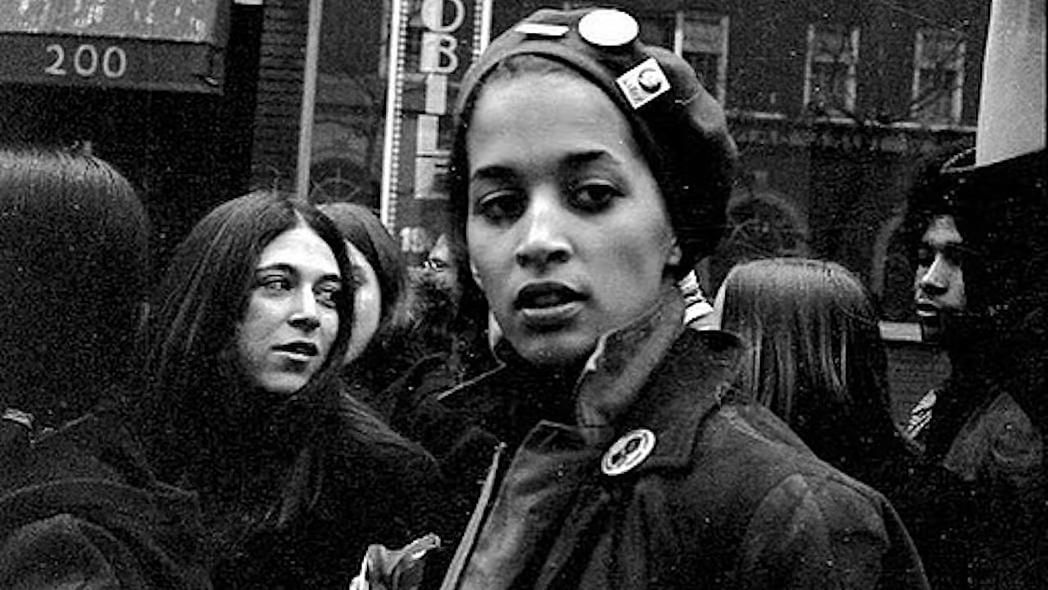
Denise Oliver-Velez, a trailblazing organizer, helped shape two of the 20th century’s most significant liberation movements. She has died at 78. Denise Oliver-Velez became the first woman elected to the Central Committee of the Young Lords. The Young Lords was a radical Puerto Rican rights group modeled on the Black Panther Party. She belonged to both organizations during a career that stretched across activism, journalism and education.
News of her death began circulating midweek, and tributes followed quickly from former colleagues across journalism, academia and the movement world she helped build. Daily Kos, Democracy Now and numerous former Young Lords members all shared remembrances within days of her passing. That outpouring reflects how many different communities she touched over the course of her life.
Born Denise Roberts Oliver in Brooklyn in 1947, she grew up surrounded by left-wing organizing. Indeed, her father was a Tuskegee Airman who later taught dramatic literature. Meanwhile, her mother worked as a teacher in the New York City school system. As a teenager, she joined the Queens branch of the NAACP. She even helped block bulldozers during a 1963 protest demanding jobs for Black workers at a Queens construction site, an early sign of the fearlessness that would come to define her.
Denise Oliver-Velez’s Howard University Years
In 1965, Denise Oliver-Velez transferred to Howard University. That move placed her inside a circle of future icons. She crossed paths with Rap Brown, Fannie Lou Hamer, Amiri Baraka and Sonia Sanchez during her time on campus. As a result, those relationships helped push her further into the civil rights movement. They also set the stage for the organizing work that would define the rest of her life.
Howard’s influence on Oliver-Velez ran deep. Her time there connected her to a broader network of Black intellectuals and organizers. That network shaped both her activism and her later academic career. Consequently, her Howard years are often cited as a turning point in her political development.
Rising Through the Young Lords
Within the Young Lords, Oliver-Velez climbed to the organization’s top leadership ranks. She first served as minister of finance, then later as minister of economic development. According to Juan González, a founding Young Lords member who worked alongside her, she helped build many of the group’s Serve the People programs. In addition, she helped shape its literature. She also played a key role producing its newspaper, Palante, along with its weekly radio program on WBAI.
Alongside fellow organizer Iris Morales, Oliver-Velez co-founded the Young Lords’ Women’s Caucus. That effort confronted sexism both in the broader society and within the movement itself. Her willingness to challenge her own comrades became one of her defining traits. Indeed, González remembered her telling fellow organizers what they needed to hear rather than what they wanted to hear.
A Career That Kept Breaking Barriers
Beyond her organizing work, Oliver-Velez kept setting firsts. She became the first Black female program director in public radio. That milestone opened doors for the broadcasters who followed her. She later taught anthropology and women’s studies at SUNY New Paltz, passing her expertise directly to a new generation of students.
For two decades, she also served as a contributing editor at Daily Kos. Her influence there grew so significant that editors reportedly weighed major decisions by asking what she would think. That kind of institutional trust rarely develops by accident. Instead, it reflected decades of consistent, thoughtful contribution to the platform’s community and coverage.
Throughout her career, Oliver-Velez used her platform to connect movement history with present-day organizing. She wrote extensively about race, politics and culture. That writing drew directly on her own experience inside two of the era’s most consequential organizations. Readers often turned to her work for perspective that few other writers could offer.
Remembering a Movement Icon
González described Oliver-Velez as a brilliant and articulate force whose influence reached far beyond her early activism. “It’s impossible really to overstate the impact that Denise had,” he said, according to Democracy Now’s coverage of her passing. He added that she inspired thousands of young people through her writings, scholarship and decades of teaching.
Tributes from former colleagues and admirers poured in following news of her death. Many pointed specifically to her rare combination of intellectual rigor and personal warmth. Others highlighted how she balanced fierce political conviction with genuine care for those around her. That combination, many said, made her a trusted voice across multiple generations of organizers.
Her passing marks the loss of one of the last major figures who helped build the Young Lords from the ground up. It also closes a chapter connecting today’s activists directly to the movements of the 1960s and 1970s. Few organizers, after all, managed to remain relevant across so many decades and so many different platforms.
As tributes continue to circulate across social media and movement circles, Oliver-Velez’s legacy remains firmly tied to Howard University’s long tradition of producing changemakers. Her journey from a Brooklyn classroom to national movement leadership reflects a throughline common among many HBCU graduates. Those graduates went on to shape American history well beyond campus. Similarly, her decades of teaching at SUNY New Paltz extended that legacy into classrooms far from Howard’s campus.
Colleagues at Daily Kos have already begun discussing ways to preserve her writing and institutional memory for future contributors. Meanwhile, former Young Lords members are planning tributes that will highlight her role in the group’s founding years. For more on the legacies HBCU alumni continue building, explore HBCU Buzz’s coverage of Howard University and its ongoing notable alumni coverage.