
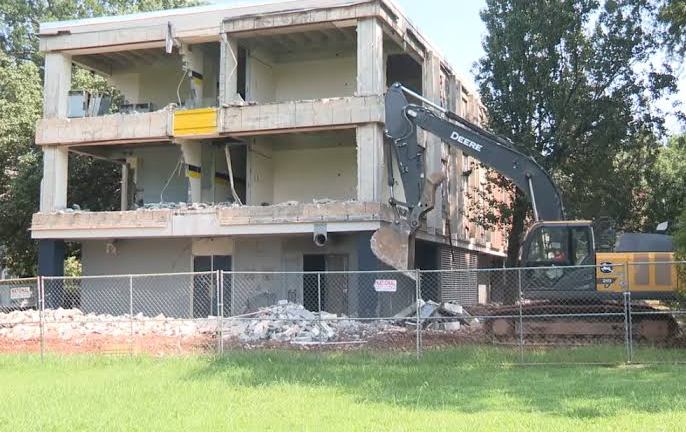
The Johnson C. Smith University Liston Hall demolition began this week, tearing down a residence hall that sheltered generations of students since 1962. Demolition started on July 29 and marks a 64-year chapter ending for the Charlotte HBCU as the school reshapes its main campus along Beatties Ford Road.
Why JCSU Chose Demolition Over Renovation
University president Valerie Kinloch said the school weighed a full renovation before landing on demolition. However, officials ultimately decided that rebuilding made more financial sense than repairing the 35,000-square-foot structure. Aging infrastructure played a major role in that call. The building’s outdated utility systems pushed the cost of renovation too high. Kinloch framed the decision as forward-looking rather than dismissive of history. She said the university wanted to invest in something more environmentally sustainable for the long haul. That reasoning tracks with what JCSU’s board of trustees signaled when it first approved the demolition plan. It also reflects a broader trend among HBCUs. Many are weighing the cost of preserving aging buildings against the price of new construction.
Liston Hall opened in 1962 and carried the name of Dr. Hardy Liston, who led the university from 1947 to 1956. At its peak, the dormitory housed as many as 148 students in double-occupancy rooms. That gave thousands of JCSU students their first home away from home over more than six decades. However, the building had sat empty since before the COVID-19 pandemic. Its condition had deteriorated to a point where JCSU determined a renovation would cost more than starting over.
What the Liston Hall Demolition Means for JCSU’s Campus Plans
This is part of a wider push to redevelop property JCSU owns on and around its campus. The Johnson C. Smith University Liston Hall demolition is only the first step in that plan. The university has also targeted a former A&P supermarket building and an adjacent laundromat on West Trade Street for demolition. Both structures, JCSU says, have declined too far to justify renovation under current building codes. Therefore, Liston Hall’s removal is not an isolated project. It is one piece of a larger master plan the university hopes will modernize its footprint in Charlotte’s Historic West End.
JCSU has not finalized what will replace Liston Hall. Kinloch indicated that a space combining student living and learning environments would fit the university’s direction. No construction timeline has been set, and administrators are still reviewing design options for the site. Meanwhile, the school is also seeking outside partners to help redevelop the West Trade Street properties. It has not released specifics on what that partnership could look like.
For alumni and former residents, the demolition carries weight beyond construction logistics. Buildings like Liston Hall often hold memories tied to community and mentorship. They capture the everyday experience of attending an HBCU with limited resources but an outsized sense of belonging. At the same time, JCSU’s leadership has been clear that preserving an outdated facility simply because of its history would not serve current or future students. As HBCU Gameday reported, the university has described the moment as a farewell. It is also calling the move a deliberate step toward what it calls its “New Era of Excellence.”
A Broader Pattern Across HBCU Campuses
JCSU’s decision mirrors choices other HBCUs have faced in recent years. Institutions across the country are balancing historic preservation with the practical demands of student housing and enrollment growth. Aging dormitories built in the mid-20th century often carry the same challenges Liston Hall did. Outdated wiring, inefficient heating and cooling, and layouts that no longer match student expectations all factor in. As a result, many institutions are opting for full rebuilds rather than costly renovations that only extend a building’s life by a few years.
JCSU sits on valuable ground just west of Uptown Charlotte. The neighborhood has seen steady development pressure for years, a pattern playing out at HBCUs across the country. That positioning adds another layer to the university’s calculus. Growing around a campus that hasn’t kept pace with modern facilities can put an HBCU at a competitive disadvantage. Prospective students increasingly compare housing options before choosing a school. By tearing down Liston Hall now, JCSU is positioning itself to build something that fits both its budget and its long-term vision for the campus.
The demolition itself will take time. Workers began dismantling the structure on July 29, and the university expects the process to continue over the coming months. JCSU has not said whether it will hold a formal remembrance for the building before it’s gone. Still, the school has acknowledged the sentimental value Liston Hall holds for those who lived there.
As the dust settles on the Johnson C. Smith University Liston Hall demolition, the bigger story is what comes next. JCSU’s willingness to demolish a building tied to its history signals a university actively competing for the next generation of students. It is not simply preserving what already exists for its own sake. Whatever replaces Liston Hall will likely carry its own legacy. That legacy will be shaped by the same balance between honoring the past and building for the future that guided this decision. Students, alumni, and Charlotte’s Historic West End community will all be watching to see what rises in its place.