

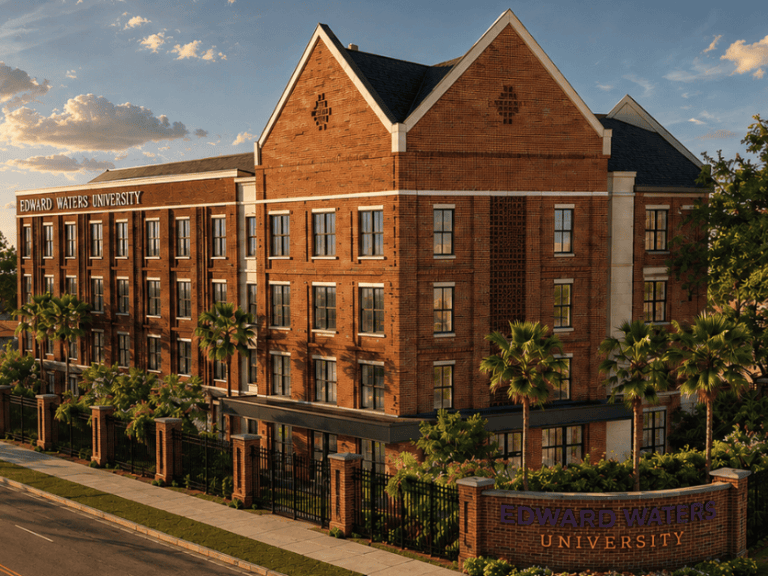
The Edward Waters University campus expansion will give Florida’s oldest HBCU its first new residence hall since 1982. The Jacksonville school announced on Oct. 8 that a $25 million loan will fund a nearly 200-bed dorm and its first on-campus track. Those builds anchor more than $33 million in capital projects. The Edward Waters University deal closed Sept. 10 through a federal program that fewer than half of HBCUs have used.
What the Edward Waters University Campus Expansion Pays For
The $25 million loan covers two big builds. According to Edward Waters, the residence hall will have nearly 200 beds and become the largest residential facility on campus. Jacksonville Today reports it’s a four-story building expected to open in fall 2028. LandSouth Construction of Jacksonville is building it, and Niles Bolton Associates designed it.
The track is a first, too. It’s the university’s first on-campus track and field facility, and it will serve NCAA Division II athletes. The city of Jacksonville put in $2 million toward it, and Edward Waters says the facility will host community health and wellness events each year. Mayor Donna Deegan said she expects it to become a recreation hub for Northwest Jacksonville.
That community angle matters. Jacksonville Today cited federal health data showing life expectancy of 68.9 years around campus. Jacksonville overall is 76.2, and the national figure is 78.8.
The Nearly $9 Million Beyond the Dorm
Another nearly $9 million goes to modernization. Centennial Hall, the oldest building on campus, gets a main-floor renovation, a new café, and restored windows and brickwork. The library lives there too. The Lee Cousins Administration Building, the second-oldest on campus, gets major work on its second through fourth floors. Its fourth floor has been out of service since 2023. A new Student Welcome Center and Tiger One Stop will centralize enrollment services. There’s also a new innovation lab and a renovated chemistry lab. Milne Auditorium gets upgrades, and safety, roofing, HVAC, and technology work will reach across campus. ShoppeBlack notes the announcement doesn’t give a full funding breakdown for the modernization work.
How the Federal Program Works
The money comes through the U.S. Department of Education’s HBCU Capital Financing Program. Congress created it in 1992 because HBCUs struggled to secure capital, including discrimination in the bond market, according to the university. The program offers rates close to the federal government’s own cost of capital. The Department of Education guarantees repayment. Rice Capital Access Program serves as the program’s designated bonding authority and arranged the deal. It’s a subsidiary of Black-owned Rice Financial Products Company. ShoppeBlack reports the loan runs 30 years.
Rice, founded in 1993, says it has closed more than $3.6 billion in higher education loans. ShoppeBlack lists $157 million for Alabama A&M in 2024, $96 million for Xavier University of Louisiana in 2025, and $72 million for South Carolina State the same year. Jacksonville Today adds that Rice has helped Morgan State, Hampton, Morehouse, and Jackson State secure financing.
Why Edward Waters Qualified
Getting in isn’t automatic. The federal review looks at leadership continuity and enrollment trends. It also examines at least five years of audited financials, according to the university. Edward Waters points to seven consecutive operating surpluses and an endowment that more than tripled since 2018. It has also grown from eight to 17 degree programs and won reaffirmed accreditation through 2035 with zero recommendations. Last month, it received a $1 million endowment gift from the Dimon Foundation. It’s Florida’s only NCAA Division II HBCU, and it graduated the largest class in its 160-year history in May.
The turnaround is sharp. Edward Waters reportedly enrolled roughly 800 students in the mid-2010s, according to HBCU Buzz’s earlier reporting, and it reached 932 in 2019. A. Zachary Faison Jr. took over as the 30th president in 2018, and at 37 he was the youngest sitting HBCU president at the time. Enrollment helps the case. Fall 2026 enrollment reached 1,286, up 37% since 2019, according to Faison. The university rounds that to nearly 1,300. HBCU Buzz reported a count of 1,281 in August as part of its HBCU enrollment coverage. William Fisher, Rice Capital Access’s CEO, said the school grew enrollment without increasing its tuition discount. He stressed the loan wasn’t charity. He called the performance “phenomenal.”
What It Means for Students and Alumni
For alumni, the timing is personal, especially in the school’s 160th anniversary year. Faison called the project a “generational investment” and said the university is building for the next 160 years. Samuel Newby, a Class of 1984 graduate and former Jacksonville City Council president, was a 19-year-old sophomore on the track team when the last hall opened. He now leads the university’s Alumni Leadership Council. Council member Rahman Johnson, a 2000 graduate, recalled his grandmother taking him to Morris-Cone when it opened in 1982.
For current students, the payoff is more beds. Faison said the hall will finally give the school the capacity to grow its traditional population. Freshman Taryn Sanders will be a junior when it opens. She said she likes that the school keeps adding to its history.
What to Watch
The details still ahead matter most. Construction milestones, the final interest rate, and how the nearly 200 beds fill will all shape the Edward Waters University campus expansion. The university says it will announce milestones as the projects advance. For now, Edward Waters has turned a decade of growth into a loan, a dorm, and a track.