Savannah State University is kicking off a new certificate program with an unlikely partner! Get the full story from Destiny Wiggins at Fox 28 below.
Savannah State University students meet Speedy Artis, Harlem Globetrotters guard. (Credit: Destiny Wiggins/WTGS)
Savannah State University has partnered with an American exhibition basketball team to give students real-world experience on what it takes to build a career in the live entertainment industry.
“We know Savannah is the hostess city and we have events all the time. With our students, a lot of them are from the region, from the area, we like them to stay here in Savannah. We like to keep our people that we grow here, to stay here. So, understanding one of the major industry’s in this town, which is events, conferences, so on, for them to get an understanding of it a detailed program that that will give them the knowledge, the professional development, to go and get the jobs out in the city and also in the region,” said Christopher Torrance, Savannah State University Assistant Professor of Management.
SSU’S new live events certificate program will create opportunities for students to learn about merchandising operations, tour management, licensing requirements and all things to play a role in putting together live entertainment. School officials say students have already shown interest in the program.
Plus, students also got to meet Harlem Globetrotters guard, Speedy Artis.
“What’s unique about our program is, it’s being associated with a world-famous organization like the Harlem Globetrotters, which I don’t believe anyone else has. Along with it, our students are extremely excited. They are very interested in event management, sport management, a lot of our athletes are very excited about it. So, I think this is going to provide a very unique niche for our university and our programs here at Savannah State University,” said Torrance.
The program is being launched under the university’s Center for Innovation and Entrepreneurship. The certificate will offer non-credit, developmental course modules for registered participants of the CIE.
Registration for the class will open in April.
The program will begin its pilot program in Fall 2022.
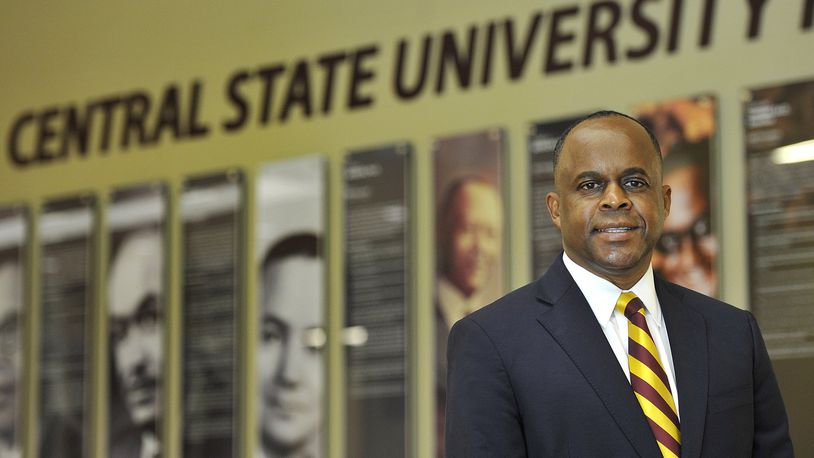
“WE MUST THINK BIG, DREAM BIG AND ACHIEVE OUR GOALS. CENTRAL STATE UNIVERSITY, IF OUR DREAMS DON’T SCARE US, THEY ARE NOT BIG ENOUGH!”
As he was teaching himself how to read and write, Frederick Douglass, a formerly enslaved person, kept stumbling over one monolith of mystery — why is it that while many will pray for change for twenty years (and the evil institution of slavery that once limited the best-kept secret in the world’s history from its due: the United States Constitution), only some will recognize that change, it happens eventually: This mainly occurs when you pray with your legs. And the crucial puzzle piece: That fire that started to kindle within his spiritual being and physical body as a self-educated black boy who later became a giant among men, black or white.
The same fire that kindled in Douglass, which made him the most photographed man in the 19th century, is the fire that kindles in Central State University President Jack Thomas, whose inauguration address earned standing ovations from the audience earlier this month as some of his family, friends, and loved ones who had come from far and near watched in attendance. Others unable to join him that day for this particular occasion instead watched virtually.
Born to godly parents that could not get a formal education because they had to work in the fields and lived through the tumultuous battles of civil rights, Thomas compared himself to many of the honorees that Friday, March 4th: He too was a first-generation college student. Thomas grew up on a farm in Calhoun, a small community in Lowndes County, Alabama (which sits between Selma and Montgomery, Alabama). Of one of his earliest memories of his mother, who is no longer with us physically, he told the audience that he remembers her saying:
“Son, I want you to finish high school and college. Someone has to do something a little different from what your father and I have done.”
Through his mother’s encouragement, the CSU leader shared that he began to excel in his studies. He continues:
“I want to dedicate this address to honor my mother, who passed away several years ago. She is symbolized in the audience today by a bouquet of roses, carried in by an usher during the procession. Mom, I know that you are smiling down on me! My father taught me the importance of a strong work ethic. My mother has passed away, but my father still lives on the family farm. Central State University, I acknowledge the solid foundation and values instilled in me by my parents. Let’s honor my parents with a round of applause.”
Observing the pandemic challenges that rocked the entire world, Thomas mentioned how he had to remain steadfast, long-suffering, meek, kind, and humble as we all prayed for better days on our blocks. He adds:
“When I accepted the position as the 9th President of Central State University in February of 2020, I had no idea that I would be starting my tenure during a worldwide pandemic. In my previous transition, I rose from Provost to President within the same organization. I began that presidency by reviewing the university budget, developing a strategic plan, and meeting alumni and community stakeholders. Here, I started with Zoom meetings conference calls and by making difficult decisions about small classes, wearing face coverings, testing and vaccinations, and by wondering if we would ever return to normal. I am proud to say that we are still standing, poised, and prepared to take Central State University to unimaginable heights of academic excellence!
Central State students, faculty and staff enjoyed a tremendous 135th Charter Day celebration. Thomas recalls that this was the first traditional Charter Day held since his arrival on campus. He reflected on how fortunate he is to be surrounded by excellent students and committed faculty and staff:
“I then paused again back in my office following Charter Day and thought of how all of us kept pushing past all obstacles. We all kept working; we kept answering phones; we kept raising money; we kept processing applications; we kept teaching; we kept enrolling students; we kept processing financial aid forms; we kept cleaning and sanitizing; we kept giving, and we kept providing wrap-around services under challenging circumstances. In the words of Langston Hughes, our lives over the past two years “ain’t been no crystal stair,” but we stayed connected, composed, and committed to Central State University and students. I stand before you today, a proud President. Proud of the sacrifices we all have made and proud that we have all made it back to this point. Please give our resilient students, staff, and faculty a round of applause! I know that it has not been easy. There have been many changes, but we are here. We are thankful and blessed.”
Check out the full inauguration address by CSU Prez Jack Thomas below.
“To Chairman Hatcher, other members of the University Board of Trustees, my fellow Presidents, other distinguished guests, University Leadership Team, faculty, staff, students, alumni, and to my family, friends, and loved ones who have come from far and near – thank you for your presence! I especially want to thank my wife, Linda, and our sons Patrick and Darius (please stand to be recognized). My father, Mr. Clinton Thomas, Sr., my sister Helen Thomas Bell, and my brother Mr. Marshall Clifford Thomas were unable to join me today for this occasion, but I know they are with me watching virtually.
I would also like to acknowledge the eight presidents who came before me. We stand on their contributions and take great pride in being a part of the Central State tradition:
President Charles H. Wesley
President Harry E. Groves
President Dr. Herman R. Branson
President Dr. Lewis A. Jackson
President Lionel H. Newsom
President Emeritus Arthur E. Thomas
President Emeritus John W. Garland
President Emeritus Cynthia Jackson-Hammond
I am incredibly humbled and honored to serve as the ninth President of Central State University and I am reminded of one of my favorite passages from Dr. Benjamin E. Mays, a Baptist minister, and former President of Morehouse College, which reads:
“The tragedy of life doesn’t lie in not reaching your goal. The tragedy lies in having no goal to reach. It isn’t a calamity to die with dreams unfulfilled, but it is a calamity not to dream. It is not a disgrace not to reach the stars, but it is a disgrace to have no stars to reach for. Not failure, but low aim is sin.”
As I mentioned on Charter Day and I’ll say it again today, we must think big, dream big and achieve our goals. Central State University, if our dreams don’t scare us, then they are not big enough!
On Monday evening, I attended a reception held to recognize our Charter Day honorees. Each honoree was asked to reflect on the question, “If not for Central State, where would I be?” I was inspired by their stories and found that we have much more in common than any of us expected. I discovered that like many of our honorees, I too was a first-generation college student. I grew up on a farm in Calhoun, a small community in Lowndes County, Alabama (which sits between Selma and Montgomery, Alabama). My parents were not able to get a formal education because they had to work in the fields and lived through the tumultuous battles of civil rights. I can remember my mother saying “Son, I want you to finish high school and go to college. Someone has to do something a little different from what your father and I have done.” Through my mother’s encouragement, I began to excel in my studies. I want to dedicate this address in honor of my mother, who passed away several years ago. She is symbolized in the audience today by a bouquet of roses, carried in by an usher during the procession. Mom, I know that you are smiling down on me! My father taught me the importance of a strong work ethic. My mother has since passed away, but my father still lives on the family farm. Central State University, I acknowledge the solid foundation and values instilled in me by my parents. Let’s honor my parents with a round of applause.
When I accepted the position as the 9th President of Central State University in February of 2020, I had no idea that I would be starting my tenure during a worldwide pandemic. In my previous transition, I rose from Provost to President within the same organization. I began that presidency by reviewing the university budget, developing a strategic plan, and meeting alumni and community stakeholders. Here, I began with Zoom meetings, conference calls, and by making heavy decisions about remote classes, wearing face coverings, testing and vaccinations, and by wondering if we would ever return to normal. I am proud to say that we are still standing, poised, and prepared to take Central State University to unimaginable heights of academic excellence!
On Tuesday, as we enjoyed a tremendous 135th Charter Day celebration, I recall that this was the first traditional Charter Day held since my arrival on campus. I reflected on how fortunate I am to be surrounded by excellent students and such committed faculty and staff. I then paused again back in my office following Charter Day and thought of how all of us kept pushing passed all obstacles. We all kept working; we kept answering phones; we kept raising money; we kept processing applications; we kept teaching; we kept enrolling students; we kept processing financial aid forms; we kept cleaning and sanitizing; we kept giving; and we kept providing wrap around services under challenging circumstances. In the words of Langston Hughes, our lives over the past two years “ain’t been no crystal stair,” but we stayed connected, composed, and committed to Central State University and to students. I stand before you today, a proud President. Proud of the sacrifices we all have made and proud that we have all made it back to this point. Please give our resilient students, staff, and faculty a round of applause! I know that it has not been easy. There have been many changes, but we are here. We are thankful and blessed.
As President, I embrace the mission, the legacy, and the rich traditions of this University. I am a graduate of two 1890 Land Grant Universities, Alabama A & M and Virginia State Universities, and I have held positions at two 1890 Land Grant Universities. My connection and experience with such institutions have uniquely positioned me to understand and appreciate the work that lies ahead. I am impressed by the rich legacy of Central State University. In 1958, then CSU President Charles H. Wesley hosted Reverend Dr. Martin Luther King, Jr., as the commencement speaker, where he encouraged students to embrace the new era ahead. Central State University, I pledge to do my absolute best, utilizing my many years of experience in higher education, to move this great University to the level that it so well deserves, a University of distinction.
Every two weeks, I hold informal conversations with separate Presidential Roundtables of faculty, staff, and students. No topic is considered off limits. We discuss everything from the condition of residential halls, the quality of customer service, all the way to library hours. All constituencies are always very respectful and thoughtful. What I get from these meetings is, first, I get to connect directly with the University’s most important populations and second, I get to hear firsthand that WE ALL recognize the greatness that lies within Central State University. The conversations also cause me to reflect on the progress we’ve made, along with the challenges and opportunities that lie ahead. Winston Churchill once said, “A Pessimist sees the difficulty in every opportunity; an Optimist sees the opportunity in every difficulty.” Before I begin to talk about the future, let me talk briefly about what we have accomplished together thus far.
Enrollment Management
When I arrived at Central State University, enrollment had decreased as it had at University’s across the country due to the pandemic. We pivoted quickly to hybrid delivery and distance learning and made quick technology adjustments. As a result, we stabilized a declining traditional enrollment and increased overall online enrollment with the launch of Central State Global that grew from 28 students to over 4,000! Overall enrollment rose by 97%.
Institutional Advancement – University Fundraising
University fundraising is a primary indicator of success, and the University Board of Trustees has charged me with starting and completing a multi-million dollar capital campaign –we are off to an excellent start! Over the last 18 months, corporate partnerships and corporate philanthropy at Central State University increased significantly. To date, the University has over 30 committed corporate partnerships and has raised over $7M towards the $30 M capital campaign goal. Additionally, the University’s public profile has been elevated.
1890 Land-Grant Mission
The goal of an 1890 Land Grant university is to improve the lives of the working classes through a liberal and practical education focused on agriculture, military tactics, and the mechanical arts as well as classical studies. CSU has a demonstrated history of “serving the underserved” and “reaching the unreached.” Central State is meeting its obligation to reduce the disparities in wealth, health, and education by conducting research addressing current societal problems, sharing knowledge through extension services, and providing first class education to our students. CSU provides over $2 M in scholarship awards to students majoring in agriculture related fields. We must encourage more students to major in agriculture.
Last year, the University received nearly $27M in research and external funds, which is the highest amount ever in CSU’s history.
Honors College
If you take a drive around campus like I do daily, you will notice construction of our new honor residential hall. The hall crystallizes the University’s commitment to academic excellence, scholarship, research, and service. Our focus is to attract, recruit, and enroll high achieving students who will enrich the academic experience of all students, enhance our overall academic profile, and increase our rankings in US News and World Report, the Princeton Review, and other rankings.
There are so many more milestones and accomplishments I could list. However, while it is important to give credit where credit is due, it is equally important to resist resting on our laurels. I established a Blue-Ribbon Task Force of educational professionals to review and recommend priorities. Will Blue Ribbons Task Force members stand to be recognized? Those nine (9) priorities we set when I first took office in July of 2020, we have accomplished them all, together (APPLAUSE)! Central State University is not and will never be second or third class! We are a first class University, and we must demand to be treated as such in all our encounters, both in public and in private!
While it will always be important to recognize wins, it is even more important to continue to move forward. Any discussion about what we’ve accomplished as a University must be accompanied by a conversation about where we plan to go. Failing to plan means planning to fail. President Abraham Lincoln once said, “Give me six hours to chop down a tree, and I will spend the first four sharpening the axe.” We are planning and collectively looking to the future with renewed energy, creative innovation, and laser focus. As such our University Strategic Plan theme is Reach Higher. Go Farther. Thrive.
Each goal in the strategic plan is accompanied by strategic initiatives, metrics, methods, and measures of success. All of us will play a critical role in embedding the plan into the very fiber of the University. Soon, across campus, you will begin to see elements of the plan reflected in new signage, new core values, and yes, new construction. The cornerstone of the plan is our bold and aggressive push to build the future Central State University – Project Innovation!
Project Innovation – Investing in Tomorrow Today
Central State University will embark on an aggressive capital infrastructure and building campaign to expand the campus footprint and capacity. The University will make a $65 M investment that will change the physical environment of the campus and begin the campaign of making Central State University a destination point for students, faculty, and professionals from around the world (APPLAUSE). If that doesn’t give you goose bumps, I don’t know what will! Let me share with you the initial projects that comprise Project Innovation:
New Honors Residential Hall and Administrative Complex
The facility will have apartment style units and the facility is scheduled to be complete in Fall 2022. These units will be available to Honors students only and will contain the latest technology and amenities and will house the administrative offices for Honors College. The facility is scheduled to be completed in Fall 2022.
CSU Health and Wellness Center
The University’s plan is to repurpose the existing facilities to create a new Health and Wellness Center. The building will include new spaces for health and wellness as well as administrative offices. The facility will also house a new Center for Minority Health Disparities Research. The expected completion of this facility is Fall 2023.
Facilities and Logistics Center
The new Facilities and Logistics Center will be the headquarters of campus physical infrastructure monitoring and logistics and capital development. The expected completion of this facility is Spring 2023.
Proposed College of Health and Human Services
The project will renovate the former Steam Plant structure, which is listed on the National Register of Historic Places. The expansion of health-related majors in CSU’s academic plan will expand our offerings and recruitment efforts. The expected completion of the facility is Spring 2023.
The final three projects will enhance our residence communities. They are Honors Hall West, Stadium Hall East, and other off-campus living options.
WE MUST THINK BIG, DREAM BIG AND ACHIEVE OUR GOALS. CENTRAL STATE UNIVERSITY, IF OUR DREAMS DON’T SCARE US, THEN THEY ARE NOT BIG ENOUGH!
On March 4, 1933, President Franklin D. Roosevelt said, “The only thing we have to fear is fear itself.” Did you catch that date? March 4, 1933. Exactly 89 years ago today, during what was also his FIRST INAUGURAL address [PAUSE], President Roosevelt shared those powerful words. He was addressing Americans who were in the clutches of the Great Depression. People were hopeless and afraid. They could not imagine a future that was full of promise. Now, I understand that this is not the Great Depression, and we are not hopeless, but the sentiment still rings true. To achieve BIG goals, we must all get comfortable with being uncomfortable!
The University’s most valuable resource is the commitment, energy, intellect, and connectedness of the people who fill our classrooms, our residential halls, our dining facilities, our financial aid offices, and our facilities offices. We absolutely cannot achieve these lofty goals and plans without each of you. We must be a community of people who accepts nothing less than excellence and demands the same from everyone with whom we interact. Let’s hold each other to a higher standard of excellence and in good service in all our interactions.
As I stated before, we are looking to grow and forge ahead. We realize that this growth will position Central State University to continue to be the global influencer that it has been for over 135 years. We will be remiss if we did not take a pause and look locally. Therefore, it is my honor to announce today our new DTXS Public School Scholarship initiative. Starting immediately, Central State University will be providing free tuition scholarships for students from the following public-school districts. Dayton public schools, Trotwood Madison city schools, Xenia community schools, and Springfield city schools. We are excited to work with these high schools to help their students not only choose Central State, but be uniquely positioned to enroll and thrive! This is only the beginning and allows us to continue to grow globally while remaining connected locally.
Central State started as the Combined Normal Industrial Department at Wilberforce University, created by the Ohio General Assembly in 1887. The objectives of the new state sponsored program were to provide teacher training and vocational education to stabilize these programs by assuring a financial base similar to other state supported institutions.
In alignment with our history, I am pleased to announce that in the Fall of 2022 we will renew our focus on the founding objectives of our University. The Ohio Classroom Teacher Initiative will focus on creating the next generation of classroom teachers in Ohio. This is a four-year program that provides tuition free for students maintaining the academic standards in the College of Education.
Students will be immersed in mentorship with classroom teachers and CSU alumni educators in Ohio. It is our goal to sustain the rich tradition of success in the classroom and empower Ohio’s newest, best, and, brightest educators.
Finally, I want to leave you with the words of George Bernard Shaw, which reflects my leadership style and my commitment to Central State University and the community:
My life belongs to the community, and as long as I live, it is my privilege to do for it whatever I can. I want to be thoroughly used up when I die, for the harder I work, the more I live. Life is no ‘brief candle’ to me. It is a sort of splendid torch which I have…for [only] a moment, and I want to make it burn as brightly as possible before handing it on to future generations.
Central State University – the future of this great institution is in our hands. We must work while we still have breath in our bodies, hope and determination in our hearts, energy and fire in our bellies, lessons and experiences to teach our students and the courage to stand even if we have to stand alone.
Central State University experienced the forces of nature in 1974.A tornado came and destroyed over 80% of the campus. Through that experience, we realized that this fine institution was destined for greater things. That is when we realized our “clock tower resilience.” The vision of Charles Wesley, the courage of Lionel Newsom, the audacity of Arthur Thomas, the discipline of John Garland, the tenacity of Cynthia Jackson-Hammond, all of them including (add other presidents) played a key role in building the foundation upon which we stand today. We stand on broad shoulders and now it is our turn, it is our responsibility, it is our duty be innovative, creative, flexible, because we are not just going to be on the cusp and just survive, we are going to thrive!
North Carolina Central University announced veteran athletics administrator and NCCU alumnus Dr. Louis “Skip” Perkins as the university’s next Director of Athletics during a press conference on Wednesday. Perkins will begin at NCCU on June 1.
A dynamic higher education leader with more than 20 years of experience in intercollegiate athletics and institutional advancement, Perkins has served as Director of Athletics at three different NCAA Division I Football Championship Subdivision (FCS) institutions with teams capturing 10 conference championships during his tenure.
“Dr. Perkins is a passionate and dynamic leader who is fueled by building winning programs focused on student-success,” said NCCU Chancellor Dr. Johnson O. Akinleye. “This ‘homecoming’ of sorts for Dr. Perkins brings him back to a place where he was not only cultivated as a student, but also grew to become a distinguished athletics and development administrator regionally and nationally.”
A 1994 graduate of NCCU, Perkins holds a Bachelor of Arts degree in political science and master’s degrees in public administration and instructional media, also from NCCU. He earned his Doctor of Education from Delaware State University, with a focus on educational leadership.
As a four-year team captain on NCCU’s tennis team, Perkins received multiple academic all-conference honors. He was also a recipient of NCCU’s inaugural Forty Under Forty Alumni Awards in 2012, and is a member of Kappa Alpha Psi Fraternity, Inc., the NCCU Alumni Association, Inc., and the United States Professional Tennis Association.
“I am truly thankful and excited to be back where I started my journey in intercollegiate athletics, as a student-athlete on North Carolina Central’s tennis team,” Perkins said. “The foundation that was instilled in me during my time competing on and off the court at NC Central has helped me become the person and leader I am today.
“One of my goals when I left NCCU in 2007 was to one day return to ‘The Nest,’ bringing back with me all of the experiences and knowledge I gained from a far to help return NC Central to its championship ways,” added Perkins. “I look forward to not only helping my alma mater win on its various fields of play, but to continue its focus on turning student-athletes into scholar-athletes.”
Perkins will join NCCU from his current role as assistant vice president for development at Morgan State University since 2020. Under his leadership, he worked in conjunction with the president of the university and the MSU Foundation Board to secure more than $67 million in fundraising contributions during the 2020-2021 academic year, which set a new university record.
Prior to his role as senior development officer at Coppin State University, Perkins was the associate vice president and director of athletics at Delaware State University from 2015-17. During that time, the Hornets secured four Mid-Eastern Athletic Conference (MEAC) championships, boasted the highest grade point average (3.1) in the athletics program history, and more than $5 million was raised in athletics development.
As director of athletics at Howard University from 2010-15, Perkins oversaw more than $10 million of renovations to Burr Gymnasium, while the Bison added another conference title to his ledger. In the same role at the University of Arkansas Pine Bluff from 2007-10, the Golden Lions achieved one of the highest graduation rates in school history and won five conference championships under his leadership.
Perkins also served as an assistant athletics director for development at NCCU from 2006-07, and as executive director of communications and external affairs at Saint Augustine’s University from 2005-06.
This weekend, the Fort Valley State University men’s volleyball program, which began this year, will be looking to show what it can do in a historic game. Get the story from staff at The Telegraph below.
Fort Valley State University volleyball coach Larry Wrather (center) during a women’s volleyball game last season. Wrather and the Wildcats’ men’s volleyball team will kick off their inaugural season Friday night. (Credit: The Telegraph)
The Fort Valley State Wildcats are set for the biggest week of their inaugural men’s volleyball.
FVSU will work together with the most successful collegiate men’s volleyball program, UCLA, in giving back to the Peach County community before the two teams take to the HPE Arena court Saturday evening.
The 19-time NCAA champion UCLA Bruins are coming to Georgia for a weekend-long trip that’s about more than playing two times on the men’s volleyball court.
On Saturday, the teams will put on a volleyball Serve/Pass clinic from 1-3 p.m. for the Big Brother/Big Sister organization of Peach County in FVSU’s HPE Arena. The Wildcats and Bruins will finish the day by playing in the same arena starting at 6 p.m.
Head coach John Speraw and his Bruins will work with both the Atlanta and Peach County communities in youth and coaching clinics, as well as playing both first-year Morehouse and Fort Valley State programs aimed to help the growth of men’s volleyball in Georgia.
“Being able to have UCLA come out and play us on our home court speaks volume to what we’re trying to do here in the SIAC and at Fort Valley State University,” said Wildcats head coach Larry Wrather. “As we continue to try to grow this game on the boys/men’s side, having a top 10 program in your gym to train with and compete against only helps our guys get caught up to that level faster.”
Fort Valley State University volleyball coach Larry Wrather during a women’s volleyball game last season. Wrather and the Wildcats’ men’s volleyball team will kick off their inaugural season Friday night. (Credit: The Telegraph)
FVSU, UCLA GROWING MEN’S VOLLEYBALL
“We are excited about the opportunity to play Fort Valley State and Morehouse College which are two of the six new men’s volleyball programs in the SIAC conference,” UCLA Men’s Volleyball Head Coach John Speraw said “This trip affords our student-athletes the chance to play our first ever match in the state of Georgia — a state where we expect boy’ volleyball to rapidly increase in participation and popularity over the coming years.
“Our players and staff are eager to make this an impactful week and appreciate the experience this will provide all the institutions.”
Led by Speraw, the Bruins team will conduct several youth and coaching clinics for local club, middle school, and high school athletes and coaches in the greater Atlanta and Peach County areas. They will end the week with matches against Morehouse College and Fort Valley State University, two of six new HBCU collegiate men’s volleyball programs in the Southern Intercollegiate Athletic Conference.
“Partnering with UCLA to reach out to the community and grow the sport is honestly awesome. We get a chance to inspire that next generation to look into volleyball and wanting to get interested in playing. That’s a big part of what we strive for here at Fort Valley as we want to grow the game in our community more, so our men are fighting hard every day in the gym and in matches to try to inspire that next kid to want to be involved,” added Wrather.
FIRST POINT HELPING FUND TEAMS
In 2019, the SIAC received a $1 million grant from First Point Volleyball Foundation ($600,000) and USA Volleyball ($400,000) to fund the addition of men’s volleyball. First Point Volleyball Foundation was co-founded Speraw in 2016.
As a result of First Point and USA Volleyball’s gift, the SIAC began its inaugural season in January with six participating programs: Benedict College, Central State University, Edward Watters College, Fort Valley State University, Kentucky State University, and Morehouse College.
A NEW HBCU VOLLEYBALL DOCUMENTARY
A team of students from Ball State University will also join the Bruins in Atlanta. The Ball State team is producing a documentary titled Match Point 2.0, which will chronicle the SIAC’s inaugural season and explore how the addition of six new programs at HBCUs is increasing opportunities for minority athletes.
West Virginia State University (WVSU) has been awarded a $764,792 grant by the Kanawha County Commission for the establishment of a Cybersecurity Innovation Center (CIC) at the university.
The funding comes from American Rescue Plan (ARP) funds that can be used to assist communities recovering from the COVID-19 pandemic. The commission approved the grant funds at its Thursday meeting.
“We are grateful to the Kanawha County Commission for their support in helping us to establish the Cybersecurity Innovation Center at West Virginia State University. As West Virginia struggles to emerge from the pandemic, and overcome the economic disparities that were compounded by the pandemic, establishment of a strong and diverse economic foundation for the future is critical,” said WVSU Interim President Ericke Cage. “The creation of this center will contribute to this effort by helping ensure a safe environment for business development in the Kanawha Valley and throughout the state, and by preparing students for high-demand jobs in this rapidly growing field.”
The Kanawha County Commission issued the following joint statement, “We cannot thank Interim President Ericke Cage enough for his leadership of WVSU at this time. President Cage led senior leadership through the process of applying for these funds and initiated this idea for a Cybersecurity Innovation Center. His leadership with WVSU has been outstanding, and he has the full support of the Kanawha County Commission. We were pleased to approve the American Rescue Plan Grant for West Virginia State University at last night’s meeting. WVSU is ‘our’ University, and implementing a CIC is greatly needed at this time as many businesses are seeking assistance daily in how to protect their infrastructure. WVSU will work to ensure that its students have the opportunity to participate in this important program. We were proud to support WVSU, especially on Founders Day and their Day of Giving.”
Establishment of the CIC at WVSU will address economic and social impact of the COVID-19 pandemic by providing academic degrees, community-based training and youth outreach to populations that have been disproportionately affected by health and economic concerns.
WVSU students who have been disproportionately affected by the pandemic will receive priority consideration for scholarships and paid internships, and graduates with credentials in cybersecurity will be well positioned to obtain and succeed in jobs related to cybersecurity.
In addition, government agencies, small businesses and community organizations will have the support and training to adopt practices and invest in resources that lead to fewer data breaches and increased understanding of and confidence in how to keep their organizations safe; data security will be especially important as many organizations continue to have a significant number of their employees working from home.
And finally, community members and youth from underrepresented communities enrolled in K-12 programming will develop increased awareness of the importance of cybersecurity, tools to keep their personal data safe, and careers available in this field.
Establishment of the CIC will begin immediately with the hiring of a director, investment in the technology infrastructure needed to deliver the programs, and development of curriculum for university students as well as community outreach.
The first cohort of cybersecurity students will enroll in fall 2022, the first community outreach programs will begin during the 2022-2023 academic year, and K-12 youth programs will begin in the summer of 2023.
The funds awarded to WVSU will be used to provide scholarships and paid internships for students, and provide support for outreach programs to county employees, community members, and K-12 youth.
Grambling State University students are being exposed to the ins and outs of the real estate industry thanks to a partnership with Arizona State University below. Get the full story from Ndumiso Shongwe and Kinaya Washington at The Gramblinite below.
Dr. Mark Stapp, left, and Clifton Johnston were two of the panelists at The Grambling State University/Arizona State University Real Estate classes. (Credit: Jalien Edwards)
Grambling State University and Arizona State University recently teamed up for an informational session concerning real estate classes taken through ASU that are credited to GSU’s students’ transcripts.
This panel conducting the session in the GSU Nursing Building auditorium on March 7 included event moderator Murphy Cheatham, a 1998 GSU graduate who is a real estate finance and fintech executive; Dr. Mark Stapp, director of Real Estate Programs at Arizona State’s W.P. Carey School of Business; Wayne Brown, founder and senior vice president of Brown Builders Inc., a development and property management company in Bossier City, Louisiana; Clifton Johnson, a 2002 GSU graduate and owner of Titan Realty Group; and Bonnie Moore, a 1979 GSU graduate who serves as director of Community Development for her native city of Shreveport, Louisiana.
The session held in GSU’s Betty E. Smith School of Nursing Building Auditorium spotlighted the university’s partnership with ASU’s W.P. Carey School of Business that enables eligible students from Grambling State to take real estate classes through Arizona State and have credits for those courses transferred to their Grambling transcript. The classes include Real Estate Fundamentals, Real Estate Appraisal, Real Estate Law, Real Estate Land Department, and Real Estate Investment.
Stapp pointed out the classes are offered online and are scheduled according to the students’ convenience.
“The five classes are offered via zoom. When setting up the schedule, the student’s Grambling existing schedule is taken into consideration, and we also work around the difference in time zones,” Stapp said.
Stapp challenged students to have an insatiable thirst for learning.
“Be a lifelong learner — do not stop learning,” Stapp said.
The program has already seen two students from Grambling enrolled in the ASU program — K’tricia Borum, a Mass Communication major with a minor in Marketing, and Kimberly Jackson, a Management major.
Borum said she was thankful to her professors who made her aware of the program and also provided her perspective on the program.
“I was not aware that even as a Mass Communication major, I could take Real Estate courses through ASU, therefore I would like to give credit to my teachers and thank them, especially Mrs. (Susan) Wiley (Student Success Instructor and lecturer with the Management and Marketing Department at GSU). For me, this program provides an opportunity like no other, and when opportunity knocks you open the door,” Borum said.
Jackson expressed her appreciation for GSU’s administration for making the program available.
“My favorite aspect of the program is the administration,” Jackson said. “They have been very helpful. At first, it was difficult to enroll because classes clashed with my Grambling schedule, but the administration worked with me until we found a way to make it work. I highly recommend that eligible students apply for the course.”
Grambling’s Provost and Vice President for Academic Affairs, Connie Walton said that as administration they are looking forward to having more students take advantage of the partnership.
“We are hopeful that next fall we will have 15 to 20 students taking the Real Estate courses through this partnership,” Walton said.
GSU President Rick Gallot Jr. was thankful to Grambling alumnus and Arizona State University for making the partnership possible.
“To Mr. Murphy Cheatham II and our friends at Arizona State University, thank you for the investment of time and treasure in making these opportunities available for our students here at Grambling State University,” Gallot said.
Students who attended the information session said they were inspired to enroll in the program.
“I think this is an awesome opportunity for students and I definitely want to enroll before I graduate,” said junior marketing major Kayla Wiley.
“I am a graduating senior, so I still have to find out how I can apply and enroll. I will certainly be in contact with the relevant personnel,” said criminal justice and sociology major Skyy Harrison.
Wiley said the immediate response to the session explaining the program was strong.
“The response to the real estate information session has been great,” Wiley said. “Ten students are already planning to take the Real Estate Fundamentals course in the fall. The valuable knowledge, experiences and words of wisdom shared by our real estate experts introduced our students to various career opportunities in this field.”
The program is open to all majors. For now, it is available in the spring and fall semesters. Interested students in enrolling may contact Wiley at wileysb@gram.edu.
University of Arkansas at Pine Bluff alumnus Terron Armstead is yet again making us proud after signing a huge new NFL contract. Get the full story from Kyle T. Mosley at Sports Illustrated’s HBCU Nation below.
The former UAPB alum and HBCU great, Terron Armstead, signed a mega-deal with the Miami Dolphins.
Terron Armstead entered free agency as one of the top offensive linemen available, and the Miami Dolphins signed the former Arkansas-Pine Bluff alum and New Orleans Saints left tackle.
Armstead, 30, anchored the Saints’ offensive line for years and protected Brees’ blindside before the future Hall of Famer decided to retire after the 2020 season. New Orleans couldn’t keep the best left tackle in the team’s history due to salary-cap limitations. He and Ryan Ramczyk were considered the best tackle tandem in the league.
The UAPB great has protected other notable quarterbacks on the gridiron like Jameis Winston, Taysom Hill, Trevor Siemian, and Teddy Bridgewater.
CONTRACT WITH MIAMI
Miami invited Armstead for a visit, and both sides agreed on a five-year, $87.5 million contract with $43.7M guaranteed on March 22.
Since the Dolphins QB is left-handed, the ex-Golden Lion will take his talent to South Beach and protect Tua Tagovailoa’s front side. Nevertheless, Miami landed one of the best offensive linemen in the league.
ABOUT COMING FROM AN HBCU
One reporter wanted to know, “what does today mean for you being a product of an HBCU and being a 10-year vet?” While wearing a classic Dan Marino No. 12 jersey, Armstead said, “It’s amazing. It’s a blessing for sure. I thank God for the opportunity, for being here, for being here for so long, for being an HBCU guy, a small school guy. It’s a longer road. It honestly is. It’s a longer trip to get here and to stay here, but it’s possible. It’s becoming more and more frequent and evident that the talent is in those buildings and in those spaces. I was at the HBCU Legacy Bowl. A lot of talented players, a lot of NFL scouts and front office people making decisions. I think it will continue to grow as they continue to get exposure.”
ARMSTEAD’S COMBINE LEGACY
The New Orleans Saints took notice of Armstead during the 2013 NFL Scouting Combine after Armstead ran a 4.71 second 40 yard-dash. His time remains the top 40 of any offensive linemen at a combine. The Saints selected him as the 75th overall pick in the 3rd round of the 2014 NFL Draft.
In ten seasons and 97 professional game appearances, Armstead earned three trips to the NFL Pro Bowl (2018-20) and was honored as a second-team AP All-Pro in 2018. Before entering the draft, the Cahokia, IL native was a three-time SWAC first-team selection from 2010-12.
The Saints will miss his leadership and locker-room presence. He was a great interview and highly personable with media during my time covering the New Orleans Saints. The big man is a philanthropist and a darn good rapper. The Dolphins landed a gem in the HBCU legend, Terron “T-Stead” Armstead.
Competitive gaming is a thriving industry, but for girls and women, it is an unleveled playing field. Learn what Tennessee State University is doing to change that in the Nashville Tennessean article by Molly Davis below.
Kiara Davis (left) teaches Sydnei Everett (right) how t play a video game during an esports gaming event hosted by Tennessee State University Wednesday, March 16. (Credit: Molly Davis/Tennessean)
Jayla Anderson didn’t know many people when she transferred to Tennessee State University this year. She had taken two years of online classes at a community college in Memphis, and when she arrived in Nashville she was thrilled to be a part of a campus community.
“Taking online classes, I felt really detached,” Anderson said. “Coming here has been really eye-opening. It has been the best experience.”
Anderson grew up playing video games with her older brother. When she arrived at TSU, she used video games to foster her own network of friendships. She plays in her dorm with her best friend, who she calls her brother, and plans informal tournaments in another friend’s off-campus apartment.
“Whenever any of my friends is playing sports games, basketball shooting games, I’m there with them,” Anderson said.
Tennessee State University hosted an event Wednesday, March 16 focused on women in esports gaming to engage more students like Anderson in the establishment of the Academic eSports Center on campus.
The SMART Global Technology Information Center will oversee the new center, which will serve as the academic hub for new classes on the history of esports and video game coding and creation. Dean of Graduate Studies Deborah Chisom said a primary initiative at the center is to recruit young women into STEAM professions through esports gaming.
Kiara Davis was the first female on the esports team at Tennessee State University. She has helped to recruit more women to the team. (Credit: Molly Davis/Tennessean)
“It opens up a whole world, especially for females,” Chisom said. “It teaches them leadership and organizational skills, and it’s important that we open up the field of gaming to women.”
The National Association of Collegiate Esports estimates that 8.2% of collegiate esports players are female, and Black women are underrepresented in the worldwide gaming community. Program director Effua Ampadu-Moss said esports and online gaming is a unique opportunity because it doesn’t have to be about what someone looks like. Ampadu-Moss wants the new center to be open to everyone, regardless of what they look like or where they come from.
The esports gaming team at TSU attends biannual national competitions and hosts internal tournaments. Kiara Davis, a freshman at TSU, said she wants to put the eSports team among the top five HBCU’s in the U.S.
Davis learned how to play video games with her dad and brother. She said competing on the team has helped her get out of her comfort zone and build a community of friends at college. This year she was the first girl on the mostly male team, so she tries to get more women involved any chance she gets.
“I can bond with guys, but it’s unique to have girls on the team,” Davis said. “When we finally got more girls on the team, I was so happy. Hopefully we will get more.”
Students stopped by to try out video games at the event, which was focused on engaging students ahead of the opening of the new academic center for gaming at TSU. (Credit: Molly Davis/Tennessean)
As students stopped by the event to learn more about the team, Davis took the initiative to show them the ropes.
When looking to the future, Chisom and Ampadu-Moss want to expand gaming and academic opportunities to women of all ages. They hope to offer summer camps for youth in Nashville when the center is finished.
“People ask me why girls should be in gaming,” Chisom said. “The question to me is why not?”
Jackson State University head football coach Deion sanders will continue to do all he can for HBCU talent to be scouted, even if it ruffles some feathers. Get the story from Adam Wells at Bleacher Report below.
Credit: AP Photo/Hakim Wright Sr.
Jackson State head football coach Deion Sanders is unhappy with those NFL scouts who didn’t attend a pro day in Mississippi for HBCU football players.
Speaking to NFL Network after Monday’s event (h/t Khari Thompson of the Mississippi Clarion Ledger), Sanders called out the 10 teams that didn’t have scouts present.
“You 10 that’s missing, if I catch you at Mississippi State or Ole Miss it’s going to be a problem, that’s all I’m going to say. That’s all I’m saying, it’s going to be a problem. Our kids are that good, you should have shown up too,” he said.
Sanders announced last month that Jackson State was going to be hosting a pro day for players from several HBCU programs, including the Tigers, Mississippi Valley State and Alcorn State.
“I’ve heard from the NFL,” Sanders said. “Not only are they sending a plethora of scouts, but they’re sending the NFL cameras as well, because our kids deserve the same thing as the Power Fives.”
Thompson noted Jackson State linebacker James Houston IV, who finished second in FCS with 16.5 sacks last season, gained valuable exposure from Monday’s pro day after not being invited to the NFL Scouting Combine in Indianapolis earlier this month.
There has been a significant push to get draft-eligible players from HBCU schools more access to NFL scouts leading up to the 2022.
The Black College Football Hall of Fame adopted the HBCU Legacy Bowl that was played Feb. 19 in Mobile, Alabama. The Legacy Bowl is an all-star game in the same vein as the Senior Bowl except it only features athletes from HBCUs.
These efforts came after no HBCU players were selected in the 2021 NFL draft. For comparison, there were four HBCU players selected in the 2019 draft, including Tytus Howard in the first round (No. 23 overall) by the Houston Texans.
A new report has outlined just how much more difficult the COVID-19 pandemic has made life for some HBCU students, and what can be done to help. Get the full story from Lily Bohlke at Missouri News Service below.
A survey of students at the nation’s Historically Black Colleges and Universities (HBCUs) found nearly half have been food insecure in the last 30 days.
More than half experienced housing insecurity during the pandemic, with many students reporting choosing between paying rent or buying food. The report noted the disproportionate impact of COVID-19 on HBCU students exacerbated existing racial inequities.
Terrell Strayhorn, provost and senior vice president for academic affairs at Virginia Union University and director of the Center for the Study of Historically Black Colleges and Universities, who co-authored the report, said investing in student needs is key to increasing student success.
“It’s hard to feel you belong in higher education when your basic needs are not met,” Strayhorn explained. “When you don’t have enough money to pay your bills and have food and have a place to lay your head, but you’re expected to show up for biology class.”
The report noted HBCUs account for more than 20% of Black Americans’ bachelors degrees, and they serve many Pell Grant-eligible students, meaning they qualify for the federal needs-based grant program.
Public HBCUs rely on federal, state and local funding for more than half their revenue, compared with 38% for their predominantly white counterparts.
Andre Smith, political scientist at Fayetteville State University, formerly of Harris-Stowe State University, said Missouri’s funding model for universities is performance based, and the two HBCUs as well as Missouri Western, a predominantly white institution in St. Joseph, end up on the low end.
“They have the neediest students who are going to require at an institutional level the most assistance,” Smith pointed out. “But due to the funding model in Missouri, these three schools get the least amount of funding.”
The report is a joint effort by the Hope Center for College, Community and Justice, and Virginia Union’s Center for the Study of Historically Black Colleges and Universities. It makes state and federal policy recommendations for lawmakers, including expanding financial aid and emergency aid options for HBCU students.
Howard University will be putting its money where its mouth is, announcing the largest construction initiative in the school’s history! Get the full story in the release below.
Fueled by the University’s unprecedented financial strength, this historic investment in the campus master plan will transform Howard’s campus over the next five years, providing new and improved facilities for faculty, students and staff
Howard University officials today announced plans for the largest construction real estate initiative in the institution’s history. The University will invest $785 million to build three new state-of-the-art multidisciplinary academic halls and renovate several existing structures, including the historic Myrtilla Miner Building, which sits prominently on Georgia Avenue, that will house the School of Education and the Howard University Middle School for Mathematics and Science. The new academic centers will house teaching and research in health sciences; arts and communications; and associated science, technology, engineering, and mathematics programs. The new construction projects are slated to begin this year and are expected to be completed by 2026.
“This is a watershed moment in the history of our institution,” said Wayne A. I. Frederick, president of Howard University. “Because of the tremendously enhanced financial posture we have worked so hard to achieve, the state of the University has never been stronger. The leadership of our board and executive team, along with the caliber of students we have enrolled, the illustrious faculty we have assembled, the dedicated staff we have hired, and the committed alumni base we have cultivated, presents an opportunity for us to solidify Howard’s status as one of the preeminent institutions of higher education in the country.”
Emerging from continued improvement in the University’s ratings and in conjunction with the priorities established in the Howard Forward strategic plan, this is by far the largest real estate investment in Howard University’s history. The historic investment is part of a phased Central Campus Master Plan (CCMP). Announced in 2020, the CCMP serves as the University’s roadmap for the long-term transformation of Howard’s main campus through capital improvements that align with the University’s mission and vision. These efforts are made possible in part because of enrollment growth, increased philanthropic and public investment in the University, and the University’s efforts to build financial strength as outlined in the five-year strategic plan.
A Major Step in the Campus Master Plan Ignited by $300M Bond and Record-Breaking Philanthropic Giving
This historic investment begins the implementation of Howard University’s 2020 Central Campus Master Plan. Unanimously approved by the DC Zoning Commission in 2021, the CCMP serves as the University’s roadmap for long-term transformation of Howard’s main campus through capital improvements that align with the University’s mission, vision and strategy. While the CCMP serves as the roadmap to the largest investment in capital projects on Howard’s campus, this investment would not have been possible apart from an intentional focus on improving the financial strength of the University – a pillar of the Howard Forward strategic plan.
The University reached record-breaking fundraising totals last year, ending the 2021 fiscal year with $170 million in philanthropic contributions. Already, the University is on track to supersede that record in 2022 with $120 million in philanthropic commitments just six months into the fiscal year. These unprecedented totals represent a far-reaching commitment from Howard University alumni, as well as individual and institutional donors, in the bold vision of Howard Forward.
In February, the University announced a shift in its national bond ratings by the Fitch and Standard and Poor’s (S&P) credit agencies from stable to positive. Both agencies affirmed Howard University’s $300 million series 2022A taxable bonds, which will support the campus master plan’s first phase.
The bonds are a critical component in the financing plan that will support the implementation of the CCMP.
Howard Constructs New Academic Buildings for the First Time Since 1984
Howard University will construct new academic-targeted centers on its campus, marking the largest investment in academic classroom space in 38 years. The investment in these academic centers was approved specifically to fund academic real estate projects and represents a continuation of the University’s overall investment in campus infrastructure. Howard has undergone significant campus renovations to include the full renovation of the Undergraduate Library in 2021, re-opening of the historic Frederick Douglass Memorial Hall in 2021, and the construction of the Interdisciplinary Research Building (IRB) in 2015. Over the last five years, the University has renovated 80 percent of residence halls with improved security and building system upgrades. The University Central Campus Master Plan also includes roughly 1,500 additional housing units.
Of the $785 million real estate investment, $670 million will be used to fund three new academic centers: the Health Sciences Complex, which will house the College of Medicine, College of Dentistry, College of Pharmacy and the College of Nursing and Allied Health Sciences; the Center for Arts and Communications, which will house the Chadwick A. Boseman College of Fine Arts and the Cathy Hughes School of Communications; and the STEM Center, which will house various STEM programs and disciplines including physics, chemistry, biology, engineering, mathematics and associated labs. The University will pursue naming right opportunities related to these campus investments in the coming months. This investment will contribute to the University’s growing $2 billion portfolio of real estate and other assets.
Alabama State University students did a sweep at a virtual STEM symposium, and we couldn’t be prouder! Learn more about the HBCU’s stellar performance at the 2022 Research Frontier Symposium in the ASU release below.
Students at Alabama State University won the lion’s share of awards given at this year’s annual 2022 Research Frontier Symposium, which was held virtually at ASU. The symposium is a well-respected national event that highlights academic research with a concentration on STEM (Science, Technology, Engineering and Mathematics) subjects, with a broader National Science Foundation definition to include chemistry, computer and information technology science, engineering, geosciences, life sciences, physics, astronomy, social sciences, anthropology, economics, psychology and sociology.
Among the 10 national awards presented to winners at the symposium, ASU won half of them with six of its students winning the top honors. All contestants competed in two event categories, which were oral and poster presentation formats. The ASU awardees for oral presentations were Kiersten McCalpine and Kelci Lawrence. ASU winners in the poster presentations were Vanella Tadjuidje, Corrigan Murry and Asia Turner (joint team); and Jordan-Haley McWilliams.
The 2022 event’s theme was “Innovation in STEM Research.”
Among the other winners were Christopher J. Gisriel (Yale University), Stephanie Monge (Instituto Tecnológico de Costa Rica), and Atindrah Harishankar, who attends Montgomery’s LAMP High School.
ASU’s Dr. Harvey Hou, the founder of this well-respected scientific event, and a professor of Forensic Science at the University, explained that the students who competed are from schools located across the United States and abroad.
“We are very proud that so many of the University’s students did so well at the science symposium,” said Hou, from his laboratory of Forensic Analysis and Photosynthesis. “This reflects well, both on the ASU students who won, as well as on the school’s faculty who teach them and on the strong STEM program that the University’s leadership supports and encourages.”
Fisk University came out on top at the latest HBCU Battle of the Brains competition presented by the NFL, becoming the last HBCU standing amid 30 other institutions. Get the story from the NFL release below.
Credit: Black Enterprise
The National Football League extended its partnership as the Presenting Sponsor for the 5th AnnualHBCU Battle of the Brains competition, which returned to an in-person event at SXSW in Austin, Texas, March 9 – 13, 2022. The annual competition featured over 30 HBCUs with students battling for coveted scholarship prizes.
“We are excited to continue our long-standing partnership with the HBCU Battle of the Brains,” said Natara Holloway, Vice President, Business Operations & Strategy, NFL. “This event gives us a unique opportunity to get a glimpse of innovative thinking and ideas from an immensely talented group of students from Historically Black Colleges & Universities. The NFL’s commitment to providing a platform that highlights the extraordinary skills and creativity of HBCU students is a priority now and into the future.” SXSW provided a backdrop to highlight and showcase innovative thinking and diversity of minorities in tech and innovation. The 2022 HBCU Battle of the Brains assembled some of the best and brightest STEM and business students from HBCUs across the country to compete for more than $80,000 in total scholarship winnings. The NFL provided the NFL Business Case to the students, who were given 24 hours to provide a solution before pitching to judges in front of a live audience. The competition concluded with students being evaluated on analysis, a business and technology solution, and a final presentation/Q&A. This year’s NFL Business Case was to design and implement a HBCU STUDENT & ALUMNI PORTAL. The teams were tasked with launching a website or mobile app by researching and finding solutions to the specific focus areas to create an original platform, develop a website or mobile app concept, assign task managers, source content, and organize the website or app launch event to showcase their HBCU Student & Alumni Portal.
The team from Fisk University was awarded the Grand Prize of $50,000. Huston-Tillotson University team came in 2ndPlace winning $20,000 and Morehouse College who finished in3rd Place won $10,000. In a surprise moment, NFL Legend, and business mogul Marshawn “Beastmode” Lynch announced he and current NFL Players Josh Johnson and Marcus Peters, would donate $10,000 from their foundation towards the scholarships.
Various NFL executives and staff across the league and media offices served as featured speakers, team mentors and competition judges during the four-day event. Gregory Gibson Jr. the Founder & Executive Director of HBCU Battle of the Brains created the competition to support the mission of HBCUs while giving exceptional business and STEM students within the African American community and technology industries a platform to shine. The HBCU Battle of the Brains also demonstrates the NFL’s commitment toward innovation to help advance the sport.
“I am so proud of each of the students that participated in the 5th annual HBCU Battle of the Brains,” said Gibson Jr. “These amazing students deserved to be seen and seen fully, and the full support of the National Football League provided illumination of what these brilliant minds are capable of.”
“The opportunity to serve as a competition judge at the HBCU Battle of the Brains was truly an honor,” said David Jurenka, SVP and General Manager of NFL Media. “It was a difficult decision to choose between so many exceptionally talented teams whose projects were not just thoughtfully constructed, but were also presented in such a dynamic manner that challenged us during deliberations. I look forward to following their journeys in the near future.”
LaMar Campbell, NFL Legend and current Vice President of Player Engagement with the Chicago Bears, witnessed first-hand the brilliance demonstrated by the HBCU students. “The excellence of the men and women that I experienced at the HBCU Battle of the Brains stands as a pinnacle experience in my NFL career”, said Campbell. “The ability to spend time with the amazing students in Austin and learn about the rich history and culture they have built at this event inspires me in a special way that contributes to my day-to-day work with the Chicago Bears. I see myself in them and in turn it contributes to the future and opportunities that I can assist them in achieving because if you want to look towards the future you have to impact the present.”
A featured NFL Panel, The Come Up: Transition from the Field to the Boardroom,included Moderator Steve Wyche, NFL Network Reporter/Host, Devale Ellis, NFL Legend and Actor, Author & Co-host of Dead Ass with Khadeen & Devale, Marcus Allen, NFL Player, Pittsburgh Steelers, Owner of Vibes Universal Apparel, Marcus Peters, NFL Player, Baltimore Ravens, Fam 1st Family Foundation Co-Founder & Owner of Juiceman Apparel, and Kelvin Beachum, NFL Player, Arizona Cardinals and Investor, who shared how they are able to navigate their success on the field as they excel in their business ventures away from the gridiron. The week also included informational meetings with Administrators, HBCU Presidents and top NFL Executives.
A special fireside chat with trailblazing African American women from football and business was moderated by Natara Holloway, NFL Vice President, Business Operations & Strategy with Dr. Valerie Daniels-Carter, one of the most preeminent business owners in the U.S. who is President and CEO of V&J Foods, Holding Companies, Inc., and Board of Directors for the Green Bay Packers and minority owner with the NBA Champion Milwaukee Bucks; and Adrian Bracy, Author, and Motivational Speaker whose earlier career included serving 18 years within the NFL as an Executive with the Miami Dolphins, Arizona Cardinals and the St. Louis Rams (now Los Angeles Rams) during their first Super Bowl win.
Atlanta HBCUs are now much more prepared for threats to their campuses thanks to a security company that has provided security tips to them. Get the story from FOX 5 below.
(Credit: Raymond Boyd/Getty Images)
Leaders of historically black colleges and universities in Atlanta are learning how to better respond to bomb threats.
It comes after Morehouse College instructed people on campus to shelter in place early last week after someone reported a suspicious package. Atlanta is home to other HBCUs threatened this year, including Spelman College.
Training presented by the Cybersecurity and Infrastructure Security Agency included discussions about how campus security and local law enforcement should respond to threats.
The event was open to school administrators and law enforcement from dozens of schools across the country.
Michael Hodge, Executive director of the Atlanta University Center Consortium, said campus police chiefs responded admirably to the threats that were ultimately not deemed credible. He said the conference provided security and police with more tools and methods to protect campuses.
“We needed to make sure that we secure all of our campuses and deal with the stress and the anxiety that these kinds of things raise in our communities,” Hodge said. “These things are historical in black communities and it’s important we deal with them head-on.”
It’s all to help HBCUs feel self-empowered when securing their campuses.
Monday’s threat was It was not the first against Historically Black Colleges and Universities this year, not even Atlanta. Morehouse alerted its campus of a separate threat in February.
The Department of Homeland Security, the Department of Justice, and the FBI launched investigations into the bomb threats that started at the beginning of Black History Month.
They’ve not altogether stopped since the end of Black History Month.
“These threats are despicable. They are designed to make us feel fearful and vulnerable,” Spelman President Mary Schmidt Campbell, Ph.D. said in a statement after the college closed its campus.
With the intentions of having a significant role in the construction of a new local development, Coppin StateUniversity President Anthony L. Jenkins, Ph.D. has announced who will sit as the development authority’s new executive director. Get the story from the CSU release below.
Coppin State University President Anthony L. Jenkins, Ph.D., today announced the appointment of Chad Williams as the first executive director of the West North Avenue Development Authority. The West North Avenue Development Authority, created through legislation, brings together state, local, and community partners to develop a comprehensive neighborhood revitalization strategy for the West North Avenue Corridor in Baltimore.
Williams, a native of Washington, D.C., has spent more than 25 years developing affordable housing and economic development initiatives using data analytics, and two decades of experience leading nonprofit organizations and government agencies and engaging public-private partnerships to improve communities.
“We welcome Chad Williams as Executive Director of the West North Avenue Development Authority,” said President Jenkins. “Mr. Williams brings a depth of experience that will help strengthen relationships that will propel this collaboration forward. Our goal is to create a better quality of life for residents in Baltimore right now, and to strongly position our community for a prosperous future. I look forward to working with Mr. Williams to truly transform the community surrounding Coppin State University and beyond.”
Executive Director Williams previously served as executive director of the Southern Nevada Regional Housing Authority in Las Vegas, NV. He is a military veteran who served in the United States Marine Corps and holds a Bachelor of Arts in Political Science from the University of the District of Columbia, with concentrations in urban policy and community planning.
“I am excited to join the West North Avenue Development Authority and engage with residents, businesses, and other key stakeholders to draw key investment to communities in West Baltimore,” said Executive Director Williams. “With an anchor institution like Coppin State University championing this effort, additional collaboration with all partners, and strategic investment, Baltimore is primed to become a leader in successful urban renewal.”
The West North Avenue Development Authority plan will focus on revitalization efforts that will benefit residents, housing, neighborhoods, economic development, and transportation in communities located between educational anchor institutions, Coppin State University, and the Maryland Institute College of Art.
Meetings of the West North Avenue Development Authority are held on the fourth Tuesday of every month. The next meeting will be held virtually on Tuesday, March 22, 2022 beginning at 1 p.m. Members of the public can view the meeting here.
Bowie State University is supporting students outside of the classroom with a new nutrition lounge. Get the full story from the BSU release below.
Sometimes despite your best intentions, things don’t go the way you planned. You didn’t put gas in the car yesterday and now the lines are a mile long. Today your daughter decides to dawdle on the way to daycare. You spend precious morning minutes looking for eyeglasses that were perched on your head — again.
You get to campus, rush through a couple classes and are soon embarrassed by the symphony of grumbles coming from your not-yet-full stomach. And, of course, it’s the day before payday and you have neither the time nor the money to buy lunch.
Catastrophe averted.
Go to the BSU Nutrition Lounge to grab up to three free items, including food, beverages and personal items. After all, that’s the reason the lounge is there — to help those on campus in a pinch. From an emergency replacement lunch for busy commuters, to athletes seeking an energy boost before practice, to residential students who need extra pantry staples for weekend or late night snacks, the lounge provides a ready supply of nutritious items. Located on the ground floor of the Thurgood Marshall Library, the lounge and is open Monday through Friday from 10 a.m. to 2 p.m. Students, staff and faculty are welcome.
Local Church Contributes Fresh Fruit to Healthy Options
Recently Zion Church of Landover, Md. partnered with the Nutrition Lounge to provide fresh fruits and personal care items. The lounge had not carried fruit in the past and it was gone in just a few days, illustrating the demand. More fruit is delivered each Monday by the church.
The doors of the BSU Nutrition Lounge opened in February 2020 to address food insecurity on campus. Bowie State partnered with Food Lion and Capital Area Food Bank to ensure the lounge is stocked regularly and abides by strict food safety standards. In its first year, more than 1,200 visitors came through its doors. While they use a tracker to gather statistics on usage, visitation is confidential. While Food Lion is a major monetary donor of the lounge, individuals and local organizations donate money, personal care, and pantry goods to the lounge. Donated money is used to purchase groceries and other items needed to run the Nutrition Lounge efficiently. You too, can donate.
According to Tosin Fashanu, an account specialist and administrative assistant in the Wellness Center, which oversees the Nutrition Lounge, the lounge got a boost following the COVID-19 shutdown with a 5K race sponsored by the athletic department in August 2021 to draw attention to food insecurity. Later in the fall semester, a second 5K walk and campus wellness program spotlighted the need for healthy eating.
In light of recent world events, which have caused price increases in gasoline and food, Tosin suspects there will be a greater need for the Nutrition Lounge. She notes there are plenty of pantry goods such as pasta, pasta sauce, rice, lentils and canned foods that are available for the campus community.