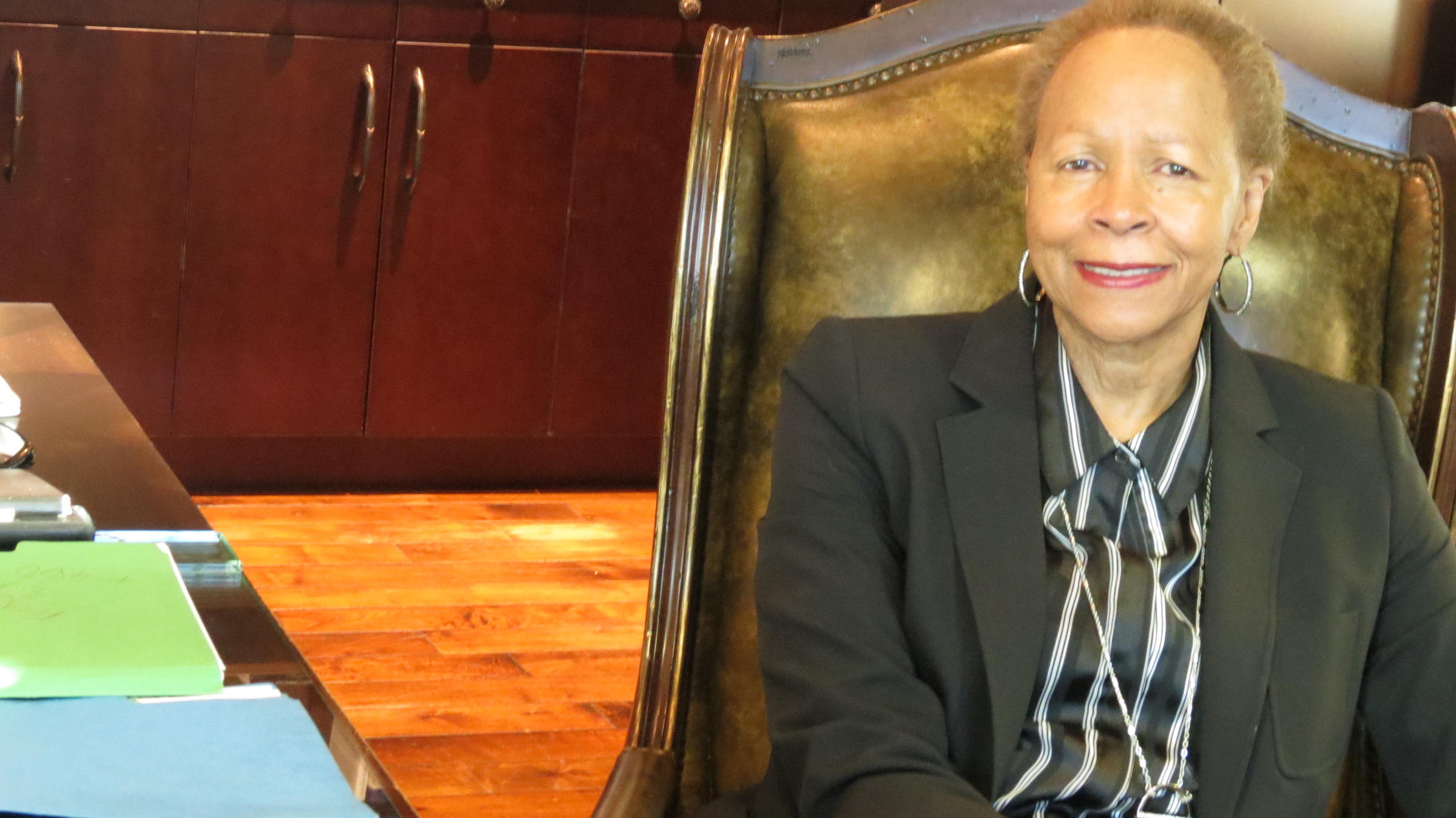
Bennett College has named Suzanne Walsh, an executive with the Bill & Melinda Gates Foundation as its next president. Just last Friday, college officials at the historically black, all-women’s school announced that Phyllis Worthy Dawkins would be departing as president immediately. No reason was given for her abrupt departure. Gwendolyn O’Neal, a Bennet alumna and college administrator was appointed interim president.
Suzanne Walsh has been named president of Bennett College. CREDIT BENNETT COLLEGE
Bennett officials say Walsh will begin work as the school’s president on August 1. O’Neal will continue as interim president until that time and then stay on as the college’s chief operating officer.
“Bennett College sought a new president to embrace and champion innovative ideas that ensure our long term viability,” said Gladys A. Robinson, chair of the Bennett College Board of Trustees. “Suzanne Walsh has the experience, passion, fundraising expertise and personal qualities that will ensure she is embraced by our students, faculty, staff, alumnae and community.”
Bennett officials say Walsh, who earned her bachelor’s degree in social work from Cornell University and a law degree from Case Western University, has significant experience working with organizations in transition and helping educational institutions find new ways to be innovative.
Bennett has struggled with convincing its accrediting agency, the Southern Association of Colleges and Schools, SACS, that it is financially viable long term. The school successfully raised nearly $10 million in February to convince SACS officials otherwise.
The school spent two years on SACS’ probation list because of financial concerns and in December its accreditation was not renewed. Bennett officials have filed a lawsuit and remains accredited as that legal process plays out.
Walsh says she looks forward to leading the school as officials work to revamp the college financially and academically.
“Bennett College has a compelling mission to produce accomplished young women who are ready to lead,” said Walsh. “In an ever-changing world that I believe is thirsting for their leadership, that mission feels more relevant than ever, and what excites me is the opportunity to help translate it for a new era. I look forward to working closely with our board, faculty, students, alumnae and supporters to find new and powerful ways of delivering on Bennett’s promise, which is the promise of a great education.”
Bennett is one of only two historically black colleges for women in the country. The other is Spellman College in Atlanta.
Morgan State University (MSU) President David Wilson has announced the appointment of Donna J. Howard, CFRE, as the university’s new vice president for Institutional Advancement and executive director for the Morgan State University Foundation, Inc. The announcement comes after a nearly yearlong national search, led by a selection committee in collaboration with an executive search firm. With the appointment, Howard will oversee operations for the University’s Division of Institutional Advancement, which includes the Offices of Alumni Relations, Development, and Public Relations and Strategic Communications, in addition to the MSU Foundation.
“I commend the selection committee for its diligent and exhaustive work to find just the right candidate to fill this vital position at the University,” said Dr. Wilson. “And as is sometimes the case when it comes to an undertaking of this kind, you may not have to look very far. Donna Howard made the most of her opportunity as the interim vice president, leaving an impression that was hard to ignore. She brings a wealth of fundraising knowledge and more than two decades of results-driven experience to this role. As we move forward in meeting the future financial goals for our University, I eagerly anticipate what we can accomplish together under her leadership.”
Howard was instrumental in enabling Morgan to complete its Anniversary Campaign, the largest such effort in the University’s 150-year history. The campaign, which attracted more than 13,000 donors, successfully raised $254 million in public and private funds. Also, during her seven-year tenure as director of Development at the university, Morgan saw its alumni participation-in-giving rate elevate to an impressive 17 percent, higher than at many private HBCUs and public regional institutions nationwide.
In her new capacity as Morgan’s vice president for Institutional Advancement, in addition to leading a combined staff of nearly 40 people, Howard will be responsible for overseeing the university’s fundraising, marketing and communications, which includes managing campaigns, special events, the annual fund, major and planned gifts, corporate and foundation relations, constituent relations, prospect management, gift processing and acknowledgement, strategic communications and publications. She will serve as a member of the university’s leadership team and will work closely with the president, the Board of Regents, the Foundation Board, other senior administrators, faculty and staff to achieve Morgan State University’s strategic goals.
“I’m inspired by Morgan’s history and mission and extremely excited to have been selected to lead the university’s fundraising and external communications priorities,” said Howard. “The university has a special place in my heart, primarily because of the wonderful alumni and friends I’ve had the privilege to meet along the way. I look forward to continuing to work with Morgan’s visionary leadership with a clear commitment to advancing philanthropy and growth.”
President Wilson appointed Howard as the interim vice president for Institutional Advancement in January 2019, after the retirement of Cheryl Y. Hitchcock, who resigned from Morgan after nearly 19 years of service. Before assuming the interim role, Howard served as the assistant vice president for Development under Hitchcock, raising support for scholarships and student success initiatives, teaching and learning programs and activities, and community outreach.
Before coming to Morgan in December 2011, Howard built her higher education experience at the New England Conservatory of Music, Cheyney University of Pennsylvania and the University of Maryland School of Social Work, where she served as the director of annual giving and alumni relations, director of annual giving and director of development, respectively. Outside of her work in higher education, she served in fundraising and public relations roles at the United Negro College Fund, the Massachusetts Audubon Society and the Metropolitan Area Planning Council in Boston. She is also a former member of the Maryland Board of Directors for the House of Ruth.
Howard received her B.A. in Non-profit Marketing, magna cum laude, from the University of Massachusetts at Amherst. Her appointment as Morgan’s vice president for Institutional Advancement is effective July 1, 2019, and she will report directly to the president.
The Division of Institutional Advancement is committed to informing, engaging, partnering with and securing financial support from a diverse spectrum of audiences through strategically aligned communications, engagement initiatives and philanthropic opportunities. It is charged with the task of building lifelong relationships that engage the time, loyalty and intellectual and financial resources of individuals and institutions in support of Morgan’s mission, goals and aspirations.
About Morgan Morgan State University, founded in 1867, is a Carnegie-classified doctoral research institution offering more than 125 academic programs leading to degrees from the baccalaureate to the doctorate. As Maryland’s Preeminent Public Urban Research University, Morgan serves a multiethnic and multiracial student body and seeks to ensure that the doors of higher education are opened as wide as possible to as many as possible. For more information about Morgan State University, visit www.morgan.edu.
It was just four years ago that I started my social media management business on a whim. I had no idea if it would work, but as a mother of a child with epilepsy, I needed to do something where I could work from home. I remember telling my friend, ‘If I could make $5K a month in revenue that would be amazing.’ I surpassed that number by the end of my first year in business and looked around for my next goal to achieve. For some, entrepreneurial success can be scary. It is at this point that you must figure out what your next move is.
For instance, now I am closing in on the second goal I set and in reviewing my accomplishments, I now must figure out how to take things to the next level. Part of that assessment is figuring out how to get out of my own way.
For many business owners, success comes as a surprise. You’ve put your head down, rolled your sleeves up, done the work to get there, and you get lost in the work. You’ve reached a goal, and then the next goal and the next and you find yourself standing on this plateau going “OK, now how do I take this further up the mountain?”
THE FIRST HURDLE IS YOU
Growing your business means adding more people; trusting more people with your dream and vision. To some extent, you must let go and open yourself up to others. Until now, all of it depended on you and your work ethic, something that you and you alone control.
Inviting people to help you grow is not always easy. The fear of failure can lie heavily upon you. It is this fear that either drives you or holds you back. The need to be perfect because now you have an audience keeps many entrepreneurs from being the true success they want to be.
You must believe in the journey you are on and be willing to bring people along for the ride. When you believe wholeheartedly in what you are doing, others will want to join in and help you achieve it. Success doesn’t happen on a straight and narrow path. It has hills and valleys and sometimes mountains to walk and climb over. Taking others with you on that path is part of attaining success.
Remember these key points when assessing your success and your future:
Failure is a learning opportunity
Trust in your vision for your company
Understand that no one is perfect
TRUST IN WHAT YOU ARE DOING
When I started my social media management company, my one goal—besides making money—was to create a service that my clients value. I genuinely believe in giving excellent service, and that customer service is what would make me successful. Today, as I look back on how things began, I realized that by providing a valuable service to my clients and being consistent and accessible I have built relationships that have allowed me to keep them as customers and as friends for all these years. Success doesn’t happen overnight, but with planning and hard work, it can be yours!
This post was written by Wendy Pace, a writer at Black Enterprise, where it was originally published. It is published here with permission.
Now that the Sixers have assembled their new starting five, general manager Elton Brand is turning his focus to the bench.
Brand and the Sixers have agreed to a one-year, veteran minimum contract with Kyle O’Quinn, from Norfolk State University a team source confirmed. Kyle Neubeck of Philly Voice first reported the deal.
The 6-foot-10, 250 pound O’Quinn has seven years of NBA experience and spent last season with the Pacers, averaging 3.5 points and 2.6 rebounds per game. He’s a sturdy, dependable option at backup center and a good team defender.
Backing up Joel Embiid was a major issue for the Sixers in 2018-19. The team largely addressed that Sunday with the signing of Al Horford, who will presumably play both as a power forward and at the five when Embiid sits. The 29-year-old Quinn presents another solid option.
With a deal in place with O’Quinn, you’d expect the Sixers to now prioritize perimeter players — capable outside shooters, in particular — as they continue to fill out their roster.
UnitedHealth Group is making a five-year, $8.25 million investment to help train data science and analytics experts at Clark Atlanta University, Morehouse College, Morehouse School of Medicine and Spelman College.
WHY IT MATTERS The money will help those colleges, part of the Atlanta University Center Consortium. The new AUCC Data Science Initiative will offer technical classes for students seeking to specialize in analytics for healthcare and beyond.
UnitedHealth notes that job openings for data experts in the U.S. will exceed more than 2.7 million by next year.
The hope is that the AUCC initiative will be able to emphasize the value of data science across academic disciplines, officials say, teaching more than 9,000 students new techniques for analytics and research, especially for healthcare and disparities that exist in minority communities.
In addition, the initiative will enable the development of new certificate programs focused on data science and analytics.
UnitedHealth Group says the investment is aimed at continuing to develop a 21st century health workforce that can develop “personalized, culturally competent care, particularly in underserved communities.”
THE LARGER TREND “The colleges in the Atlanta University Center, for decades, have been in the vanguard of educating African Americans who succeed in STEM fields,” said Mary Schmidt Campbell, president of Spelman College. “This gift by UnitedHealth Group is an investment in our commitment to continue that primacy in STEM by making the AUCC a center of excellence for the study of data science across a range of disciplines in medicine and the liberal arts.”
In our focus on workforce development this month, Healthcare IT News and Healthcare Finance are exploring the ways healthcare workforces are changing – and how they ought to be changing – in the era of accountable care, population health management, artificial intelligence, evolving technology and emerging data-driven care models.
ON THE RECORD “The Data Science Initiative has the potential to make the Atlanta University Center Consortium a national resource for experts in data analytics,” said Dr. Valerie Montgomery Rice, president and dean of the Morehouse School of Medicine. “This program will not only produce talented data scientists who will be leaders in their fields, but increasing the number of degree offerings with data science competencies at HBCUs will assist in diversifying a career field that is currently made up of less than 7% of under-represented minorities.”
“Technology in general, and data science in particular, are critical to better meeting the needs of our customers,” said David S. Wichmann, CEO of UnitedHealth Group. “We are grateful for the opportunity to support this initiative because it aligns with our desire to ensure our workforce for the future is diverse and possesses the skills needed to propel our company for continued success.”
Sports Illustrated shares, “Five years after setting the Little League World Series ablaze, Mo’ne Davis is college-bound to play softball and chase her TV-host dreams.
On an unseasonably cool afternoon in mid-June, Mo’ne Davis strode into the student center on the harborside campus of Hampton University in south-east Virginia, nearly 300 miles from her home in Philadelphia. It had been a little less than five years since those weeks in August 2014 when Davis’s well-developed right arm grabbed the sporting world’s attention.
Pitching for the Taney Dragons in the Little League World Series, 13-year-old Mo’ne, only the fourth American girl to ever play in the tournament, threw two shutouts, paving the Dragons’ way to the semifinals. Her precocious, composed demeanor and dazzling performance landed her on the cover of SPORTS ILLUSTRATED, on Jimmy Fallon’s couch, onstage at the ESPY Awards—all before she had started ninth grade.
Now, with all of high school complete and her first
day of college less than three months away, she headed for the second
floor of the student center, where a coach and two future teammates
awaited to present the new spikes and uniforms Davis will be wearing for
the next four years, at her new home, playing her new sport: softball.
The road that brought Davis to the Pirates’ incoming class was a winding one. Back in 2014 she said basketball was her best sport, and she wanted to play at UConn. But a junior-year ankle injury had back-burnered that plan. She played varsity baseball as a freshman at Springside Chestnut Hill Academy, the private school she attended in the Philly suburbs, but then gave it up for softball because she “was just wasting [her] time on the bench not doing anything.” read more
Every year, HBCU Students, HBCU Grads, and Friends travel from college to college enjoying whats called “Homecoming”. If you didn’t attend one you wouldn’t understand. For updates email info@hbcubuzz.com
Do you envy other entrepreneurs who attract media attention for their companies? Do you see other business successes and silently wonder why they’re doing so well when your product is even better? It could be that it’s not a matter of product/market fit, but more a matter of founder/market fit. Entrepreneurs who succeed tend to possess specific skills others fail to hone.
5 SKILLS SUCCESSFUL ENTREPRENEURS POSSESS
THEY ARE SOCIALLY SAVVY
Failing to be socially savvy can have a direct impact on the success of your company. Knowing how to schmooze at a conference or how to interact with well-known members of the tech Twitterati can significantly improve your business’s exposure. Many startup companies have enjoyed increased success simply because their founders were wise in the ways of social connections. It’s not necessarily the business with the better product that wins; it’s the company with the socially-savvy founder that is more likely to earn attention.
THEY ARE GOOD LISTENERS
Entrepreneurs who are good listeners not only become better leaders, they also tend to outshine competitors. The more you develop your listening skills, the better prepared you are to notice tidbits others miss. Stop yourself from trying to think of your response while others are speaking and instead focus on listening intently to what others are saying.
THEY ARE GOOD COMMUNICATORS
Just as good listening skills are essential, so too are excellent communication skills. From the way you speak to team members to how you explain your company in front of a crowd, each aspect of your communication efforts needs to be finely tuned. Customers (and angel investors) respond better to entrepreneurs with excellent verbal skills. Making an effort to improve your communication skills continually is an endeavor you will never regret.
THEY ARE SELF-CONFIDENT
An entrepreneur without confidence is destined for mediocre success at best. It would be best if you believe in yourself as a business builder and as a leader. If you can’t confidently explain your business vision to others around you, don’t expect customers to come beating down your door.
THEY ARE RISK-TAKERS
Entrepreneurs who are risk-takers tend to achieve greater success than those who are timid and meek. Even if you tend to be more of an introvert, you can still improve your risk-taking skills. Try different marketing techniques, approach high-profile venture capitalists, or speak to journalists at tech conferences; anything you can do to get out of your usual comfort zone is fair game when becoming more of a risk taker.
Working on these skills can increase your odds of long-term success as an entrepreneur. Not only will you build a better business, but you will also create a better you in the process.
This post was written by Jeff Shuford, a writer at Black Enterprise, where it was originally published. It is published here with permission.
Officials at four colleges announced the abrupt departure of their presidents last week — Marist, Muhlenberg, Auburn and, in North Carolina, Bennett College. Officials at the historically black college for women in Greensboro are not saying why Phyllis Worthy Dawkins is leaving or why the departure was effective on the day it was announced.
Dawkins served as Bennett’s president for three years and led the school’s successful fundraising campaign only four months ago that netted more than $9.5 million. The goal was to raise $5 million, needed to restore Bennett’s accreditation with the Southern Association of Colleges and Schools. Dawkins led that charge and spoke of the need to revamp the school. She appeared on numerous local and national news shows in her appeals for support, such as NPR’s 1A program.
“The success of HBCUs is dependent on the size of the endowment,” Dawkins said on 1A. “We need people to contribute to the endowment, and then we just have to continue to get out there and beat the walls and continue to raise funds.”
Phyllis Worthy Dawkins left as Bennett College’s president on the same day that her departure was announced.
School officials are not saying why Dawkins left, and why so abruptly. Usually outgoing college presidents remain in office for several months to pave the way for a smooth transition.
Last May, Central State University graduate Austin Oten released his new clothing brand, Wrath, which is a skate-punk clothing brand geared towards skaters of all color. The black university graduate is someone who has always been inspired by fashion. ”An idea came to me to start a clothing brand that would fuse skate and punk culture,” he told HBCU Buzz. He says that Wrath is also for those who enjoy quality fashion. ”I started this brand to be an inspiration to my son, and I have a passion for fashion,” he said.
HBCU Buzz recently got the opportunity to catch up with Oten discussing things like what’s his favorite moment so far in regards to being a relatively new and small black-owned business, real life heroes that he gains inspiration from, and his alma mater, Central State University.
Tommy: Your clothing brand is now in its first month of being open to the public, what’s your favorite moment so far in regards to this new venture?
Austin: ”My favorite moment since our launch has by far been bringing along my Wrath Ambassador team, meeting this great group of individuals over the past month has been awesome. These guys have inspired me to grind that much harder because those that put in the work with us will continue down greater paths with this company.”
Who are your inspirations?
Austin: ”One of my biggest inspirations to start my company was Jay-Z verse on ’What’s Free’ by Meek Mill. It made me want to be an owner. Nothing like having something to call your own.”
Tommy: Any comments on being a black-owned and startup business?
Austin: ”Yes, being a black owned business is a tough thing in today’s society because there’s a lot of negative stereotypes that come with being a black owner. I’m here to change that mold, I believe conducting yourself with a certain level of professionalism is the way.”
”We may not be a million dollar business yet but we will continue to display proper service as well as supply our customer base with quality clothing.”
Tommy: How has Central State University impacted your life for the better?
Austin: ”Man Central State was the best thing that happened in my young life. Taught me so many lessons inside and outside of the classroom. I learned how to carry myself no matter if I’m amongst friends or a room full of CEOs and that confidence is still here today.”
Tommy: Who is Wrath, or what is your target audience/customers?
”Wrath Brand is a skate-punk clothing brand geared towards skaters of all color and also those who enjoy quality fashion. I started this brand to be an inspiration to my son but also because I have a passion for fashion.”
In this June 17, 2019, photo, Democratic presidential candidate Sen. Kamala Harris, D-Calif., speaks at the Poor People’s Moral Action Congress presidential forum in Washington. Harris is stepping up her outreach to the black community as she campaigns for the Democratic presidential nomination. (AP Photo/Susan Walsh)
Democratic presidential candidate Kamala Harris is stepping up her campaign outreach to the Black community.
The California senator is seeking to mobilize students and graduates of historically Black colleges and universities — known as HBCUs — as well as the country’s nine Black fraternities and sororities.
The effort getting underway Wednesday includes adding a new section to her campaign website that will make it easier for people connected to these groups to organize and to advance her candidacy.
Supporters will be encouraged to host events that could feature Harris’ senior campaign members or surrogates.
HBCUs and Black Greek organizations are a natural constituency for Harris. She graduated from flagship HBCU Howard University and is a member of Alpha Kappa Alpha, America’s oldest sorority started by and for Black women.
Since getting into the 2020 race in February, Harris has visited more HBCUs than any other candidate.
The new outreach is a recognition that she needs to do more to organize this network of schools and Greek organizations.
“As we look to realize the promise of the first African American female president, we must be intentional about organizing these communities to ensure they feel part of this campaign and incentivized to take political action going forward,” Missayr Boker, Harris’ national political director, told The Associated Press.
Fifty Houston-area high school rising seniors are experiencing a life-changing, week-long program at Texas Southern University this week thanks, in part, to the generosity of an entrepreneurial benefactor and the sponsorship of two dedicated entities – the Thurgood Marshall College Fund (TMCF) and Strada Education Network.
TSU is hosting these 50 students as part of the TMCF Fleischer HBCU Scholars program – with the goal of serving first-generation, under-resourced prospective college students by providing a unique opportunity to experience college life, entrepreneurship and business throughout the week. Students reside on campus at TSU, attending classes, developing business plans, visiting local companies, talking with business professionals, interacting with college students, and hearing presentations from various professionals on campus.
TSU is one of three Historically Black Colleges and Universities (HBCUs) selected by TMCF to participate in the pilot version of the Fleischer Scholars program funded by Strada Education Network. When the original program started in Arizona, the Fleischer Scholars program was intended to provide deserving Arizona-area high school juniors with an opportunity to experience college life, entrepreneurship, and business during a week-long residential program.
Program participant Tarah Peart, a rising senior at William B. Travis High School in Fort Bend Independent School District, said she became aware of the program because of exposure at her school’s campus through posters and her counselor. Never having been on a college campus, Peart said she was interested in attending because of the cost-free week-long stay and campus experience. She says she is looking forward to the program’s fun activities and the competition. “It’s very interactive, that is what I like about it.”
To kick off the program at TSU, participants attended a session where entrepreneur Mort Fleischer, founder of the program, and Fleischer Scholars alumni Josh Elizetxe served as keynote speakers. Paquita Yarborough, Ed.D., program director for the Thurgood Marshall College Fund, and Patricia Roe, vice president of philanthropy at Strada Education Network, were also in attendance.
“I actually believe we will never achieve the American dream until we get those people who are less privileged economically into the mainstream of this country,” said Mort Fleischer, “I believe this environment allows people to succeed and I am an example of that.”
“This particular program has several facets to it that we feel will have a huge impact on the community and Texas Southern University,” said Yarborough, “We want them (students) to learn more about TSU, learn about business and entrepreneurship, have some exposure to college life, socialize and build their network.”
Pat Roe of Strada Education Network wants program participants to become familiar with career pathways and with employers so that when they enroll in college, they have actually been to a campus, with the opportunity to experience personnel at the campus, understand the layout and what is expected of them.
“Most important we want to establish pathways to careers that are also embedded with internship opportunities and exposure to employer partners,” said Roe. “We believe that if you are on a career track you should have experiences with networking, with employers, and with internships that will help you make a smoother transition into your career.”
ABOUT TEXAS SOUTHERN UNIVERSITY
Texas Southern University (TSU) honors our designation as a special-purpose institution for urban programming and research. TSU is a comprehensive university providing higher education access to the nation’s underserved communities. TSU’s academic and research programs address critical urban issues, and prepares its diverse student population to become a force for positive change in a global society. TSU offers more than 100 undergraduate and graduate programs and concentrations – bachelor’s, master’s, doctoral and professional degrees – organized into 10 colleges and schools on a 150-acre campus nestled in the heart of Houston’s historic Third Ward. The University’s enrollment has a population of more than 9,700 undergraduate and graduate-school academic candidates. Texas Southern has been a distinguished educational pioneer since 1927, and the University has become one of the most diverse and respected institutions in Texas. TSU has positioned itself as a proactive leader in educating underserved students and many who are the first in their family to attend college.
Reparations are emerging as a front-and-center debate and likely to be a hot topic during the 2020 election.
Black leaders including actor Danny Glover have been outspoken about the need for the U.S. government to pay African Americans reparations for the slave labor of their ancestors.
The conversation was ignited by a stirring essay Ta-Nehisi Coates wrote for The Atlantic, “The Case for Reparations,” in 2014.
On Wednesday, Coates made the case in person in front of Congress. You can [and should] read hiscomplete testimony, courtesy of The New York Times. Presented below are seven especially powerful statements Coates made during his testimony:
It’s impossible to imagine America without the inheritance of slavery.
…for a century after the Civil War, black people were subjected to a relentless campaign of terror, a campaign that extended well into the lifetime of Majority Leader McConnell.
We grant that Mr. McConnell was not alive for Appomattox. But he was alive for the electrocution of George Stinney. He was alive for the blinding of Isaac Woodard. He was alive to witness kleptocracy in his native Alabama and a regime premised on electoral theft.
…there is, of course, the shame of this land of the free boasting the largest prison population on the planet, of which the descendants of the enslaved make up the largest share.
The matter of reparations is one of making amends and direct redress…
… if Thomas Jefferson matters, so does Sally Hemings. That if D-Day matters, so does Black Wall Street. That if Valley Forge matters, so does Fort Pillow.
…the question really is not whether we’ll be tied to the somethings of our past, but whether we are courageous enough to be tied to the whole of them.
This post was written by Samara Lynn, a writer at Black Enterprise, where it was originally published. It is published here with permission.
Texas Southern University is now home to the region’s first Shared Autonomous Shuttle. A ribbon-cutting ceremony was held Wednesday morning on the campus of TSU to commemorate the launch between METRO and Texas Southern University in conjunction with project partners First Transit and the Houston-Galveston Area Council.
METRO introduced the University District Circulator in which a driverless EasyMile SAV shuttle travels on the Tiger Walk, a one-mile pedestrian walking loop, providing connections to multiple points and buildings on campus for students and faculty. The shuttle can carry up to 15 passengers and travels using a pre-programmed route, equipped with a sensor and intelligent vehicle system to detect obstacles and avoid collisions. This shuttle is the eighth SAV initiative for First Transit and the first such shuttle on a university campus in this region.
“I often talk about Texas Southern University being the ‘heart and soul’ of Houston,” said TSU President Austin A. Lane, “Well, today, that rings true more than ever. TSU is so proud to be METRO’s pilot institution for this groundbreaking and innovative service.”
In every aspect, the shuttle’s presence on the TSU campus connects to the university’s Top Five priorities: student success and completion, academic program quality and research, culture, partnerships, and finance.
“It sets TSU apart and it creates a feeling of pride, knowing that, once again, TSU is on the leading edge,” said Lane. “This has a positive impact on our campus culture.”
Dr. Carol Lewis, a Transportation Studies faculty member in the university’s College of Science, Engineering & Technology, played a major role in facilitating this emerging technology coming to TSU. Through this unique pilot program, TSU students, faculty/staff and community members have an opportunity to engage with this emerging technology. It provides an alternative option for mobility within the campus and generates hands-on research for students and faculty members interested in the Transportation Studies program.
Texas Southern University (TSU) honors our designation as a special-purpose institution for urban programming and research. TSU is a comprehensive university providing higher education access to the nation’s underserved communities. TSU’s academic and research programs address critical urban issues, and prepares its diverse student population to become a force for positive change in a global society. TSU offers more than 100 undergraduate and graduate programs and concentrations – bachelor’s, master’s, doctoral and professional degrees – organized into 10 colleges and schools on a 150-acre campus nestled in the heart of Houston’s historic Third Ward. The University’s enrollment has a population of more than 9,700 undergraduate and graduate-school academic candidates. Texas Southern has been a distinguished educational pioneer since 1927, and the University has become one of the most diverse and respected institutions in Texas. TSU has positioned itself as a proactive leader in educating underserved students and many who are the first in their family to attend college.
Apparently, no one was ready for Ava DuVernay’s recent series, When They See Us. Across social media, discourse about the movie ranges from whether or not people would tune in at all to how weighty and emotionally stirring it was to watch. Judge Greg Mathis posted a disturbingly tearful picture on Facebook expressing his angst about the film:
An extremely angry Twitter user tweeted their reaction upon watching:
And Kandiss Edwards, a Georgia educator, told BLACK ENTERPRISE that post-traumatic syndrome is why she wouldn’t watch the film immediately:
I knew the Kalief Browder story before I watched the documentary about his suicide. What I didn’t realize was how the story would cling to the marrow of my bones and stay with me. Kalief’s story gave me anxiety for weeks after watching. I’m determined to be more careful this time around with When They See Us. I will watch the movie, but first I have to make sure I am emotionally prepared.
BE‘s own Alfred Edmond penned an op-ed on why he may never watch stating, “I’ve reached a stage of my life where I do my best to avoid unnecessarily re-traumatizing experiences.”
The film gives a nuclear lens into the lives of Yusef Salaam, Antron McCray, Raymond Santana, Korey Wise, and Kevin Richardson, who are widely known as “The Central Park Five,” and the hell they experienced as young teens wrongfully accused and convicted of assaulting, raping, and sodomizing a white woman jogger, in New York City in 1989.
In an effort to bring justice to a victim who was brutalized and robbed of the memory necessary to identify her attackers, the New York State justice system and national mass media made victims of five black men, aged 14-16, in the most callous, coercive, and corrupt way. Sadly, each entity received their props. The news media got its ratings, the NYPD got its confession, the prosecutor, Linda Fairstein, got a conviction and went on to be a top-selling author of crime fiction, the justice system got its contribution to mass incarceration—all off the backs of black and brown boys. Yet, they had also gotten it ass backward. Mathias Reyes confessed to the crime 11 years later. Salaam, McCray, Santana, Wise, and Richardson were each cleared by DNA technology, exonerated and poorly compensated to the tune of $41.3 million by New York State.
DuVernay certainly does her part as she continues to highlight and produce content that brings nuance to injustices suffered by African Americans. Her work deserves our eyes, collective contemplation, and action. While it is understandable, the personal reasons, why many choose not to engage When They See Us, watching is important for the greater good. Support for DuVernay and other social justice warriors is the least we can do. As black people, we must be aware of the aggressive criminalization of black and brown people—which lends a hand to mass incarceration. We must know these stories and be familiar with the entities who benefit from our demise. In the weeks since the miniseries premiered, Fairstein has gotten her share of attention. The former prosecutor has been dropped by her publishing company and forced to resign from her post as a Vassar College trustee—and rightfully so. In another instance, black Columbia law students were successful at forcing another prosecutor’s hand. Manhattan Assistant District Attorney Elizabeth Lederer, who was associated with the Central Park 5 case, is no longer teaching at the law school at students request for her resignation.
New statement released from the @ColumbiaLaw Black Law Students Association
Students call for #CentralPark5 prosecutor Elizabeth Lederer to be fired from her Lecturer in Law position
Also call on the law school to center anti-racism in its curriculum and pedagogy pic.twitter.com/U8By81KWBB
— Barred and Boujee and Unburdened aka Madiba Dennie (@AudreLawdAMercy) June 11, 2019
And though these justified actions against Fairstein and Lederer are not exactly justice enough, they do serve as retribution of sorts. And trust, this ain’t karma at all. It is an example that shows that it is not OK to abuse leadership, nor railroad people, particularly when it involves their freedom. It is collective action in the fight against injustice and oppression. It’s how we as a people do our part.
This post was written by Ida Harris, a writer at Black Enterprise, where it was originally published. It is published here with permission.
HOUSTON (June 19, 2019) – Texas Southern University President Austin A. Lane has been selected as an Honorary Co-Chair for the National Black MBA Association Incorporated’s 41st Annual Conference & Exposition, “Transcend the Power of You – Empowered to Lead, Equipped to Succeed.” The event will be held in Houston, September 24-28, 2019, at the George R. Brown Convention Center.
“It’s an honor to be selected to serve as a co-chair for this extraordinary organization,” said President Lane, “I look forward to interacting with those who will attend the conference and gaining knowledge that will benefit the students and faculty of Texas Southern University.”
The 41st Annual NBMBAAConference and Exposition will focus on the power that each member possesses to control their professional destiny through focused planning and preparation. Conference tracks will be aligned to address leadership competencies needed to accomplish career goals and objectives.
Conceived in 1970, the National Black MBA Association is one of the largest non-profit organizations advocating minority business professionals year-round. Its mission is to lead in the creation of education, wealth building, and growth opportunities for those historically underrepresented throughout their careers as students, entrepreneurs, and professionals.
ABOUT TEXAS SOUTHERN UNIVERSITY
Texas Southern University (TSU) honors our designation as a special-purpose institution for urban programming and research. TSU is a comprehensive university providing higher education access to the nation’s underserved communities. TSU’s academic and research programs address critical urban issues, and prepares its diverse student population to become a force for positive change in a global society. TSU offers more than 100 undergraduate and graduate programs and concentrations – bachelor’s, master’s, doctoral and professional degrees – organized into 10 colleges and schools on a 150-acre campus nestled in the heart of Houston’s historic Third Ward. The University’s enrollment has a population of more than 9,700 undergraduate and graduate-school academic candidates. Texas Southern has been a distinguished educational pioneer since 1927, and the University has become one of the most diverse and respected institutions in Texas. TSU has positioned itself as a proactive leader in educating underserved students and many who are the first in their family to attend college.