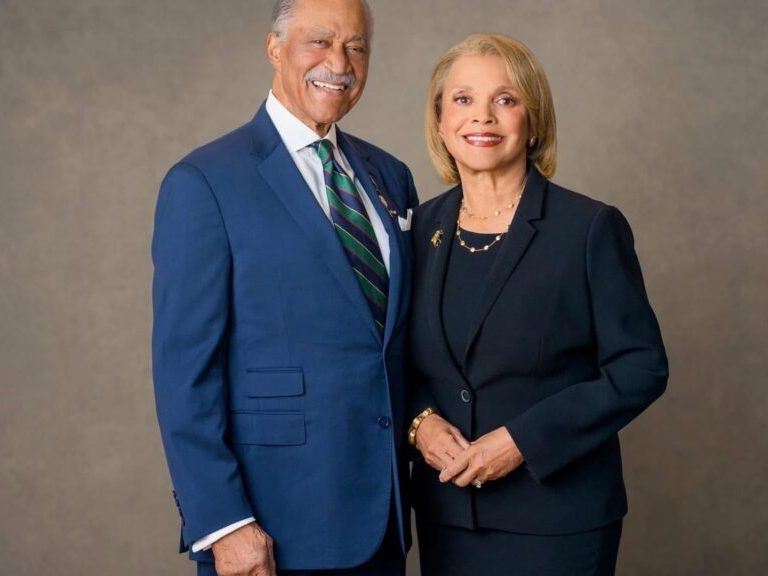
Tennessee State University’s successful end-of-year giving campaign raised over $600,000 to support graduating seniors. This accomplishment was largely made possible by the matching contribution pledge made by renowned alumni Amos Otis and Brenda Otis. They promised on Giving Tuesday that they would match every donation.
Under the #FutureReadyTSU campaign, #CloseTheGap aims to alleviate the financial challenges faced by students nearing graduation. The campaign will significantly impact this initiative thanks to the Otises and the overwhelming response from alums and supporters.
“As an alumnus myself, I am extremely proud of the fact that alumni giving has increased from previous years,” shared interim President Dwayne Tucker. “Tennessee State University is a great institution, and with continued alumni and community support, this university will continue to be a key part of the community and this city’s growth.”
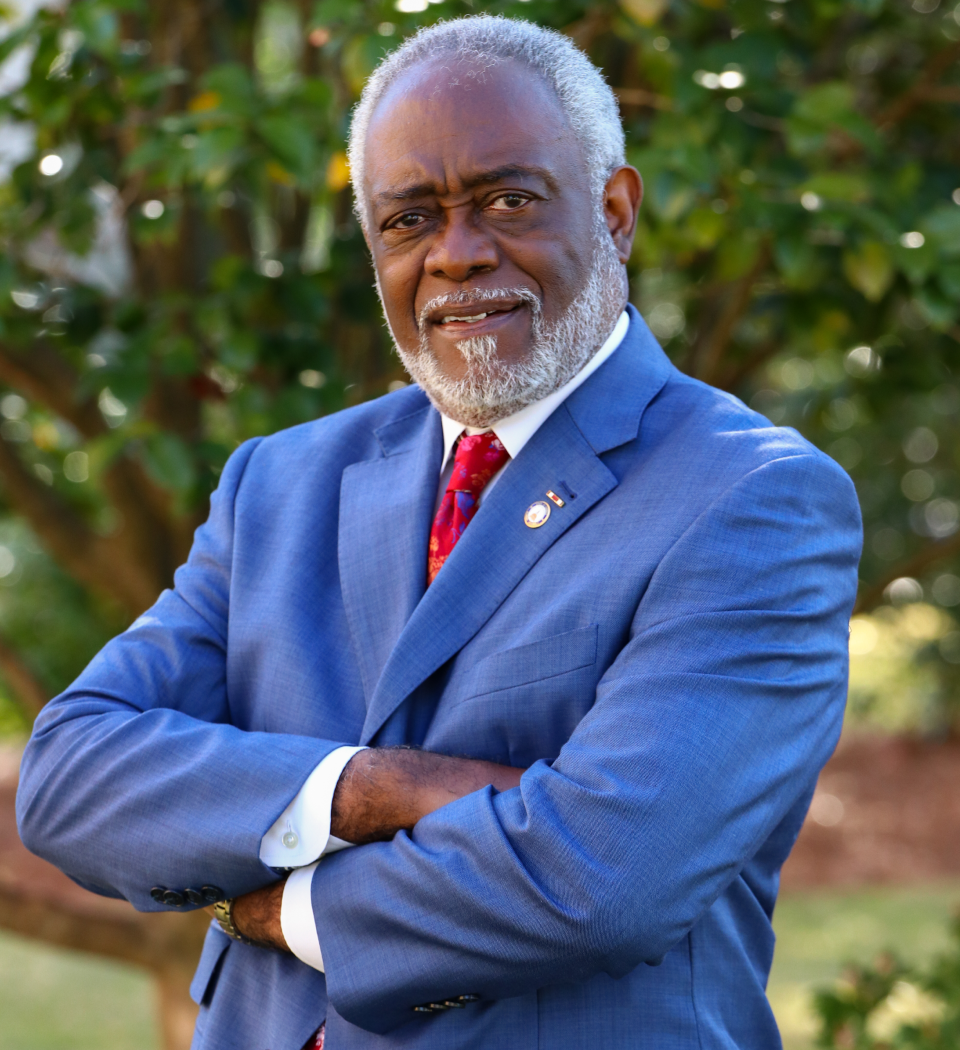
The Otis family has long supported TSU. Amos established SoBran, Inc. in 1987 and is the company’s president and CEO. The company specializes in global bioscience, logistics, and SafeMail® services for government and commercial clients. Amos is also the vice chairman of the TSU Foundation Board. His wife, Brenda, is a retired broadcast television production and management professional with experience at major networks like ABC, CBS, and NBC. She also played a key role in creating BET News.
“Each dollar raised was a testament to the power of the TSU community,” said Dr. LoLita Toney, vice president of Institutional Advancement. “Every gift, no matter the size, reflects a shared belief in our students and their ability to change the world.”
The campaign’s success proves the long-lasting impact of alum involvement in creating brighter futures for students.
Baltimore is ready to prove why it is the perfect host for sporting events. From Feb. 25 to March 1, the CFG Bank Arena will host the Central Intercollegiate Athletic Association Men’s and Women’s Basketball Tournament, bringing together the best HBCU matchups in an electric atmosphere.
The move from Charlotte to Baltimore isn’t just a geographical shift but a chance to recenter the focus on the game and community interaction itself. The city’s goal is to keep the light on the sports, people, and their performances. Baltimore wants the excitement of the competition to fuel supporters to cheer on their teams and give their full attention to the action on the court.
“CIAA and Baltimore go together like Old Bay and crabs—it just makes sense,” said Baltimore Mayor Brandon M. Scott. “For the fourth year in a row, we’re proud to host this historic tournament, bringing unmatched Black excellence, culture, and legacy right here to Charm City.”
Baltimore’s bustling charm includes a passionate fan base, a great sports legacy, and CFG Bank Arena’s state-of-the-art amenities, which guarantee fans can be engaged in the action rather than merely watching.
Beyond the Court
Photo Credit: James McQueen, Chief Photographer, City of Baltimore
Maryland has emerged as an epicenter of Black leadership and culture, boasting the Country’s only Black Governor, a Black Mayor, and is home to one of the Country’s two Black women Senators. The city is a collage of creativity, history, and cultural diversity, saturated with live music and colorful street art and museums like the Baltimore Museum of Art, the Reginald F. Lewis Museum, the largest African American museum in Maryland, and the Baltimore Times’ newly launched “Creatively Black Baltimore” pop-up exhibition. Tournament attendees can dive into these cultural hubs in between matchups to enhance the overall experience.
Baltimore‘s diverse attractions also range from historic neighborhoods like Fells Point to the memorable Inner Harbor, providing opportunities for exploration that both basketball fans and general tourists would enjoy getting lost in.
Come Hungry
So, what sets Baltimore apart from other cities? For starters, the city offers an incredibly diverse food scene, which is a direct reflection of its rich global roots. Visitors can sample this diverse food scene by enjoying some of Maryland’s famous crab cakes or indulging in Berger cookies.
Baltimore’s Black-owned Restaurant Tour, which features 20 restaurants from cozy cafés to upscale dining, adds another layer to the city’s vibrant dining scene and rich culture. This year-long initiative invites locals and tourists to sample diverse flavors while supporting the city’s black-owned businesses.
Same Place Next Year
Founded in 1912, the CIAA holds the honor of being the oldest historic Black athletic conference in the United States. With the agreement to stay in Baltimore until 2026, players and supporters can look forward to a distinct fusion of sport and Baltimore’s unique local culture as part of their tournament experience.
As Black History Month unfolds, the spotlight shines brightly on numerous historical figures who have shaped the narrative of the African American experience, from activists like Dr. Martin Luther King Jr. and Rosa Parks to cultural icons such as Maya Angelou and James Baldwin. However, reflecting on the past, it is equally important to recognize the current wave of leaders emerging from Historically Black Colleges and Universities. These alumni are breaking barriers and redefining what leading in today’s society means.
From entertainment to politics to technology to social justice, HBCU graduates exemplify the spirit of resilience and innovation that has long been associated with these institutions. They are taking on previously thought unattainable roles and proving that excellence for the Black community is an aspiration and a legacy. Today’s HBCU alums include CEOs, award-winning artists, political leaders, and entrepreneurs who continue to uplift their communities while paving pathways for future generations.
Among this trailblazing group are notable figures like Kamala Harris, the former United States Vice President and a proud graduate of Howard University. Harris’s historic ascension reflects the kind of transformative leadership that HBCUs cultivate. Meanwhile, other illustrious alums, such as Grammy-winning rapper Megan Thee Stallion from Texas Southern University and NBA player Chris Paul from Winston-Salem State University, showcase the vibrant culture and talent that these institutions nurture.
As the legacy of Black excellence continues, we want to highlight 36 remarkable alums currently making significant impacts in their respective fields.
36 Notable HBCU Alumni Making an Impact Today
Leadership
Kamala Harris (Howard University) – Vice President of the United States (Alpha Kappa Alpha Sorority, Inc.)
Tamara Bates (Philander-Smith University) – Director of Community Engagement for Tennessee Democratic Party (Delta Sigma Theta Sorority, Inc.)
Kamau Marshall (Texas Southern University) – Former Senior Advisor for Kamala Harris (Alpha Phi Alpha Fraternity, Inc.)
Andres Martin (Howard University) – Founder/Executive Director of HBCU Night
Entertainment
2 Chainz (Alabama State University & Virginia State University) – Rapper
Emondre Johnson, an animal science graduate of Alabama A&M University, has always had a deep affection for animals. While in high school, he gained crucial experience as an intern at veterinary clinics. On Feb. 22, The Bark Park opened in his hometown of Birmingham, Alabama, and that love blossomed into a successful business.
“I created The Bark Park because I’ve always known I wanted to work with animals, but not as a veterinarian,” says Johnson. “With my background in animal science, hands-on experience in veterinary clinics, and deep understanding of dog behavior, I knew I could build something special – not just a business, but a welcoming environment where pets and their owners can enjoy quality services and a sense of community.”
The Bark Park/Photo Credit: Alabama A&M University
The Bark Park promises to be more than just a place for dogs to play. Johnson carefully designed it to offer pet owners who want to unwind at the coffee bar while their furry companions play or get groomed.
“The Bark Park offers more than just pet services – it’s a lifestyle destination,” he explains. “Owners can relax at our coffee bar while their pets enjoy safe play, professional grooming, and even high-quality pet photography, creating lasting memories.”
The Bark Park will also function as an education hub for pet owners. Workshops in body language, stress management, dog behavior, basic obedience training, and nutrition aim to help pet owners better understand and care for their animals.
For Johnson, this entrepreneurial leap is not just about business. It reflects a lifetime of passion and dedication. “My family is excited and happy for me. They know I’ve been at this my whole life,” he says.
Tennessee State University kicked off its inaugural Black History Month tour this month. This project aims to recognize the significant cultural contributions made by African Americans to Nashville. The tour included stops at the Fisk University Galleries, the National Museum of African American Music, and the Jefferson Street Sound Museum.
TSU faculty, staff, and students traveled on TSU’s charter bus with expert guides who illustrated African Americans’ artistic, musical, and historical significance. Tonya Turner, senior assistant and training coordinator for TSU’s business and finance department, played a pivotal role in organizing the tour. Inspired by an orientation bus tour for new employees, she expanded the concept into a dedicated event for Black History Month.
The Inspiration Behind the Tour
“I overheard a few employees discussing the history of Jefferson Street,” Turner said. “At first, I wanted to focus solely on Jefferson Street, but then I thought, why not create a Black History Month tour instead?”
Olivia Whitmore, a Nashville native and junior majoring in family and consumer sciences, learned about the tour through an advisor. “It was enlightening to learn about our history in such a personal and engaging way. I appreciate TSU providing these opportunities during Black History Month; it really deepens our connection to our culture,” Whitmore shared.
TSU faculty, staff at The Fisk University Galleries during an inaugural Black History Month tour. (Photo courtesy Tennessee State University/ Aaron Grayson)
Kristian Butler, another student, shared her experience at The National Museum of African American Music. “My favorite experience was watching the ‘Roots Theatre’ documentary and seeing how African American music has transitioned and evolved throughout history and around the world,” said Butler, who is from Memphis,” Butler stated.
During the tour, attendees explored interactive exhibits emphasizing Black music’s evolution and its influence on various genres. The tour concluded at The Jefferson Street Sound Museum, where many participants gained a newfound appreciation for Nashville’s rich Black music scene.
Participants received gift bags filled with TSU memorabilia to commemorate the event, sealing a day built on gratitude, education, and empowerment.
This article sources information from Tennessee State University.
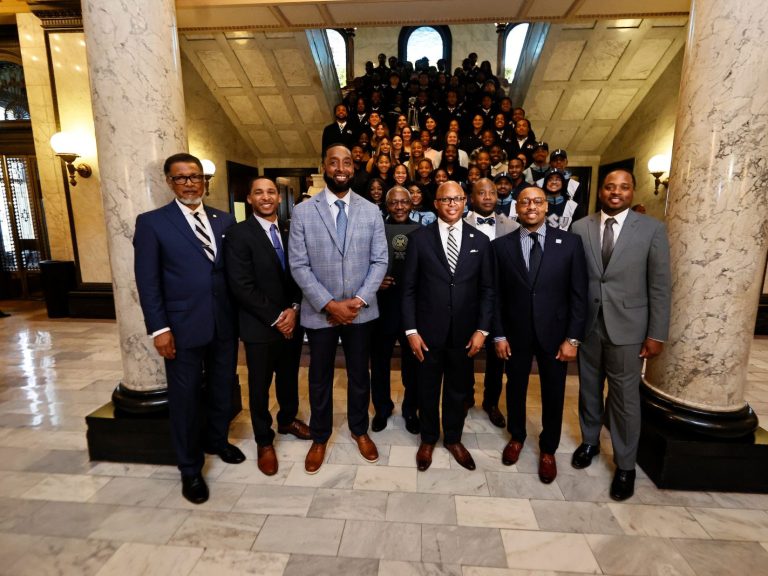
Jackson State University alumni and student-athletes gathered at the Mississippi State Capitol for the yearly JSU Day at the Capitol event. Lawmakers recognized the university’s recent achievements, including winning the national football championship and progress in other programs.
During the event, Senator Sollie. Norwood (D), a JSU alumnus, introduced JSU football, softball, and tennis team members from the Senate floor, honoring them for their academically and athletically impressive performances. The J5 drum majors and the Prancing J-Settes from JSU’s renowned Sonic Boom of the South marching band were also present.
Sen. Sollie Norwood introduces representatives of his alma mater to his fellow senators. (Aron Smith/University Communications)
“[[The year] 2024 was a valiant year for THEE I Love, from the classroom, with a conference-high grade point average, to record success in the respective arenas: the softball field, the tennis court, the Super Bowl, the Celebration Bowl, and the prestigious Rose Bowl,” Norwood said during his address.
A highlight of the day was when Senator Norwood presented a resolution to Coach T.C. Taylor, who led the football team to victory in its third bowl appearance in four years. “I really appreciate the invite down to the Capitol,” Taylor said. “Two years ago, I came down and spoke to you guys following the SWAC Championship, and here it is two years later, and I brought something extra: a national championship.”
Coach T.C. Taylor accepts Norwood’s resolution. (Aron Smith/University Communications)
JSU Day at the Capitol also serves as a platform for university leaders to advocate for essential campus needs. Marcus L. Thompson, Ph.D., president of JSU, used the event to list the university’s top needs. His list included upgrades to the Rose E. McCoy and T.B. Ellis buildings and the Heritage Dining Halls. He also underlined the need for more student housing and stricter safety regulations to handle the university’s growing enrollment.
The 2025 Mississippi legislative session will wrap up later this spring. JSU looks forward to ongoing assistance in furthering its goals and enhancing campus amenities.
This article sources information from Jackson State University.
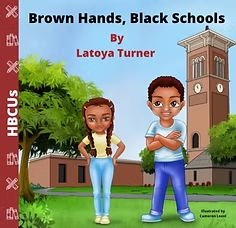
To educate and inspire, the new documentary “Brown Hands, Black Schools” aims to explain Historically Black Colleges and Universities’ cultural impact and historical significance to young children. The film is adapted from a published children’s book by Latoya Turner, a Central State University alumna.
Aria and Walter, the book’s two main characters, are followed as they visit a cousin at a Homecoming celebration. While there, the two experience the vibrancy of marching bands, step shows, and football games. Producer Angela Davis says it is important to introduce children to HBCUs early. “A lot of young people don’t find out about historically black colleges and universities. And so they’re well into their high school years,” she told WDTN.
The filmmakers blended live-action and animation to bring the story to life. “We also wanted kids to know that this isn’t imaginary; this is real,” Davis explained to WDTN.
Davis and her team delve into the triumphs of HBCU alumni who have made significant contributions in various fields—from inventors like Tuskegee University graduate Lonnie Johnson, creator of the Super Soaker, to influential figures in politics, science, and the arts. Along with celebrating the joys of HBCU culture, the film also confronts the struggles faced by these institutions throughout history.
The documentary team is collaborating with schools and libraries nationwide to offer free screenings and literacy workshops. The “Brown Hands, Black Schools” premiere screening will take place at the Dayton Metro Library on Saturday at 1 p.m.
“It’s up to us to make sure that our young people understand their greatness,” Davis said. “We have to be the village. And this book and our film is a part of that village helping our young people understand their greatness.”
In a move towards greater diversity and representation within the University System of Georgia, Rep. Floyd Griffin introduced House Bill 203. This bill seeks to ensure that at least one Historically Black College or University graduate holds an at-large position on the Board of Regents by January 1, 2028. By 2031, this figure would increase to a minimum of two HBCU graduates.
Rep. Floyd Griffin
“Under HB 203, we commit to accurately representing our state’s university system by guaranteeing that a position of the Board of Regents is held by a member of a HBCU,” said Griffin.
The bill mandates that the at-large members be graduates of one of Georgia’s ten HBCUs. These institutions include Albany State University, Clark Atlanta University, Fort Valley State University, Interdenominational Theological Center, Morehouse College, Morehouse School of Medicine, Morris Brown College, Paine College, Savannah State University, and Spelman College. Importantly, these institutions must meet federal eligibility requirements as of January 1, 2025, to qualify under this legislation.
Prioritizing Diversity
This legislative effort underscores a growing recognition of HBCUs’ vital role in fostering academic excellence and community leadership among Black students and other underrepresented groups. Griffin’s initiative aims to enhance representation on the Board of Regents and ensure that the decision-making process reflects the diverse perspectives of Georgia’s student population.
As this legislation moves through the legislative process, supporters see it as a critical step towards creating a university system that mirrors the demographics of its student body. By prioritizing HBCU graduates in leadership roles, Georgia would proactively promote diversity, equity, and inclusion within its educational framework.
As House Bill 203 progresses, all eyes will be on the Georgia legislature to see how this pivotal change unfolds and what it means for the future of education in the Peach State.
The loss of cherished coach and player Sean Wallace has left the Southern University football community in mourning. At 52, Wallace lost his fight with pancreatic cancer. He was a Hall of Fame player and a cornerstone of the Jaguars football program.
Wallace’s journey with cancer became public in 2023 when he openly discussed his fight against stage four pancreatic cancer. He was surrounded by love and support from his family, who proudly wore “#SeanStrong” shirts during the 2023 Bayou Classic, where he served as acting head coach.
The New Orleans native idolized the Bayou Classic and considered it a homecoming. As a standout player on the Jaguars’ legendary team during the early 1990s, he earned numerous accolades, including Bayou Classic MVP and SWAC Defensive Player of the Year. His career included playing in the NFL with the Arizona Cardinals before he turned his focus to coaching and ministry.
Wallace led the Jaguars to victory again in his final appearance at the Bayou Classic last November. It was a fitting tribute to a man who exemplified his team’s spirit.
Throughout his life, Wallace demonstrated unwavering dedication on and off the field. After a 25-year hiatus, he returned to Southern University to complete his degree. He was also a devoted husband for 28 years, a loving father, and a proud grandfather.
Wallace had always had a strong desire to coach young athletes. His goal as a safety coach was to instill in his players the same passion that motivated him as a player. In 2011, Wallace was inducted into the Southern Athletic Hall of Fame.
The Southern University football family honors Sean Wallace’s extraordinary life by remembering his accomplishments and significant influence on countless lives.
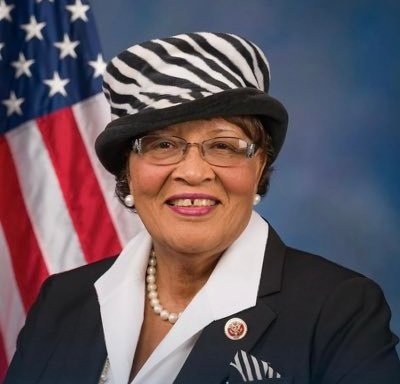
In a statement released Thursday, Congresswoman Alma S. Adams, PhD, reacted to the recent suspension of the USDA’s 1890 Scholars Program. She labeled the move an unjust attack on educational equity for underserved communities nationwide. The Trump-Vance Administration announced the abrupt decision without prior notice after a series of executive orders to dismantle diversity, equity, and inclusion initiatives within government programs.
“It is infuriating that the U.S. Department of Agriculture has suspended the 1890 Scholars Program ‘pending further review,” stated Congresswoman Adams, a senior House Committee on Agriculture member. “This is a clear attack on an invaluable program that makes higher education accessible for everybody, and provides opportunities for students to work at USDA, especially in the critical fields of food safety, agriculture, and natural resources that Americans rely on every single day.”
Supporting Students From Rural And Underserved Communities
The 1890 National Scholars Program, established in 1992 as a partnership between the USDA and the 1890 land-grant universities, aims to increase educational and career opportunities for students from rural or underserved backgrounds. The scholarship covers full tuition, fees, books, and room and board for students pursuing degrees in agriculture, food, natural resource sciences, and related disciplines. Additionally, it offers valuable work experience at the USDA.
“This program is a correction to a long history of racial discrimination within the land-grant system, not an example of it,” Adams emphasized. She insists that the USDA immediately reverse the suspension and reinstate the program. With the original application deadline for the scholarship set for March 1, 2025, the Congresswoman stressed the urgency of the situation for students counting on this opportunity.
In Fiscal Year 2024, the USDA awarded 94 scholarships through the 1890 program. The 19 participating institutions include historically Black colleges and universities such as Florida A&M University, Alabama A&M University, and North Carolina A&T State University, among others.
With uncertainty surrounding the program’s future, students and supporters are left awaiting a response from the USDA that could further entrench disparities in access to education or pave the way for renewed commitment to equity and inclusion.
In 2021, El Salvador became the first country to adopt Bitcoin as legal tender. Brought in by President Nayib Bukele, many believed the gamble was too big or was massively ahead of the curve. Last week, a reform was made to the law that saw Bitcoin acceptance curbed. This was so the struggling country could accept $1.4 billion in credit from the International Monetary Fund. However, by no means has the country given up on Bitcoin.
Will Bitcoin maintain its position?
Yesterday, El Salvador added 11 Bitcoins to its national reserve at a cost of around $1.1 million. This takes the country’s ownership to 6.067 BTC. It has also said that it will grow its reserve, despite not allowing tax payments in Bitcoin. Many believe El Salvador is seeing this as a hedge against inflation, which may be emanating from events elsewhere in the world. Generally, these overriding economic fears are coming from the US and are also having an impact on the volatility of Bitcoin. When inflation is high, people tend to invest in less risky assets and commodities. This results in the price of Bitcoin falling. When inflation lowers, people invest in riskier assets, raising the price.
Inflation worries tend to stem from tariffs imposed by the US on other countries. When these are put to rest, or when they are delayed as has been seen this week, the price has risen accordingly. The Bitcoin price today signals a positive shift upwards, though it remains volatile. Its current position around the $100,000 mark will be dependent in part on how other countries respond to these tariffs. If they supply a large number of necessary goods to the United States, this could ramp up inflation further. Even the Federal Reserve has stated that its goal of keeping inflation at 2% may need to be adjusted if the current policy continues. If inflation fears remain, then Bitcoin may remain trading sideways.
The long term can be viewed by looking at the bond market. People use the yield curve here, looking at the interest rates of bonds with different maturity periods. People tend to look at long-term bonds as indicative of what the Federal Reserve will do in the future. If they drop, then it could be a sign that less spending and a period of stagflation begin.
There are two other factors that may signal the direction Bitcoin will take. The first of these is that the currency’s recent run was in part down to the incoming government’s stance on a strategic bitcoin reserve. This was said to be a certainty. Yet while the government has signed orders on most of its promises, the Bitcoin reserve is notable by its absence. The government has said it will evaluate this, which means it will be looked at, and that may take some time. It decision will inevitably impact the price.
Another is that market liquidity is also tightening. The Treasury General Account has seen a rise over the last month, despite a self-imposed debt limit. The US is not running down its debts; they are, in fact, getting bigger. This means we may see higher borrowing rates. When this happens, people tend to turn to more traditional, less risky asset classes.
Pressures on Bitcoin production
Another strain El Salvador must be aware of is the pressure placed on those producing Bitcoin. MARA is one business that has faced difficulties producing Bitcoin. In January, they reported a 12% decline in production from the previous month. While they managed to maintain their hash rate, they did not deploy any new miners in the month.
The problems facing miners are plentiful. MARA itself cited the extreme weather conditions and intermittent outages as a problem. However, increased energy costs are hitting Bitcoin miners hard. Coupled with a reduction in the reward for producing Bitcoin as of last year, we are not entering a period where the gold rush of Bitcoin mining is over. Companies must be astute in their operations and work out if production is viable anymore.
This could be seen from two angles. If Bitcoin is not being produced, it becomes a much more scarce asset. Thus, prices will rise accordingly, and this would be a benefit to El Salvador, which would see its reserves rise in value. The second scenario is a half-glass empty one, wherein with no Bitcoin being produced, people lose interest in having it. This would lead to a collapse in value.
The economic and historical ties between El Salvador and the US may not seem apparent. However, the country accepts deported migrants and criminals from the US for a sum of money. US events also have a huge impact on Bitcoin, which El Salvador is linked to for better or worse. The future of Bitcoin could be that of El Salvador itself.
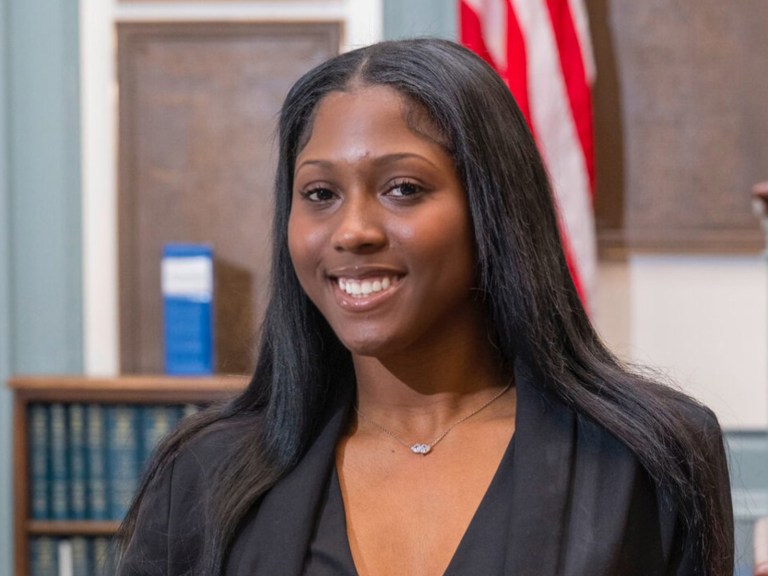
Dejanae Carter-Montaque, a political science major at Delaware State University, has been chosen to participate in the Delaware General Assembly’s prestigious Legislative Fellows program for the 2025 legislative session. Thanks to this opportunity, students like Carter-Montaque can interact with state legislators directly and participate in the legislative process.
The New York City native has always had a strong interest in public service, legislation, and public policy. The senior stated that she hoped to obtain a practical understanding of how laws affect the lives of common people. “I have always wanted to gain firsthand experience in the legislative process and understand how policies are crafted and implemented at the state level,” she said. This desire has influenced her academic journey at DSU.
Focus of the Fellowship
Carter-Montaque wants to concentrate on important topics including criminal justice policies, education reform, and healthcare access during her fellowship. “I would like to address important issues concerning access to healthcare, mental health treatment, and economic inequality. These are problems that plague so many people, and I know I could make a difference through this fellowship,” she stated.
Carter-Montaque will work with lawmakers and staff on a variety of projects at Legislative Hall in Dover three days a week during the fellowship. Taking notes during committee hearings, conducting legislative research, and supporting media and communications initiatives are some of her duties.
Carter-Montaque credits her time at DSU for her readiness to excel in this role. “The courses and professors here have given me a solid foundation in understanding state government,” she said.
Next for Carter-Montaque
After graduation, Carter-Montaque plans to take a year off to prepare for the LSAT and gain more legal or governmental experience. She made it clear that she intends to continue working in public policy, especially in a legislative capacity, prior to attending law school. “This fellowship is a big step in helping me achieve those goals,” she stated.
Dr. Larry Webster, Dean of Career and Technical Education at Coahoma Community College, has received the Phi Theta Kappa Distinguished College Administrator Award. The award recognizes his outstanding commitment to student success.
For two-year college students, PTK is the biggest international society. It offers professional development courses, community service opportunities, scholarships, leadership development programs, and recognition for academic accomplishment.
CCC students directly nominated Dr. Webster for the award. His honor highlights his important efforts to create a stimulating learning environment. Students have frequently commended his assistance with their academic endeavors.
“I am deeply honored to receive this award, ” said Dr. Webster. “Supporting our students and seeing them succeed is my greatest reward, and this recognition from our outstanding students means the world to me.”
Receiving His Flowers
The award will be presented at the PTK Annual Convention, held at the Kansas City Convention Center in Missouri from April 3 to 5, 2025. Dr. Webster has also been invited to the President’s Luncheon on April 4.
“These college administrators are beloved on campus—they know students by name and by circumstance,” Phi Theta Kappa president and CEO Dr. Lynn Tincher-Ladner previously said about the award. “This award is special because it comes directly from the students, and it is evidence of the gratitude they feel for the support for them and students like them.”
Following the luncheon, he will formally receive the Distinguished College Administrator Award during the Third General Session in the Grand Ballroom. This event, which brings together thousands of students, advisers, college presidents, and other distinguished guests, is sure to be a highlight. Steve Burns, a well-known children’s television personality best known for his work on Blue’s Clues, will be the special guest speaker.
The campus community is ecstatic about Dr. Webster’s achievements and offers sincere congratulations for this merited recognition. This honor is evidence of how important college administrators are in determining the course of students’ lives.
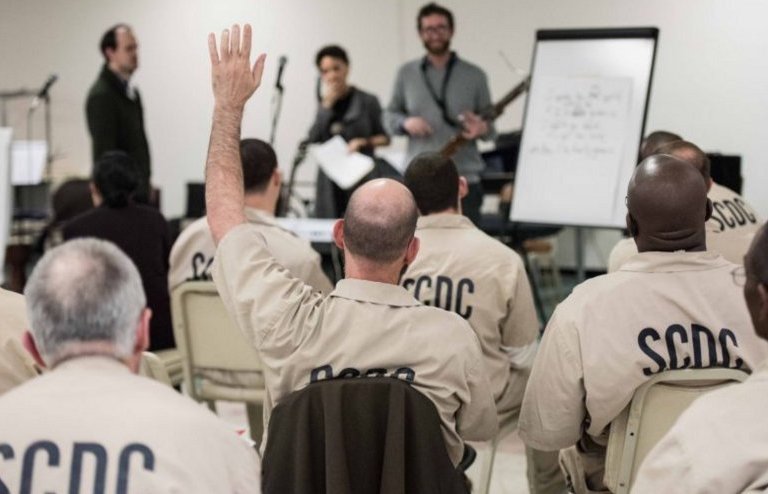
A coalition of South Carolina colleges is set to enhance its prison education programs thanks to a $1.3 million grant to support formerly incarcerated students.
The funding, provided by Ascendium, a Wisconsin-based philanthropic organization, will enable Healthy Routines, a nonprofit based in Columbia, to enhance its technical assistance. The South Carolina Coalition for Higher Education in Prison will also receive funding to hire four new academic reintegration coordinators. Institutions like Benedict College, Claflin University, and Voorhees University currently serve more than 200 jailed students throughout many state prisons and are part of this cooperative initiative.
The newly appointed coordinators will be essential in helping students during their incarceration and after they are released from prison. Among their duties will be assisting students in finding housing, developing their employability, and connecting with prospects for more study.
Second Chances
Preventing recidivism is the ultimate objective. According to a recent state Department of Corrections report, 17% of South Carolina offenders return to jail within three years, highlighting the urgency of these initiatives. The coalition’s programs give incarcerated students a crucial “second chance” following their convictions and the opportunity to earn associate’s or bachelor’s degrees.
“This partnership will enable our scholars to continue their academic journeys post-release and make meaningful contributions to our community and to our world,” said Roslyn Clark Artis, president of Benedict College.
The expansion of Denmark Technical College’s classes at Allendale Correctional Center from five students in 2021 to eighteen students, with many more interested, is one noteworthy success story. Students who earn associate degrees in business, technology, and science do so in full academic regalia.
“Our goal is to help our students find their highest and truest selves,” said Denmark Tech President Willie Todd.
This investment is a major step forward for the South Carolina Coalition for Higher Education in Prison, which strives to improve the lives of inmates permanently.
This article sources information from Benedict College.
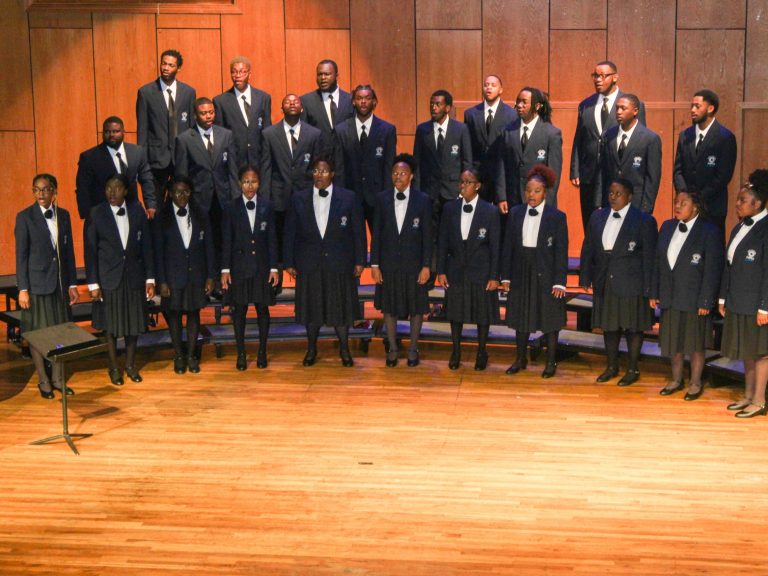
The A’Cappella Choir at Rust College is thrilled to have received an invitation to compete in the 36th Annual International Verona Competition. The competition is scheduled for March 26–30, 2025, in Verona, Italy.
“We are immensely proud of our A’Cappella Choir’s selection for this prestigious competition,” said Dr. Robert M. Dixon, president of Rust College. “It is a testament to the dedication of our students and faculty, and the rich musical tradition we have cultivated at Rust College.”
The choir is well known for its extensive and diverse repertory, which includes spirituals, anthems, and major compositions. Rust attributes their selection for the Verona Competition, a renowned international choral showcase, in large part to their versatility and unwavering quest for musical perfection.
The beginnings of the Rust College A’Cappella Choir can be traced to the early 1930s. It has left a legacy of outstanding music and cultural influence. They have gained international recognition thanks to their successful tours in Europe and South Africa, as well as their remarkable performance at Notre Dame in Paris, France. They were first guided by alumna Miss Natalie Doxey and are currently led by Dr. Karl Twyner.
“This opportunity to compete on an international stage is both an honor and a challenge that our students are eager to embrace,” added Dr. Twyner. “We look forward to sharing our music and representing Rust College and the United States in Verona.”
How You Can Help
This extraordinary opportunity promises choir members valuable exposure, insightful feedback from distinguished judges and unforgettable experiences. While they have the talent and passion, they need the community’s support to turn this dream into reality. Each student’s expenses for travel, lodging, meals, and competition activities amount to $3,544.00.
The Rust College community is pooling efforts to generate funds for this worthwhile cause. Donations are welcome to help these gifted students step onto the global stage. To donate and help lift their voice on a world stage, click here.
The University of Arkansas at Pine Bluff School of Agriculture, Fisheries, and Human Sciences uniquely celebrates Black History Month by hosting two on-campus screenings of the film series Hip Hop Farmers. Dr. Obadiah Njue, interim dean and director of SAFHS, announced that the events will underscore the vital role of the U.S. Department of Agriculture while fostering interest in agriculture among young audiences.
The first screening was held on Feb. 19 from 4 to 5 p.m. at the Henderson-Young Hall Auditorium, followed by a second screening on Wednesday, Feb. 26, from 4 to 5 p.m. at the Woodard Hall Auditorium. Both events are free and open to the public. After the screenings, attendees will be able to interact directly with the filmmakers and cast.
“The project is the brainchild of James Bunch, a UAPB agriculture alumnus who went on to have a 35-year career with the USDA Natural Resources Conservation Service,” Dr. Njue explained. “The videos work to popularize the field of agriculture among young Americans, especially among Black, Hispanic and other minority youth.”
About Hip Hop Farmers
James Bunch created “Hip Hop Farmers” to tap into a demographic that frequently engages with social media platforms like TikTok and Instagram. He envisions this approach as essential for modern agricultural outreach. “Think Green Acres meets hip-hop,” Bunch said, describing the series’ premise. It follows a young hip-hop mogul who relocates to Memphis, Tennessee, to manage an urban farm after the unexpected death of a close college friend alongside his fashion influencer fiancée. Together, they navigate the challenges posed by gentrification while promoting sustainable farming practices.
The narrative centers around three main characters who form friendships while at UAPB. Two pursue degrees in agriculture, while the third studies music.
“The series not only works to recruit youth to agriculture by presenting a compelling story, but it also demonstrates how families can use USDA resources to make their family farms profitable and sustainable,” he continued.
“Hip Hop Farmers” promises to be both entertaining and educational. It will encourage the next generation to explore opportunities within the agricultural sector while celebrating the rich legacy of Black farmers and agricultural innovators.