TheFirst-Ever HBCU Technology Conference Is Available On-Demand
Interested in an amazing learning opportunity? The HBCU Technology Conference 2021 that we first told you about back in September still has resources for students to take advantage of! All of the sessions and workshops are now available on-demand. And, you can still upload your resume to HP, all you have to do is register. There are great careers in technology, and they aren’t just for the technical-minded. An exciting part of technology is that it fits into any industry: entertainment, marketing, finance, and more! If you’re an HBCU student interested in how technology can advance your career goals, then look no further.
The HBCU Technology Conference is the first-ever technology conference crafted just for HBCUs. Presented by HP, the conference was supported by sponsors Hewlett Packard Enterprise, Intel, and Microsoft. There was an entire track dedicated just to students—The Future of Work Academy brought to you by HP and Microsoft. With a theme like “Tradition, Excellence, Transformation: Empowering HBCUs To Meet 21st Century Student Needs,” you can be assured there are gems from the conference no matter what your major is. Additionally, you’ll hear great information from HP and Microsoft plus Warner Music Group, Atlantic Records, and LinkedIn.
Watch on-demand sessions to:
Learn how the future of work is evolving with the acceleration of digital transformation.
Explore an automation learning journey that prepares you for future work.
Hear from HP and Microsoft leaders and learn from the success of others.
Learn first-hand about internship possibilities.
Discover what the Bot-A-Thon was all about—and consider participating next year.
Register today and get more information about the HBCU Technology Conference!
This time next week, you could be enjoying all your favorite artists, industry leaders, and REVOLT TV shows all in one place! November 11-13 we hope to see you at the 2021 REVOLT Summit x AT&T, where we’ll celebrate “Hip Hop In The Cultural Capital” with some of the biggest names in music and entertainment.
You won’t be able to find this much talent concentrated anywhere else in the country! When it comes to the artists, you’ll find the best of the best! Enjoy appearances by Lil Yachty, Anuel, City Girls, NLE Choppa, Joey Bada$$, Shenseea, Rhapsody, Rubi Rose, Slim Thug, Yung Bleu. In addition to the music, personalities like DJ Envy, Druski, Big Tigger, and Gia Peppers will keep you entertained. Plus, shows like Drink Champs (N.O.R.E & EFN) and Big Facts (Big Bank, DJ Scream, Baby Jade) will be there too.
Choose your experience with the option to purchase two types of tickets. With General Admission tickets, you’ll have access to all three days of the summit, access to all of the shows, experiences, and programming. Plus, get the unprecedented opportunity to receive a mentor session with an industry titan through an AT&T Office Hours appointment.
While all that sounds great, VIP Admission, which has since sold out, would really make it all worth your while! As a VIP ticket-holder, you’d receive every perk of General Admission and then some. Enter the venue with ease thanks to VIP parking, bypass the line with Fast Pass entry, and reserved seating both at the Main and Dream In Black stages. Finally, enjoy the flavors of onsite food vendors with a $20 food voucher. All you’ll need for either of these ticket experiences is just to be 18 years old or older.
Get the full list of attendees, buy a ticket, and learn more by clicking here. The first 20 people to use the code “FREEGAME” will receive 50% off their ticket, so spread the word!
A new program at Florida A&M University will diversify the beauty industry thanks to a partnership with The Estée Lauder Companies (ELC). Get the full story from Andrew Skerritt at FAMU Forward below.
(Left to Right) Tiffani Davis, executive director, Financial Planning & Analysis, ELC; Israel Assa, president, Commercial, Travel Retail Worldwide, ELC; and Alessia Wheeler, executive director, Innovative Hub, Travel Retail Worldwide, ELC. (Credit: AJ Shorter)
Florida A&M University (FAMU) and The Estée Lauder Companies (ELC) Monday announced a partnership to create a new talent and development program to build the next generation of Black beauty leaders in Travel Retail.
In line to create a more diverse workforce, ELC’s Travel Retail division has established an exclusive internship and scholarship program with FAMU furthering the company’s goal to double full time and intern recruits from Historically Black Colleges and Universities (HBCUs).
Through this exclusive 10-week summer internship program, rising FAMU juniors and seniors will have an inside look into the fast-paced world of Travel Retail at ELC. One of the company’s fastest growing channels, Travel Retail, covers the world of duty-free environments, including airports, downtown locations, airlines, cruises and border shops, touching over three billion passengers annually.
With placements in the company’s New York and Miami offices, students will be exposed to the dynamic, international channel and have a chance to learn how to build brand equity and market share by catering to the diverse, traveling consumer. In addition, ELC will award 41 $10,000 merit scholarships to FAMU School of Business and Industry (SBI) students over five years.
“What distinguishes FAMU from other universities is its legacy of providing access to high-quality, affordable education to many students who otherwise may never have the opportunity to fulfill their dreams of getting a college degree,” said FAMU President Larry Robinson, Ph.D. “We are thrilled to build on this legacy of development in partnership with The Estée Lauder Companies to open new doors for our student population and demonstrate for them how their voices and unique perspectives can create a positive impact to build a better beauty industry.”
To celebrate the new partnership, executives from ELC attended FAMU’s Homecoming, hosting a series of informal meet and greets, along with a formal presentation to students to share with them the vision and values of ELC and introduce the Travel Retail team.
“As a graduate of two HBCUs, I know the power these communities have in raising each other up, celebrating our unique perspectives and building confidence to seize opportunities,” said Nicole Monson, senior vice president, Equity and Engagement, The Estée Lauder Companies. “Our goal at ELC is to create a similarly inclusive culture and to be both the employer of choice for diverse talent and the brand of choice for our global consumers. By welcoming FAMU into the ELC Family, we are taking another critical step towards racial equity, and I look forward to developing what I am confident will be a meaningful, long-term relationship with the University, its students and alumni.”
Added Olivier Bottrie, global president, Travel Retail and Retail Development, The Estée Lauder Companies: “As one of the company’s fastest growing channels, Travel Retail opens up a world of possibilities for young talent, introducing them to not only our broad portfolio of brands, but an inherently diverse, international consumer base. We are thrilled to partner with FAMU and its The Estée Lauder Companies’ (ELC) collective vision is to be the most inclusive and diverse beauty company in the world, and today the company is proud to announce a new talent and development program in partnership with FAMU to build the next generation of Black beauty leaders in Travel Retail.”
He’s now mayor-elect of Pittsburgh and will take the oath of office on Monday, January 3. But who is Pennsylvania Rep. Ed Gainey, a 51-year old from Lincoln-Lemington and the first Black elected mayor of a city that is still overwhelmingly white?
Gainey grew up in East Liberty and attended Peabody High School before attending Morgan State University where he got his degree in business management.
He served in various government agencies before winning a seat in the state House of Representatives in 2012, and then he surprised everyone by defeating incumbent Mayor Bill Peduto in the May 2021 Democratic Primary.
With 25,784 votes for Gainey, he narrowly beat Peduto with 22,029 votes before going on to crush his Democrat-turned-Republican opponent Tony Moreno with 70 percent of the vote on November 2 with 48,430 votes to 19,552, unofficially.
Gainey credits a broad-based coalition that gave him the victory over Peduto.
“We brought together a lot of different coalitions. You heard me talk about when I first ran. We wanted to unite Pittsburgh. We want to bring this city together so we intentionally reached out to everybody,” Gainey told KDKA political editor Jon Delano shortly after winning the Democratic nomination.
“And we saw that coming together. Even on election night, it was amazing just seeing the diversity of people that were at the election night party.”
Those same comments were made following the November victory.
Gainey credits a number of organizations, including some labor unions like the SEIU and liberal grassroots groups like Unite and One Pittsburgh. And he singled out younger voters whom he says came out to vote in larger numbers than usual.
He said the message is one of change for the city of Pittsburgh.
“Look at the unity in the different groups, different ideologies, coming together in the name of justice, in the name of wanting to see a better Pittsburgh. That shows you that change is here,” Gainey said.
In an earlier interview with KDKA’s Jon Delano, Gainey outlined some of the changes to expect, including in police-community relations.
Delano: “How is the police force going to change under Mayor Ed Gainey?”
Gainey: “There’s going to be a couple of changes. One, we will not tolerate any officers that make racist comments. We’re not going to do it. You can’t grow a city on racism.
“Two, we will definitely be having police officers walk the beat. There’s no question about that.
“Thirdly, we’re not going to over-police communities. We have seen the trauma that has been brought to Black and brown communities. We will change that. And we believe that social workers need to go out on calls, and we’re serious about that and will develop that.”
Gainey said the key to reducing the crime rate in these communities is a more respectful police force.
“We have to rebuild the trust that has eroded between police and community. We have to. If not, we can’t get better. So at the end of the day, that’s what I’m focused on. It’s how we build better relationships, and I’m willing to do that,” Gainey said.
Some of the other changes Gainey is promising could impact UPMC and other large nonprofits.
Delano: “Will you be suing UPMC and other nonprofits to pay their fair share?”
Gainey: “We want them to pay their fair share. We will take the action that is necessary. If that means going to court, then we have to go to court.”
Throughout his campaign, Gainey said that UPMC and others cannot avoid paying taxes simply by calling themselves nonprofits. And given his agenda, he says the city will need the money.
“We want the tax revenue,” Gainey said. “The city needs the tax revenue. There’s no question about that. There are disparities in this city when it comes to the Black and white community that need to be addressed.”
Gainey and many who supported him accuse Mayor Peduto of being pro-development and allowing the displacement of low-income residents.
Delano: “Do developers, those who want to construct new office buildings or housing in the city of Pittsburgh, do they have anything to worry about from a Gainey administration?”
Gainey: “I’ve said it before and I’ll say it again, we’re going to make this city affordable. We’re going to make sure we’re investing in affordable housing. We want to pass inclusionary zoning.”
Inclusionary zoning means requiring all developers to set aside some housing for low-income residents. Gainey says that’s key to growing the city of Pittsburgh.
Another big difference from Peduto, says Gainey: he won’t travel the nation or the world.
“Eighty percent of my time is going to be in the city of Pittsburgh. Now, if there some conferences I have to go to or if we’re recruiting business here, of course, I want to be an ambassador for that,” Gainey said.
“But I have to make sure that Pittsburgh is moving properly and that requires me to be present.”
Emmy-nominated actress Keshia Knight Pulliam and media personality Terrence J will be teaching classes at HBCUs, the Chicago Defender reports.
As part of Now and Later’s “Recognize The Chew” series, both stars will return to historically Black institutions to teach courses. A graduate of Spelman College, Pulliam heads back to Atlanta, Georgia to teach a class on entrepreneurship at Clark Atlanta University.
“I look forward to partnering with Now and Later on this program and sharing my personal and professional experience with the #RecognizeTheChew Class in Session students,” Pulliam said about her new journey. “This next generation of HBCU leaders are resilient, and I am honored to provide any helpful nuggets to help fuel their entrepreneurial passions.”
Terrence J, a graduate of North Carolina A&T University, will teach a class on the entertainment industry at the Cathy Hughes School of Communications at Howard University in Washington, D.C.
“As an HBCU alum, I am thrilled to partner with Now and Later on its #RecognizeTheChew Class in Session Series,” he said.“HBCUs are major pillars in the Black community that reflect the very essence of Black excellence, and when married with a nostalgic brand like Now and Later the possibilities can’t get any better.”
Alnese Thomas, Brand Manager of Laffy Taffy & Now and Later, shared her excitement about the partnership.
“Now and Later is a brand built on the values of hard work, resilience, transformation, and authenticity. HBCU faculty, students, and alumni embody these values daily,” she said.“It’s a pleasure to support the incredible impact these institutions play in fostering some of the nation’s most influential leaders,” she added.
In addition to Terrence J and Keshia Knight Pulliam being visiting scholars, Now and Later will also donate $10,000 to each school to establish a scholarship fund.
Lincoln University in Missouri is looking to make several updates for its academics both in classrooms and virtual learning. Get the full story from Ryan Pivoney at News Tribune.
Lincoln University’s new academic initiatives and classroom technology upgrades are still in development, but the university may be moving forward with a change to the campus residency policy.
In preparation for the final Board of Curators meeting of the calendar year, the Lincoln University Board of Curators Academic and Student Affairs Committee met Tuesday to discuss academic affairs with Jennifer Benne, interim vice president for academic affairs and provost, and Zakiya Brown, dean of student success.
Benne said LU has some new academic programming in the works, but it remains at the department level as faculty and staff are working out details.
The School of Business, for example, is looking at a market analysis report produced by Hanover Research, an outside research and analytics firm the university hired in 2020 to conduct multiple studies, including a regional and state market analysis of business programs offering certificates and bachelor’s degrees.
The School of Business is considering where to expand its offerings and will use the report to focus those efforts, Benne said.
After a department approves its plan for academic programming, it goes to the LU Faculty Senate to approve new courses and degree options.
The committee will get an update from the School of Business at its next meeting.
Classroom technology was another topic of discussion for the committee Tuesday.
Lincoln has convened a faculty committee to assess current classroom technology and sent a small group of faculty and staff to Columbia College to tour its classroom technology.
“Much like us, they have many small classrooms and a few larger classrooms, so we were able to look at some of the different ways that they’ve organized the technology in their classrooms to accommodate HyFlex learning, where you can have simultaneous in-class and remote instruction,” Benne said.
She said Lincoln is still planning how to equip classrooms with similar technology.
Curator Stacia Bradley Brown, who chairs the committee, suggested the technology upgrades could help attract more students looking for remote options.
“We think there’s a variety of different ways that it can be used to help us gain students,” Benne said.
On the student affairs side, the committee approved a recommendation to update the University Rules and Regulations as it relates to campus housing.
Lincoln’s policy requires students living on campus to be full-time students taking at least 12 credit hours.
Zakiya Brown has suggested the university lift that requirement to allow graduating seniors to live on campus, even if not taking the full-time course load of 12 credit hours.
The move would also require the university to create a Residence Life Review Committee to review any appeals students would make to housing requirements.
Lincoln’s residence halls are around half full this year.
“Dean Brown recommends it, President (John) Moseley recommends it, so I’ll agree with them,” Curator Terry Rackers said.
The suggestion now goes to the full Board of Curators for approval at its next meeting Nov. 11.
The Academic and Student Affairs Committee is also looking to the future.
As Lincoln conducts its search for a permanent president and provost, Stacia Brown asked that all academic and supporting campus departments create a status update to provide the president once selected.
The reports would provide quick information about each area of campus, such as strengths, weaknesses, goals and targets, wish lists and budgets, and would need to be completed prior to Feb. 10, when the new president is nominated.
In order to honor the mental health needs of Hampton University students and its community, the university will give them a day off! Learn more about the “Wellness Day” in the release below.
Credit: Hampton University
One of the chief responsibilities of Hampton University is to ensure the health and safety of our students and other members of the Hampton community. The manner and methods that the Hampton team has utilized in approaching and dealing with the challenges presented by the COVID-19 pandemic have been successful and are nothing short of amazing. Despite the many adjustments that have been made because of the pandemic, this academic year has gotten off to a great start, and we are glad to have students and faculty back on campus. In light of the ongoing Coronavirus pandemic, Hampton University is giving students a Wellness Day on Friday Nov. 5, 2021 to focus on self-care.
“The health, safety, and well-being of the Hampton University community remains our top priorities. Just as I did last year, I am authorizing a Wellness Day for students on Friday, November 5, 2021,” said Dr. William R. Harvey, Hampton University President. “Classes will not be held on this date. It is my hope that this gives students and faculty an opportunity to take some time for self-care. It is my hope that you will use this time to reflect on the first half of the semester and mentally prepare for the remainder of the semester.”
This is the latest example of Hampton University assisting its student body in response to the COVID-19 pandemic. In August of 2021, Dr. Harvey announced the University would provide assistance to its returning students by utilizing funds received from the Federal Relief Act and pay the outstanding balances owed by continuing undergraduate students who were enrolled at the end of the Spring 2021.In May, Hampton University announced it is are providing each graduate in the Class of 2020 and the Class of 2021, who has a federal student loan, the sum of $500 toward repayment of that loan. These payments were sent directly to the U.S. Department of Education loan servicer that was the holder of the student loan. Those students who did not have student loans were reimbursed their graduation fee of $150. In April of 2020, Dr. and Mrs. Harvey made a $100,000 matching donation of their own money to a $100,000 gift from the Andrew W. Mellon Foundation to provide each on-campus student $100 to assist with travel costs to retrieve their belongings from campus or to return to school this past fall.
Dr. Charles Spurgeon Johnson, a student of Virginia Union University, and Fisk University‘s first black president, will be honored this weekend! Get the full story on an upcoming state historical marker in Virginia from news station WCYB.
Two state historical markers issued by the Virginia Department of Historic Resources will be dedicated in Bristol – one marker will highlight Dr. Charles Spurgeon Johnson and the other will highlight Lee Street Baptist Church.
Dr. Charles Spurgeon Johnson was a Bristol-native and a scholar of race relations and major contributor to the Black cultural movement known as the Harlem Renaissance. Lee Street Baptist Church was established by recently emancipated African Americans in 1865.
The markers’ sponsor, the Bristol Historical Association (BHA), will dedicate the signs during a public ceremony beginning on Saturday at 2 p.m. at Cumberland Square Park, where the signs are installed on the park’s east side, facing Lee Street.
Event speakers will include Bristol Virginia Mayor Anthony Farnum and Bristol Tennessee Mayor Mahlon Luttrell; Jeh Johnson, former Secretary of Homeland Security and a grandson of Dr. C. S. Johnson; Sid Oakley and Tina McDaniel of the BHA; Dr. W. A. Johnson, pastor at Lee Street Baptist Church; Dr. Kris Aaron of First Baptist Church; and Dr. Colita Fairfax, a member of the Virginia Board of Historic Resources, which is authorized to designate new historical markers.
Inside Lee Street Baptist Church (Credit: WCYB Photo)
Dr. Johnson attended Virginia Union University and the University of Chicago and served in the military during World War I. He gained his academic reputation as “the primary author of a seminal analysis of the Chicago race riots of 1919,” according to the historical marker. He later served as the first director of research at the National Urban League (NUL). As editor of the NUL’s academic publication Opportunity: A Journal of Negro Life, he “was a driving force behind the Harlem Renaissance,” the marker states. In 1947, Dr. Johnson became Fisk University’s first Black president.
Lee Street Baptist Church has its beginnings when 42 formerly enslaved members of the white-led Goodson (now First) Baptist Church organized the Anglo African Baptist Church in 1865. Under the leadership of Rev. Charles Henry Johnson, the father of Charles Spurgeon Johnson, the congregation built a church in 1905. Later renamed Lee Street Baptist Church, that building stood for six decades before it was razed. In 1966, the congregation moved into a new building located at 1 West Mary Street.
Both markers were approved earlier this year by the Virginia Board of Historic Resources. The markers’ manufacturing costs were covered by the BHA.
Here is the text for the markers:
Dr. Charles Spurgeon Johnson (1893-1956)
Charles S. Johnson, sociologist, author, and civil rights leader, was born in Bristol, son of a 42-year pastor of Lee Street Baptist Church. He attended Virginia Union University and the University of Chicago and served in combat during World War I. A scholar of race relations, he was the primary author of a seminal analysis of the Chicago race riots of 1919. He became the first director of research at the National Urban League and was a driving force behind the Harlem Renaissance as editor of Opportunity magazine. At Fisk University, Johnson led the social sciences department, published widely, and established annual Race Relations Institutes. In 1947 he became Fisk’s first Black president.
Lee Street Baptist Church
In 1865, at the dawn of their freedom from slavery, 42 former members of the white-led Goodson (now First) Baptist Church organized the Anglo African Baptist Church. The congregation met in a series of buildings until, under the leadership of the Rev. Charles Henry Johnson, they built a new edifice just across the street from here in 1905. The Rev. Johnson served the church, later renamed Lee Street Baptist, until he died during his 42nd year as pastor in 1932. After six decades here, the original brick-veneer church, weakened by the periodic flooding of adjacent Beaver Creek, was razed. In 1966, the congregation moved into a new building at 1 West Mary Street.
Harris-Stowe State University has partnered with Nine PBS to support early literacy at its Community Impact Network Education Center (Impact Education Center).
The Center recently opened Nine PBS Early Learning Nook to encourage early literacy for pre-K through third grade to experience learning through play. Nine PBS donated PBS KIDS Playtime pads, reading area furniture, and toys that encourage imagination and collaboration for the nook.
Harris-Stowe State University Impact Education Center Executive Director, Dr. Aline Phillips said, “We have designated an area on our lower level for this resource. We plan to use this space to encourage families and early childhood centers to bring young learners for storytelling, academic engagement, and literacy opportunities.”
The partnership is a part of a larger community initiative by the Nine PBS Raymond Wittcoff Community Engagement Fellowship. They were given the task of going into the community, creating partnerships, and connecting them to Nine PBS’s free educational resources.
“This partnership is more than just a shared space,” said Gina Watkins, a Wittcoff Community Engagement Fellow. “It is the hope that with this partnership between Harris-Stowe State University Community Impact Network Education Center and Nine PBS together, we can make a difference in the lives of the families of this community and do our part in changing the narrative.”
Watkins’ goal in initiating the partnership with Harris-Stowe is to promote early literacy and expose young children to the concept of advanced education at an early age.
“We understand that children with a solid foundation in pre-reading and social-emotional self-regulation skills would be on a path to college readiness,” Watkins said. “As young adults, parents, and grandparents benefit from the services offered by the Center, it would be child friendly, a space for early learners to engage in learning activities. The space could also be used as a resource room for neighborhood daycare facilities to hold events like parent meetings or hiring fairs.”
The Harris-Stowe State University Impact Education Center provides Early College Programs, Dual Enrollment, Continuing Education, HiSet Testing, and job training opportunities for students and families residing in the Normandy Collaborative School District and parts of North St. Louis County.
A grand jury on Tuesday returned an eight-count indictment against two law enforcement officers in connection with the 2016 killing of a man shot 76 times during an attempted fugitive arrest in the Atlanta area.
Eric Heinze, an assistant chief inspector with the U.S. Marshal’s Southeast Regional Fugitive Task Force, and Kristopher Hutchens, a Clayton County police officer working with the task force, were formally charged with felony murder, aggravated assault, burglary, making false statements and violation of oath by a public officer, news outlets reported.
A medical examiner’s report said Jamarion Robinson, 26, was shot 76 times by police on Aug. 5, 2016, when officers tried to enter his girlfriend’s apartment. Law enforcement believed Robinson was the man responsible for pointing a gun at Atlanta officers and fleeing, according to authorities.
It wasn’t immediately known if Heinze or Hutchinson had lawyers who could comment on their behalf.
Attorney Gerald Griggs, who is close with Robinson’s family, said the family celebrated the decision, which they’ve been waiting on for five years.
A U.S. Marshals Service spokesman has said officers were attempting to serve warrants on Robinson issued by Atlanta police and Gwinnett County police in the Atlanta suburbs.
Credit: Monteria Robinson
A private detective hired by Robinson’s mother uncovered evidence of gunshots fired straight into the ground where her son’s body was lying.
Robinson had been a college football player at Clark Atlanta University and Tuskegee University, and had no criminal convictions.
There is no body-camera video of the shooting. At the time, federal policies didn’t allow U.S. Marshals or local police officers assisting them to wear body cameras. Cell phone video from outside the apartment where the shooting took place captured nearly three minutes of gunfire.
Robinson’s family said their son, who suffered from mental illness, was at his girlfriend’s apartment when 16 officers broke down the door.
“Over 90 rounds were fired at my son, flash-bang grenades were thrown at him, landed on him, burning him. Somebody walked up the stairs, stood over him, and shot down into his body two more times. After that he was handcuffed and drug down a flight of stairs,” Monteria Robinson said at a news conference in June 2020.
The case had been delayed from being brought before a grand jury a couple of times, with the latest owing to the coronavirus pandemic.
A former Fulton County district attorney, Paul Howard, had said the investigation into the case was blocked by the officers’ refusal to cooperate and the absence of body camera footage. But when Howard lost his position to Fani Willis, the new prosecutor promised swifter action.
The District Attorney’s Office declined comment on the grand jury action, saying late Tuesday it was waiting for a copy of the indictment.
New athletic director and Bowie State University alumna Ayanna Tweedy will be the first full time leader in that role at the Rose-Hulman Institute of Technology! Get the full story in the release from Rose-Hulman below.
A former all-conference collegiate athlete, Ayanna Tweedy has helped lead athletic departments across the U.S. and is involved in several campus, conference and national committees on a variety of administrative and student-athlete issues.
Visionary intercollegiate athletics leader Ayanna C. Tweedy has been appointed the first full-time athletic director at Rose-Hulman, which has one of the nation’s leading NCAA Division III athletic programs with teams and student-athletes recognized for excellence nationally, regionally and within the Heartland Collegiate Athletic Conference. She is scheduled to begin the new responsibilities January 3, 2022.
Rose-Hulman conducted a nationwide search for a leader of its intercollegiate athletic program following the retirement of longtime athletic director and head baseball coach Jeff Jenkins.
Like Jenkins, Rose-Hulman’s past athletic directors have split time between coaching responsibilities and leading the athletic department. Tweedy will have full-time administrative responsibilities to help coaches, other staff members and student-athletes achieve department and personal development objectives. Tweedy also will oversee compliance to federal government, NCAA and conference regulations and policies, help build relationships with internal and external audiences, and collaborate with enrollment management, advancement, and other offices to achieve the institute’s strategic initiatives.
“The increasing administrative responsibilities of having an athletic department with 20 intercollegiate sports teams along with their coaches, support staff and student-athletes made it a necessity for us to have a full-time athletic director,” said Rose-Hulman President Robert A. Coons. “Ayanna brings the necessary skills we sought to keep our athletic programs successful and vibrant for today and well into the future. We want our athletic teams and student-athletes to remain competitive nationally and in the Heartland Collegiate Athletic Conference.”
Tweedy, a native of Chesterfield, Virginia, is presently the associate director of athletics and campus wellness along with being senior women administrator at Wabash College, a NCAA Division III college in Crawfordsville, Indiana. In these roles she helps supervise the athletic department’s business, compliance, DEI initiatives, equipment, facility and game day operations, sports performance, and sports medicine/athletic training. Tweedy is the head administrator for five athletic programs, supervises 12 coaches, and assists Wabash’s COVID-19 management and testing team that implemented health and safety protocols for game day management and administered the weekly testing of 800 students, faculty and staff. Additionally, Tweedy’s passions are in student-athlete and coach professional development, along with program and policy implementation for diversity, equity and inclusion.
“I would like to humbly thank President Coons, Vice President Erik Hayes and the search committee for entrusting in me to serve this remarkable institution,” Tweedy said. “I am blessed and honored to join the Rose-Hulman family and I am excited about this transition. I look forward in working with our coaches, staff, and the greater Terre Haute community to continue the work of developing passionate and competitive scholar student-athletes.”
Tweedy also currently chairs the North Coast Athletic Conference’s Diversity, Equity and Inclusion Committee, co-chairs Wabash’s Diversity, Equity, and Inclusion Committee, and has made presentations this year before the Women Leaders in College Sports Institute for Administrative Advancement and NCAA Division III Institute for Administrative Advancement. She is a 2020-2021 graduate of the NCAA Leadership Academy cohort and a 2019 graduate of the Women Leaders in College Sports’ Institute for Administrative Advancement. Tweedy participated in the 2019 NCAA effective facilitator workshop and currently serves as a DISC facilitator, which is an assessment tool used by to help improve teamwork, communication and productivity in the workplace.
“This position attracted a quality pool of candidates from throughout the country. Ayanna epitomizes the necessary qualities of today’s small-college athletic director and I’m looking forward to working with her to further enhance the athletic experience for our student-athletes,” said Vice President for Student Affairs Erik Hayes, whose institutional administrative responsibilities include athletics. “Athletics are an important part of the student experience – for our student-athletes and general student body that loyally support the Fightin’ Engineers.”
Before coming to Wabash, Tweedy was at Pomona-Pitzer Colleges, a combination of NCAA Division III institutions in Claremont, California. She was deputy Title IX coordinator, senior woman administrator, assistant athletic director for compliance, and student athlete services coordinator. Additionally, she led the department in policy implementation pertaining to student-athlete well-being and best practices to serve the LGBTQ+ community. She was a key planning member in game day management and special events, assisted compliance operations, and was assistant track and field coach at Bowie State University, a NCAA Division II and Historically Black Colleges and University in Bowie, Maryland.
Tweedy was a three-year women’s track and field student-athlete at Bowie State, receiving numerous all-conference awards and serving two years as team captain. She was the 2012-13 recipient of the D2 ADA Academic Achievement Award, was selected president of the national student-athlete advisory committee for the Center Intercollegiate Athletic Association, and was the national representative to the NCAA Division II Student-Athlete Advisory Committee.
Tweedy earned a master’s degree in higher education and administration from Southern New Hampshire University after receiving a bachelor’s degree from Bowie State.
Rose-Hulman athletic teams captured 10 HCAC championships in the 2020-21 academic year, with three teams making appearances in the NCAA Division III championships last spring. The athletic department has earned the HCAC Commissioner’s Cup, signifying the conference’s top overall athletic program, eight times in the past 14 years. The institute also ranks in the top 10 among all NCAA Division III colleges in the number of Academic All-Americans and has led the HCAC in academic all-league honorees for 14 consecutive years.
Meanwhile, Rose-Hulman’s athletic facilities have hosted four NCAA Division III national championships along with numerous regional and conference championship events. Recent donor-funded upgrades to facilities include synthetic turf fields for football and soccer and significant additions to the baseball and track and field complexes.
Jurnee Smollett, who is an actress most recently known for her breath-taking work in “Lovecraft Country,” is coming to Dillard University! The activist is going to be sitting with the beloved President of DU. Get the full story from the Dillard release below.
Actress and activist Jurnee Smollett will visit Dillard University 4 p.m., November 2 as part of “The Seventh’s Last Words” lecture series. Smollett, who endeared herself to Louisianians as Eve Batiste in 1997’s “Eve’s Bayou,” will sit with Dillard president Dr. Walter M. Kimbrough for a Q&A in the Georges Auditorium in the Professional Schools Building.
Smollett is a well-known and lauded talent whose star has risen even higher in the past two years. In 2020, she received critical acclaim for her starring role in HBO’s “Lovecraft Country” as the fiery Letitia “Leti” Lewis. For her work, she earned a Critics Choice Super Award for “Best Actress in a Horror Series,” and she was nominated for a Critics Choice Award and NAACP Image Award for “Best Actress in a Drama.” That same year, Smollett dipped her toe into the comic book world by playing Black Canary in Warner Bros DC Universe’s “Birds of Prey.” Earlier this year, Smollett wrapped production with Chris Hemsworth and Miles Teller on the Netflix original film “Escape from Spiderhead”
Aside from her Broadcast Film Critics Award-winning performance in “Eve’s Bayou,” Smollett’s fans know her for her performances in “The Great Debaters,” for which she won an NAACP Image Award for “Outstanding Lead Actress in a Motion Picture.” She also starred in Tyler Perry’s “Temptation,” his highest-grossing box office hit outside of his “Medea” films. Smollett has also appeared in “One Last Thing” alongside Wendell Pierce, “Hands of Stone” opposite Robert DeNiro and Edgar Ramirez, “Roll Bounce,” WGN’s critically acclaimed drama “Underground,” “True Blood,” “Grey’s Anatomy” and “Friday Night Lights.”
Many in the Fayetteville State University community are seeking for the university to have its own historic civil rights trail marker to commemorate its contribution to the civil rights movement! Get the full story from Akira Kyles at The Fayetteville Observer below.
Marchers take part in a civil rights protest in 1963 in downtown Fayetteville, near the old Prince Charles hotel. Protests included boycotts and sit-ins. Willis B. McLeod was a student at Fayetteville State University at the time and took part in protests. He would later become chancellor of the university. (Credit: Dr. Stanley Johnson)
In the 1960s, as the civil rights movement spread throughout the country, Fayetteville State University made its own strides locally.
Now, there is a push to recognize the contributions of FSU during the civil rights movement. In a City Council meeting Oct. 11, Fayetteville resident Joann Adams made comments about the city applying for a historical civil rights trail marker for FSU.
Councilwoman Shakeyla Ingram said she has spoken with Adams and is now in the planning stages of putting together information for Fayetteville to put up a historical marker program.
“We are looking forward to working with her,” Ingram said. “It’s very needed in the community.”
Adams said she found out about the William G. Pomeroy Foundation, which helps preserve community history, and how the organization has helped get markers at historical sites.
Adams, who took part in protests as an FSU student in 1963, said she feels it’s important to recognize the efforts of FSU students that year.
“I was interested in markers and I found out the foundation was actually going to give 50 markers in North Carolina, and it has to do with places there were protests, there was marches and all events,” Adams said.
Adams was a freshman at FSU when she joined the protests.
“I remember when we formed our circle and sang ‘We Shall Overcome’ a man came out and threw a bottle of ammonia in the circle,” she said.
Adams said it was important to her to participate in the protests despite all the cruel treatment because of the segregation she saw around her.
“I grew up in an area where there was the water fountains that said ‘colored’ and there was others that said white, and the bathrooms the same,” she said. “I recognized that we were not considered first-class citizens.”
‘We deserved the same treatment’
After former FSU chancellor Willis McLeod learned of efforts to secure a marker, he said he was proud that the legacy of the movement was being honored.
In the spring of 1963, McLeod was a student at FSU. He helped organize marches and protests, and participated in sit-ins in shops and restaurants where Black patrons were denied, he said.
“I was arrested five times, I endured a lot of heckling, spat on, hit, called names, was treated very badly as an individual and as a group,” he said.
McLeod said protests and marches would range between 75 to 100 people.
Through all that the protesters endured, he said it was their determination that pushed them through.
“We felt strongly that we deserved the same treatment,” he said. “We were determined that we will get those rights. That determination and commitment to the cause is what kept us going.”
McLeod said after several weeks, the city organized a biracial committee, composed of diverse leaders from the city, and they all sat down and worked out an agreement about how they would integrate different businesses in downtown Fayetteville. Your stories live here.Fuel your hometown passion and plug into the stories that define it.
The students gained entry to restaurants and theaters and earned jobs they were previously turned away from, McLeod said.
“We were euphoric,” he said. “We had worked hard, we had suffered and lived through a lot of pain and hurt. We were very happy, very pleased that we were able to accomplish many of our objectives.”
In 1962, Jimmy Buxton was an E.E. Smith High School freshman. Buxton, now the NAACP Fayetteville chapter president, participated in demonstrations alongside FSU students.
“When the demonstrations started downtown integrating the Woolworth and Kress, and all those sit-in places like that, Fayetteville State and E.E. Smith students were both going in and doing this,” he said.
Buxton said Fayetteville was a lot easier to integrate compared to other cities.
“It didn’t last long; I think they gave in pretty much,” he said. “I think it really got bad one day over the summer and after some of them, I think they somewhat broke down.”
Even though he found that Fayetteville was easier to integrate than other places, there are still some instances he can’t forget, such as the tear gas and reading about a woman who threw a snake at protesters.
Buxton said he felt it was important to participate after witnessing racism and segregation since he was young.
It was experiences like watching a white man drinking water out of the “colored’ fountain to rinse tobacco out his mouth and spitting it back in the “colored” fountain before going to the “white” foundation for a drink of water.
Buxton also recalled a time when he was even younger and just learning to whistle.
“I guess I was probably four or five … I was just walking down the street and I started to whistle and my dad snatched me and said ‘boy, are you trying to get us killed?'” he said. “When he got me back home, he showed me a picture in the Jet [magazine] of a Black boy hanging from a tree in South Carolina for whistling at a white woman.”
Jimmy Buxton, the president of the Fayetteville branch of the NAACP. (Credit: Andrew Craft, The Fayetteville Observer)
Beyond the 1963 demonstrations
According to FSU adjunct history professor Francena Turner, although the 1963 protests are more widely known, students in the Fayetteville area were protesting before and after that.
“The fact that that was the bulk of the work to effectively desegregate the stores and shops and eating establishments, downtown movie theaters happened but we were active in 1960, as well,” she said.
The 1960 protests didn’t last as long as the 1963 protests, and they weren’t as strategically organized, according to Turner.
“There was a small cadre of students who had been present for both the 1960 sit-ins and the 63′ sit-ins,” she said. “So I kind of argue in my dissertation that there was some established leadership in, at least if nothing else we know, what didn’t work in 1960. So, they could more effectively plan in ’63.
Turner said she thinks a historical marker should be placed to honor the sacrifice of the FSU students in the 1960s.
“There was this constant marching back and forth from Fayetteville State to downtown, I think matters,” she said. “I think it should be, not just locally known but nationally known because movement is much more than what happens in one location, what happens in one city.”
According to McLeod, the protests led to the Black community getting more statewide representation.
“The movement wasn’t just confined to a national movement,” he said. “We were able to get more of the resources we needed, and we had more advocacy. We were able to elect minority representatives to the General Assembly and as a consequence of that, we had a presence in the General Assembly, in the state and people to advocate more funding and more services and programs for the university.”
Florida A&M University’s (FAMU) Center for International Agricultural Trade Development Research and Training (CIATDRT) will help lead global efforts to advance production, handling, and consumption of fruits and vegetables as part of a five-year $15 Million award from the U.S. Agency for International Development (USAID) for its Feed the Future Innovation Lab for Horticulture.
“One of our main objectives, as we lead FAMU’s effort within the Horticulture Innovation Lab, is to help the targeted communities develop the much needed sustainable solutions to the challenges faced globally within the horticultural value chains to improve productivity, incomes, and livelihoods,” said Harriett A. Paul, CIATDRT and International Agriculture programs director for FAMU’s College of Agriculture and Food Sciences (CAFS).“As we move forward with the project’s implementation, there may be additional opportunities for FAMU faculty members to participate.”
Lambert Kanga, Ph.D., director of FAMU’s Center for Biological Control, will serve as lead scientist for Entomology/Integrated Pest Management (IPM) program as he joins the FAMU CIATDRT in this effort.
“One of the most important aspects of food safety in the global food supply chains is pest management. As climate changes, economic losses due to insect pests will increase, thus, we will contribute to the implementation of successful integrated pest management strategies for the communities we will serve,” said Kanga.
Locally Let, Globally Supported
USAID will provide a base $15 million investment over the next five years, with up to $34.5 million total funding possible to support this global research program and consortium, led by the University of California-Davis. This competitive program was first awarded to UC Davis in 2009 and renewed in 2014.
The global consortium aims to help develop sustainable, local expertise and innovative technical and social solutions for horticulture producers and their communities. The consortium consists of: Florida A&M University, Michigan State University, Texas A&M University, UC Davis, and the World Vegetable Center, along with subject matter experts from Penn State University and Making Cents International, to help manage this program.
Within the consortium are partners and specialists with expertise in horticulture, agronomics, agri-sociology, agribusiness and agri-policy. The Horticulture Innovation Lab will convene these global, regional, and local experts to determine research needs in each geographical area, and the team will emphasize a holistic, locally led approach to build community resilience and support inclusivity.
The Horticulture Innovation Lab will work with and promote local leadership in communities across the globe while focusing their efforts in West Africa, East Africa, South/Southeast Asia and Central America. At the forefront of their research is the development of environmentally sustainable, market-oriented production and post-harvest handling methods that improve income for smallholder farmers and other stakeholders in fruit and vegetable value chains, as well as providing them more access to nourishing fruits and vegetables.
Professor Kanga will serve as the lead scientist
Building on fertile grounds
Fruits and vegetables provide vital nutrients for healthy communities, empower women and youth, and improve overall sustainability in production systems – this was the central tenet informing all of the work that the Horticulture Innovation Lab did during its first 10 years.
As a direct result of the Horticulture Innovation Lab’s work, more than 750 horticultural technologies are now available for transfer and scaling in communities across the globe. More than 32,000 farmers are applying or using these technologies as a result of the lab and its network’s collective work, and more than 13,000 hectares of land are under new management practices.
The Horticulture Innovation Lab produced a number of innovative technologies, including a chimney solar dryer that more efficiently dries and preserves fruits and vegetables for long-term storage, and a simple tool called the DryCard that lets farmers know if food is safe for dry storage.
Additionally, researchers facilitated the adoption of improved agricultural methods, such as drip irrigation in Guatemala, and conservation agriculture for vegetable production and a packinghouse in Cambodia, that led to climate and social resilience.
The Horticulture Innovation Lab is a part of Feed the Future, the U.S. government’s initiative to combat global hunger and poverty. It brings partners together to help some of the world’s poorest countries harness the power of agriculture and entrepreneurship to jump-start their economies and create new opportunities. For more information visit: https://www.feedthefuture.gov/.
The 2021 class of HBCU Buzz’s HBCUTop 30 Under 30 features an extraordinary list of trailblazers and history-makers. If you’re looking for inspiration in your industry, then look no further!
The seventh class of honorees are creating lasting change in a wide variety of industries including politics, sports, education, business, health and music. In fact, this list is the perfect example of just how quickly the HBCU experience can catapult the careers of its students. The youngest person to make this year’s list is 19-year-old Rajauh Caruth, current student at Winston-Salem State University who made NASCAR history.
“We’re thrilled to spotlight this year’s honorees as it reflects a great diversity of HBCU graduates in our community” said HBCU Buzz Founder & CEO Luke Lawal. “Each year, the Top 30 Under 30 are selected based on their exemplary devotion to their alma mater and impressive achievements to build a better future.” Get inspired by the impressive list of students and alumni from HBCUs all over the nation! Check out the former classes: 2014, 2015, 2016, 2017, 2019, and 2020.
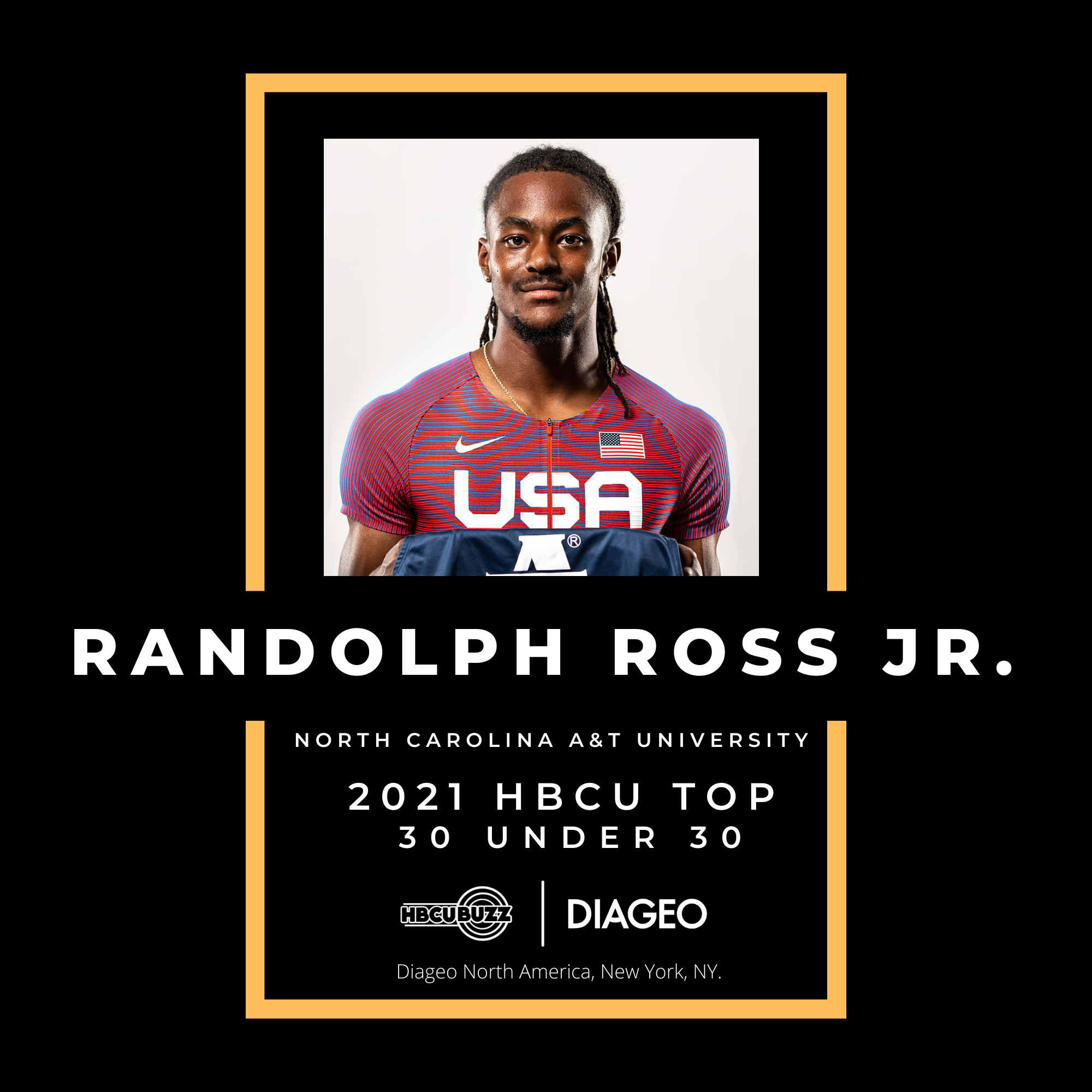
Randolph Ross Jr. – North Carolina A&T
Track and field is a family sport for Randolph Ross Jr., who is coached by his Olympian father at North Carolina A&T State University. So, it wasn’t a surprise when Ross, one of the world’s best 400 meter runners, made it to this year’s Olympics! Prior to qualifying for the iconic games, Ross was a trailblazer who helped to shatter records. Along with N.C. A&T’s Akeem Sirleaf, Trevor Stewart, and Daniel Stokes, Ross’s team had the fastest world time in the 4x400m with a time of 3:00.23 to qualify for the big games.
Rajah Caruth – Winston-Salem State University
Winston-Salem State University sophomore Rajah Caruth developed a love for NASCAR at a very early age. He knew he wanted to be a racecar driver when he saw his first race in person at Richmond Raceway in Virginia at the age of 14. Now at not even 20 years old, he is on track to becoming the 8th African American in NASCAR history to make a national series debut. In 2022, the history-maker will race part-time in the NASCAR Xfinity Series team with “Alpha Prime Racing,” a venture with Caesar Bacarella and Tommy Joe Martins .
Never missing an opportunity to work toward his dreams, he currently majors in Motorsport Management at WSSU.
Nia Page – Spelman College
Nia Page is a rising star in the political space, and she is working with leaders at our country’s highest levels. The recent Spelman College alumna has worked on the Joe Biden for President campaign, as well as for Congressman and Morehouse College alum Cedric Richmond, who now serves as Director of the White House Office of Public Engagement.
Page’s time at Spelman laid a strong foundation for her career aspirations. She majored in International Studies and served as president of the Student Government Association. She interned with civil rights greats Congressman Elijah Cummings and Congressman John Lewis, who fueled her goals of advocacy. By her senior year in 2019, she had begun working with the Biden campaign. Notably, she helped create the campaign’s national HBCU Students for Biden program, and became its co-chair and program lead. One of her proudest feats was planning the program’s Homecoming Week; where HBCU students from the AUC, now Vice President Kamala Harris, and more attended one of the week’s events. Page went on to become the Biden campaign’s National African American Program Coordinator. Additionally, Page was a student at the Harvard Graduate School of Education in the International Education Policy Program.
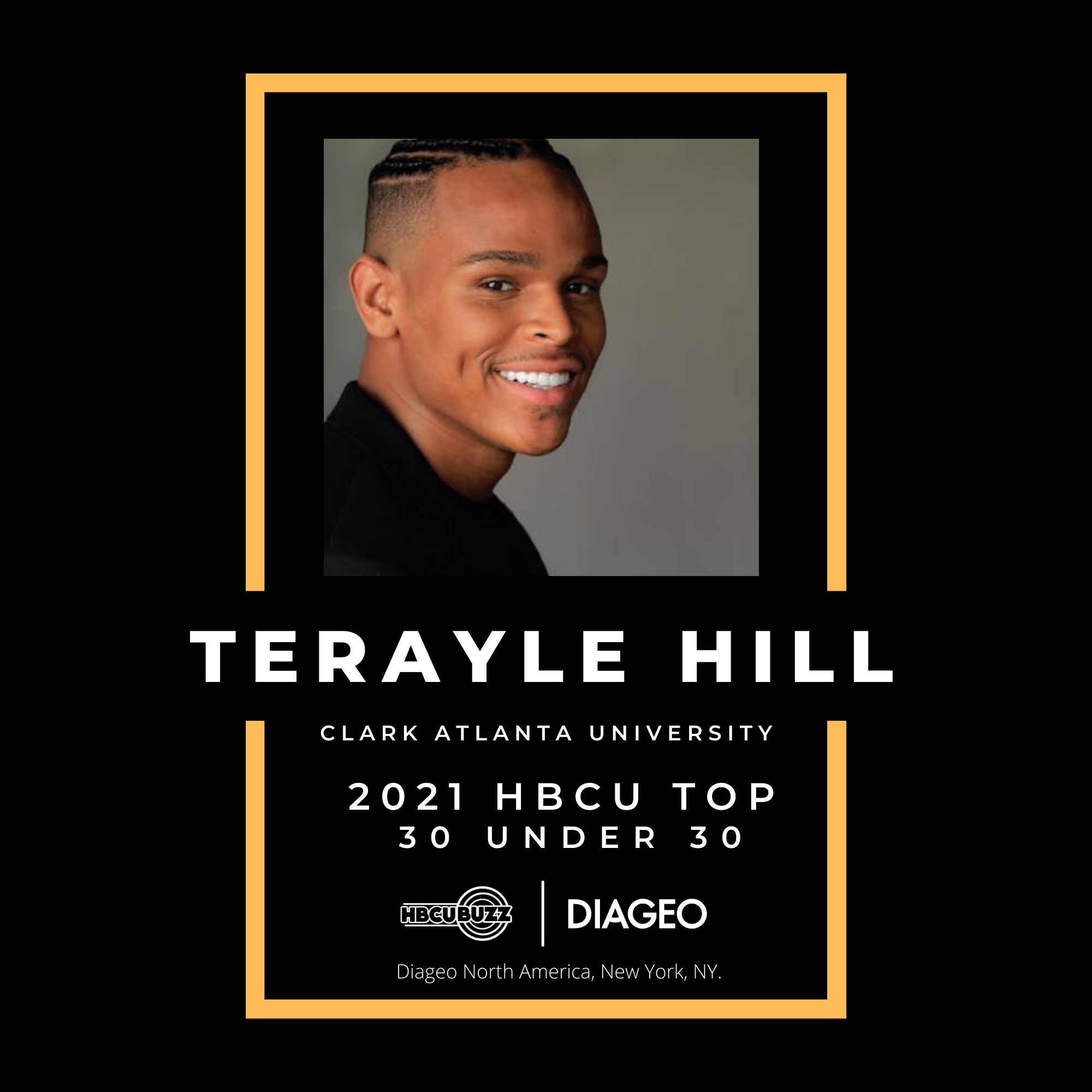
Terayle Hill – Clark Atlanta University
Terayle Hill is an actor, producer, musician, and entrepreneur. Hill was born in Pomona, California in 1994 and raised in Moreno Valley, California – before venturing over to Atlanta, Georgia where he graduated from Clark Atlanta University in 2016 with a Mass Media Arts Degree; with a concentration in Television and Film.
Outside of acting, Terayle engages his time and energy in other areas of the entertainment industry. Since 2014, he’s been directing and producing films that have garnered much attention and recognition in yearly film-festival circuits. One of his award-winning films, “Novella” (produced by Damn Write Originals) can currently be found on RevoltTV. Terayle has also brought his first love, rapping, to the main stage of television and film. He’s landed a few musical placements in the film industry and television industry and most notably writes and performs music for the Starz television series “Step Up.” Terayle also released his debut album, “Hyena” on February 21, 2021 and is available everywhere!
When he is not in the studio, on set, or behind the camera, Terayle makes time to connect with the youth across the country. Since the loss of his brother Tevyn in August of 2018, Terayle has instituted a legacy scholarship award in his brother’s name.
Today, you can find Terayle progressing on his journey toward a higher truth to live by example and educate himself and others. Hill is the co-founder of the mulit-media enterprise, “Everybodies Inc,” and is on a daily pursuit of mastering his on-camera abilities.
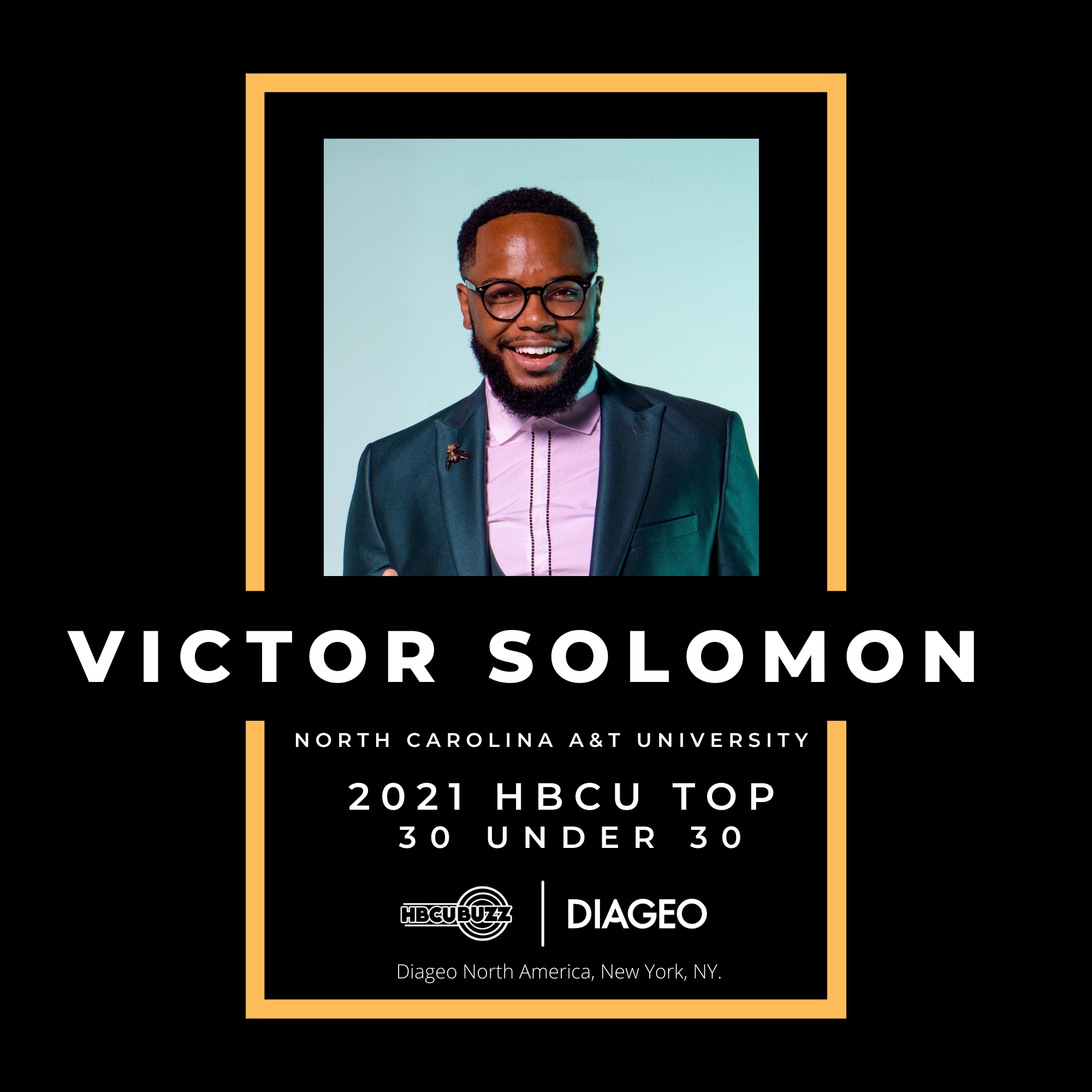
Victor Solomon – North Carolina A&T State University
You might hear Victor Solomon before you see him! At only 22 years old, this soulful singer finished in the top 5 contestants on the 20th season of NBC Universal’s popular show The Voice. With sultry singer John Legend as his coach, Victor mesmerized audiences and was an instant favorite who left viewers craving more. Ironically, Solomon won his 8th grade talent show by singing Legend’s hit “Ordinary People,” so to make it so far on the show was a well-earned full circle moment for him.
Prior to his time on the show, you could hear his melodies at church. While he does sing well, many have come to know Victor Solomon for his leadership and engagement on campus at North Carolina A&T State University. He has made a name for himself with students and community leaders as Mr. N.C. A&T, and Mister HBCU 2021-22. He has served on the Student Government Association Executive Board. He is a member of Alpha Phi Alpha Fraternity, Inc. He began singing at the age of 6, so of course, he sings in the gospel choir on campus.
Quanera Hayes – Livingstone College
World-class track and field runner Quanera Hayes is a force to be reckoned with. Most recently, she competed in this year’s Olympics. Yet even before that, she broke records as a student-athlete at her alma mater Livingstone College. By the time she was a sophomore, she had become Livingstone’s first female NCAA champion. She then became the first woman at any Division II school to win three straight NCAA titles for outdoor 400 meter races. Hayes also became a member of Alpha Kappa Alpha Sorority, Inc.
After graduating, she didn’t stop her hustle! In 2016, she won the USATF National Championship, earning a bronze medal in the 400m and gold in the 4x400m relay. Hayes has in the past credited a coach in middle school who saw her potential and encouraged her to join the track team.The North Carolina native is also inspired by her young son Demetrius.
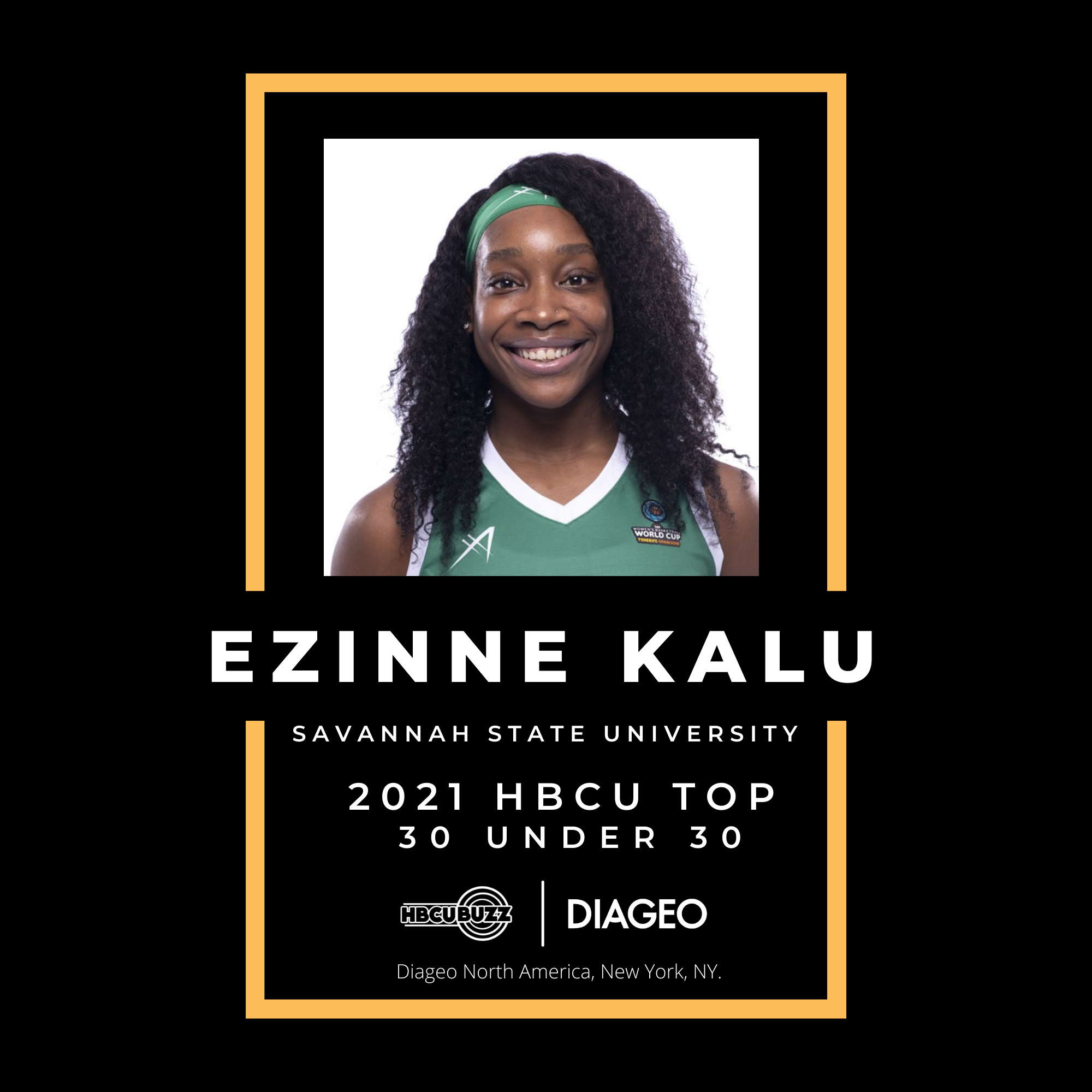
Ezinne Kalu – Savannah State University
Nigerian basketball star Ezinne Kalu was a star player at Savannah State University, and has kept her momentum up ever since. Ironically, Kalu eyed cheerleading as her sport of choice as a young girl, before her mother helped her to discover her love for basketball. She went on to become the first women’s basketball player in Division I history to score more than 1,000 career points. She earned 1,607 career points and averaged 16 points per game. After her time at SSU, Kalu was recruited to play professionally in the European basketball league in Portugal, and then went on to play for Hungarian, German, and French teams.
Born in Newark, New Jersey, Kalu has most recently graced the courts of this year’s Olympics, where she performed well with an average of 12.3 points, 4 rebounds and 3.7 assists.
Camerron Dangerfield – Alabama A&M University
Chef Cam, aka Camerron Dangerfield, is an Alabama A&M University alumnus taking the culinary world by storm. He prepared himself for a successful career as a celebrity chef, author, restaurant consultant, reality tv personality and entrepreneur when he decided to major in International Business. He has also made time to return to his alma mater to advance Food Science programs during its Community Health Fair, and conducted virtual cooking classes for Global Employee Health and Fitness Month.
Chef Cam is a chef with lots of personality, and lots of accolades to back it up! He is a Food Network’s Cutthroat Kitchen Champion, a Georgia Chef of the Year honoree, and was a participating chef in seasons 9 and 10 of Master Chef, hosted by world renowned Chef Gordon Ramsey. He is also a Resident Chef on the NBC Universal daily talk show Sister Circle Live. Over time, the chef has worked with big brands like Anheuser Busch, Walmart’s Repurpose Brand, Bolthouse Farms, and more. Plus, he’s even written a few cookbooks! In the fall, Chef Cam even plans to open his first restaurant: “Brunch at CAM’s.”
Chef Cam also has a philanthropic side. He created Chefs For Change to feed the less fortunate in food deserts and for families who experienced income loss during COVID-19. He challenged other chefs around the country to join his efforts, so that the reach extended further than his home state of Georgia. As a member of the LGBTQ+ community, he also serves as an advocate and Atlanta Gay & Lesbian Chamber of Commerce rising star honoree. He continues to use his platform to bring communities together and produce executive events for like-minded creatives.
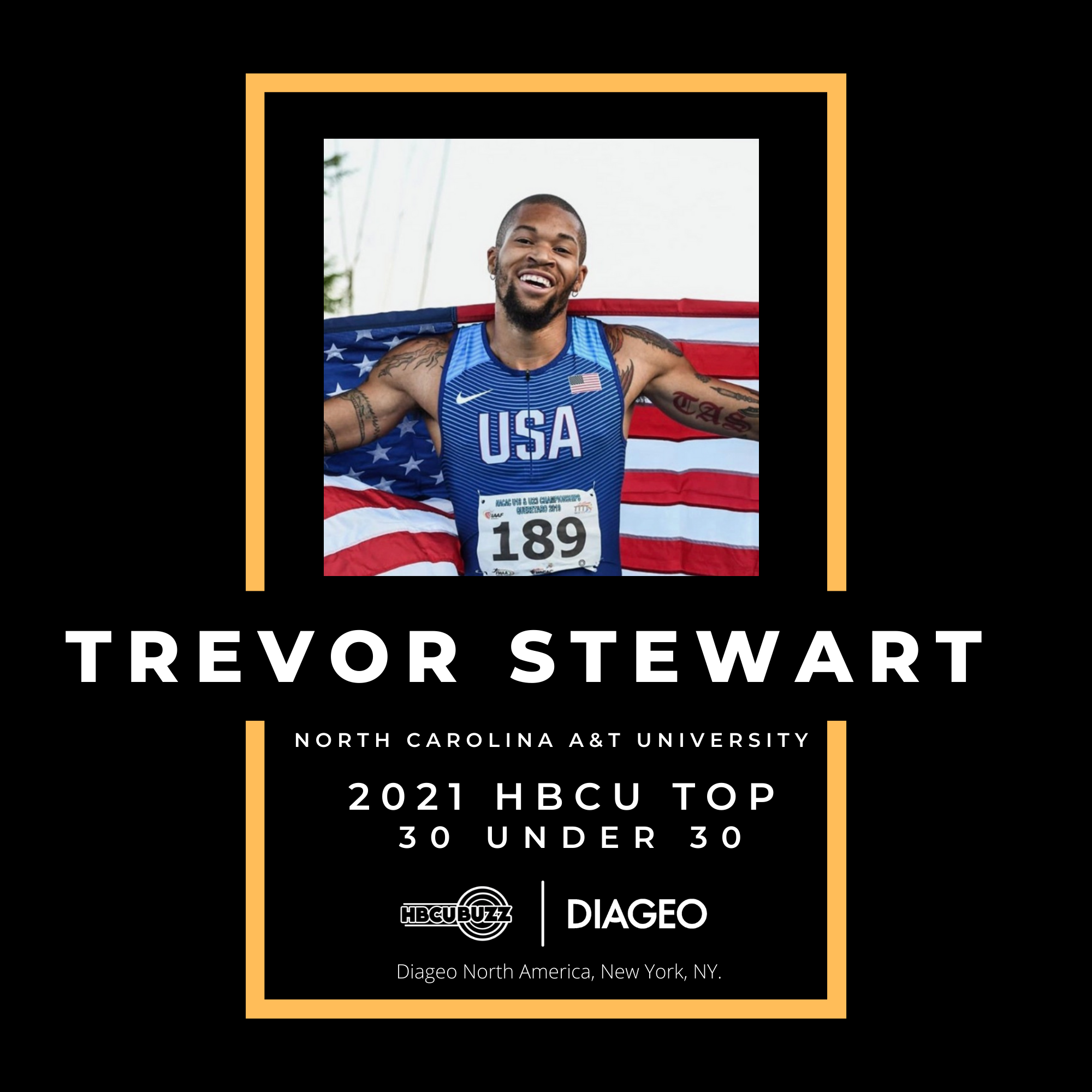
Trevor Stewart – North Carolina A&T
Olympian Trevor Stewart is another hot shot on North Carolina A&T State University’s track team. He broke the 4x400m record with Randolph Ross Jr., Akeem Sirleaf, and Daniel Stokes to qualify for the Olympics, but there’s so much more to him.
Despite having asthma, Stewart has collected titles like the 400m title at the Mid-Eastern Athletic Conference (MEAC) outdoor championships. He also held the fastest 400m qualifying time at the NCAA Division I East Preliminary Round. He has twice finished top 4 in the nation for NCAA Championships for 400m races, including placing 2nd in the nation in 2019.
Ultimately, Stewart is a two-time Olympic medalist, taking home 1 gold (4×400-meter relay) and 1 bronze (for the 4×400-meter mixed relay) during his trip to the 2020 Tokyo Olympics!
Mike Hamilton – Howard University
If you’re a serious artist looking to have visibility in the industry, Mike Hamilton is the person you want to know. The cum laude Howard University alumnus and member of Alpha Phi Alpha Fraternity, Inc. has made a name for himself as the Senior Director of Commerce at Epic Records. Just in August Hamilton was recognized as one of Billboard’s 2021 R&B/Hip-Hop Power Players. He was also honored in October 2020 by HITS Magazine as one of the music industry’s Noisemakers.
The impressive catalogue of R&B and hip-hop artists that Mike Hamilton oversees includes artists like Future, 21 Savage, Rick Ross, Travis Scott, and DJ Khaled. Plus, he’s boosted rising stars like GIVĒON, which he personally prides himself in after celebrating the artist early on. As a result, GIVĒON, who has 2 RIAA platinum singles and other accolades, was named an Apple Music Up Next artist in 2020, and became the face of Spotify’s Are & Be playlist rebrand. Hamilton worked in the same executive role at Atlantic Records, supporting the rollouts of Grammy-nominated albums like Cardi B’s Invasion of Privacy (the 2019 winner for Best Rap Album), Nipsey Hussle’s Victory Lap, Meek Mill’s Championships, and Janelle Monae’s Dirty Computer.
Outside of work, Hamilton continues to advocate fearlessly for diversity and inclusion within the music industry. Among other endeavors, he is involved with #TheShowMustBePaused organization & helped to craft its “From Books to Boardrooms” virtual career fair during Black History Month, which paired college students from underrepresented communities with music industry professionals. He also sits on an internal task force at Sony Music that further helps underrepresented students realize their dreams in the challenging yet rewarding music industry.
Jasmine Butler – Bowie State University
Jasmine Butler is an award-winning events professional who in her spare time thrives as an entrepreneur. By day, the Bowie State University alumna is the Events Manager for the Center for a New American Security (CNAS). Having majored in Communications and Public Relations at Bowie State University, she has been able to showcase her ability to strategize events and campaigns, and capture strong engagement. In just a few short years, she has gone from Events Specialist at Marriott International where she managed over 300 events and meetings annually to Event Manager at CNAS, where she now manages budgets upwards of $200,000. Just this summer, CNAS recognized Jasmine Butler’s hard work by honoring her with the 2021 Bacevich Award for leaders in national security. It honors emerging leaders who show courage, integrity, and commitment to public service.
Although CNAS keeps Jasmine Butler hard at work, she has ventured into entrepreneurship with 2 different businesses! She entered the beauty space with her unique lip gloss line Juicy By Jay. Prioritizing product quality over profits, she created a line with well-made vegan and cruelty-free products. The brand also has a philanthropic side. To stand with her community as a business woman, Jasmine donates a lip jelly to women in programs and facilities that protect them. Butler is also the CEO and Event Director of a second business: J. Butler Events, LLC. Based in Washington, D.C., Butler continues to bring on clients to plan, manage and execute special events, conferences, and more. Similar to what she does at CNAS, she handles everything about the event from invoicing, to contracts, to vendors, and day-of execution.
John T. Rose – Hampton University
John T. Rose is a dynamic young attorney taking the entertainment industry by storm, and his accolades speak for themselves. For one, the Hampton University alum is among the youngest attorneys ever to be honored on Billboard’s Top Music Lawyer list, and has been featured 2 years in a row. He has also been chosen for Variety’s Legal Impact list and named a 2020 Noisemaker by Hits Daily Double. Whether the case is against an award-winning entertainer, a rising star, or a major corporation, Rose is ready to fight to win.
Rose has presided over many high-profile cases. He earned a victory for client Rick Ross in the U.S. Second Circuit Court of Appeals after he was sued by 50 Cent for using “In Da Club” on a mixtape. The landmark win set a precedent, clearing the way for creators to sample music without permission on projects they aren’t profiting on. He has had lawsuits dismissed against labels Universal Music Group (UMG) and Def Jam. Also, clients of John and his team have been able to negotiate and secure seven-figure deals with companies like Facebook, Bleacher Report, BET, and Sprite. Rose also entered a groundbreaking joint venture with renowned music photographer Cam Kirk with Atlantic Records. Kirk is not only a client of Rose’s but also a fellow member of this year’s HBCU Buzz Top 30 Under 30. Together, they sign and develop visual content creators, offering a full-service creative division to use as a resource.
When he’s not fighting cases or closing deals, Rose often uses his voice to advocate for diversity, equity, and inclusion in the entertainment industry. Mainly, he uses his membership and connections with BESLA, or the Black Entertainment and Sports Lawyers Association, the largest professional organization of its kind to be a vessel. During the racial reckoning of the pandemic he brought Black creatives amazing opportunities to showcase their talent and create content for big names in the music industry through his photography label collective gallery.
Rose frequently volunteers his time as a speaker on professional, business and music industry topics to groups such as 100 Black Men of Atlanta, Tuskegee University’s 8th Annual Men’s Leadership Conference and Black Law Student Association chapters at universities in and around Atlanta and throughout the South.
Mike Carney – Howard University
If you’re looking for a connector in the entertainment industry who has helped craft some of the best events in music, then you may be looking for Mike Carney. The Howard University alumnus earned his BA in Economics, but soon learned that he could make a career out of uniting people and exciting experiences.
Currently, Carney thrives in the Booking department at the famous Live Nation Entertainment. Yet his coordination experience can be traced all the way back to his time at The Howard Theatre, where he served as Homecoming Coordinator for a year and then Events and Partnership Assistant for the next year. He then entered the music industry in Atlanta as an executive assistant to the co-CEO of Grand Hustle Records. While there, he coordinated and facilitated events like Grand Hustle Weekend, BET Weekend, and more. He then moved on to record label LVRN, helping to launch their flagship studio in Atlanta. The experience opened him up to tour management and operations with artist 6black’s Free 6lack Tour and DRAM during Kendrick Lamar’s The DAMN. Tour.
By prioritizing focus, humility, and integrity, Mike Carney will continue to move higher and higher up the ladder at his own pace! He has had his hand in booking for big festivals like Broccoli City, The Roots Picnic, and H.E.R.’s Lights On Festival, plus specialty shows for Amazon, Michelle Obama, Youtube, BET, Budweiser, and more. You can find him and his team forging unique opportunities for urban content, developing up and coming Hip Hop and R&B artists, and beyond.
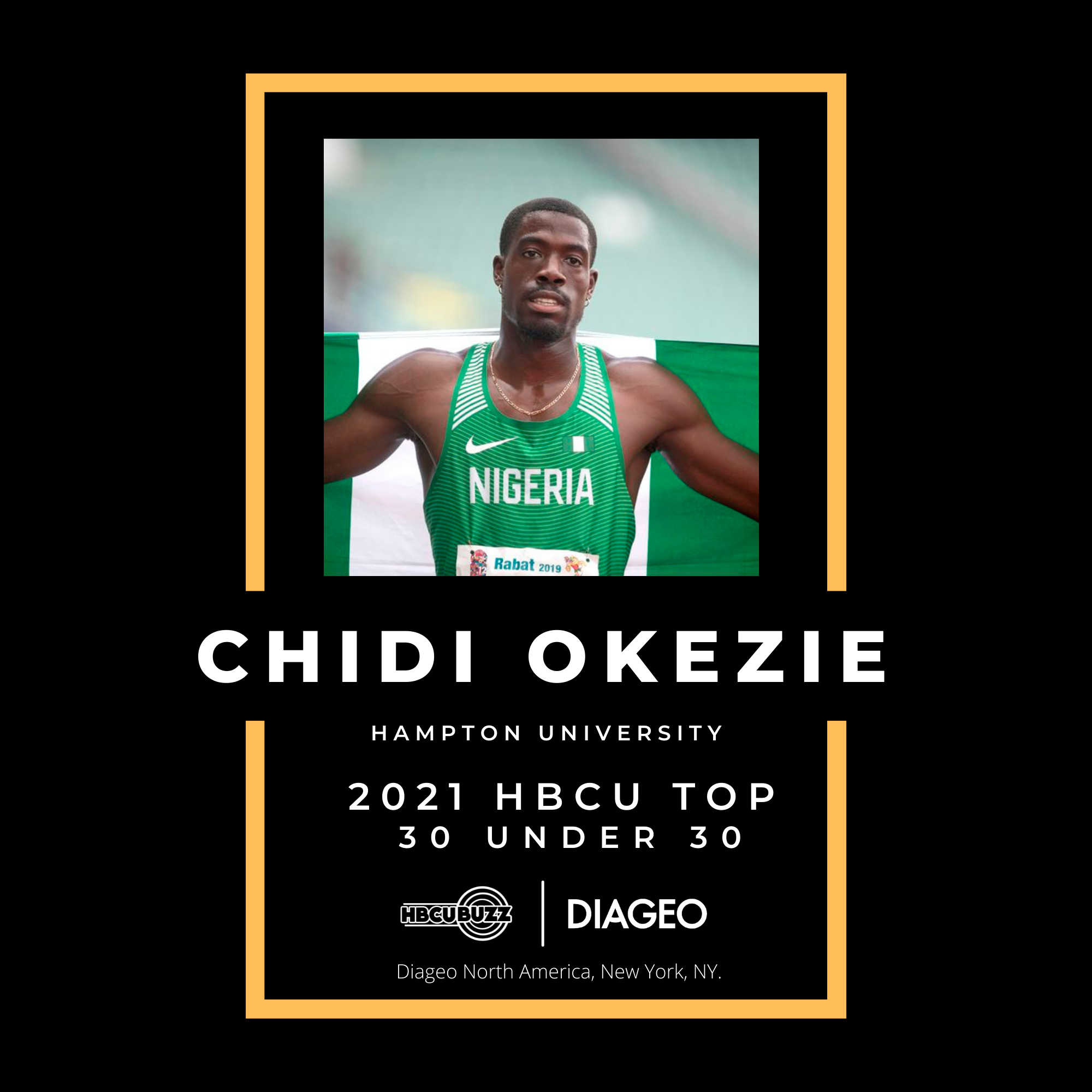
Chidi Okezie – Hampton University
Double Hampton University graduate Chidi Okezie has lived and breathed track and field all his life. He earned many accolades at his alma mater. He has been recognized several times by the U.S. Track & Field and Cross Country Coaches Association, and has made several All-American teams.
Most recently, Okezie’s talents allowed him to qualify for this year’s 2020 Olympics. In fact, Okezie competed in a way contenders rarely do: he had the opportunity to compete for 3 different countries! He has a Jamaican mother, a Nigerian father, and was ultimately raised in the United States, in Philadelphia. He made his choice diplomatically, considering the unity that could come from Nigerians in Africa and America rooting for the same athlete. While his team didn’t qualify to run in the actual Olympics due to a tragic blunder of no fault of his own, his Mixed 4×400 relay team set a national record time for Nigeria at 3:14:09 when they competed to qualify for the Olympics in Lagos.
Jahliel Thurman – Virginia State University
Host and executive producerJahliel Thurman stepped onto the campus of Virginia State University with a full academic scholarship and a level of determination that has since paid him 1,000 times over. While majoring in Mass Communications with a focus in Television, he chose to become a member of Omega Psi Phi Fraternity, Inc. and became president of the Nu Psi chapter. He served as the SGA Vice President for two years, eventually becoming SGA President in his senior year. He then graduated from VSU magna cum laude.
Thurman’s love for HBCUs and his goal to ensure they were positively represented and discussed led him to create the Yard Talk 101 digital marketing agency. Putting his mass communication skills to work, the VSU alum created a path for HBCU students and alumni to have meaningful conversations that extend beyond their campuses and communities to major corporations and beyond. Yard Talk 101 has collaborated with companies and organizations like the Thurgood Marshall College Fund, the Shawn Carter Foundation, Cigna, and Toyota.
In addition to the valuable marketing work being done at Yard Talk 101, Jahliel Thurman also hosts and executive produces a television series about HBCUs and trailblazing alumni for AsprieTV. Aptly named “HBCU 101,” the show has featured actress Keisha Knight-Pulliam, film producer Will Packer, actor, host and entrepreneur Terrence J, and more!
Sidnee Michelle Douyon – Howard University
You can count Sidnee Michelle Douyon as one of the most gifted storytellers of our generation. She has blazed the entertainment industry as a reporter, journalist, producer, editor, and media and pop culture guru for close to a decade. Originally from Brooklyn, the Howard University alumna got her start writing and reporting for her alma mater. Determined, she climbed her way from being an on-camera personality at The Source Magazine to Forbes Magazine’s first-ever woman of color to ever report on camera.
Douyon now works as a freelance journalist with interviews under her belt from the likes of Michelle Obama, Samuel L. Jackson, Cardi B., Dwayne “The Rock” Johnson, Eddie Murphy, and more! She is also one half of the famous travel blog Black Travel Journey. In her free time, she pays it forward mentoring Howard students through Howard’s Entertainment Group, which is powered by Amazon.
Taylor Reeanna Johnson – South Carolina State University
Taylor Reeanna Johnson is an ambitious television writer and actress who has enjoyed storytelling since she was a child. Her third grade teacher’s assignment to write an essay about Martin Luther King, Jr. unlocked her love for writing. She honed her craft by attending South Carolina State University, where she received a BA in Communications and Journalism. She then went on to earn her Masters of Fine Arts in Creative Writing. She went on to found Vir Madera Productions, a company that uplifts other writers, actors, directors, producers, and more professionals of color, giving them a community to call their own. Over time, Johnson’s career has taken her from BET, to OWN, Aspire TV, and more television networks.
Maya Allen – Howard University
If you have somewhere to go and want to look effortlessly fly, find Maya Allen! The writer, director, beauty director and Howard University graduate is a woman on the move. She is currently the beauty director for In Style Magazine, overseeing all of the magazine’s beauty coverage! In the past she has worked with big brands like Cosmopolitan, Marie Claire, and Byrdie.
Allen first found her purpose in the beauty industry when she looked through her mother’s beauty magazines as a kid. She began collecting them herself, and found an issue with the fact that she had difficulty finding people who looked like her. Determined to lead the change that she wanted to see, she interned every summer in college at leading magazines in New York. While there the Journalism major and African American Studies minor learned all she could from accomplished editors there. Since showcasing her dedication as a young college student, Allen’s writing has appeared in magazines like Essence, In Style and O, The Oprah Magazine, and more. Always a fan of beauty and fashion, Allen is known for her bold style and impressively large collection of at least 200 red lipsticks!
Dr. Alexandria Washington – Florida A&M University
What doesn’t Dr. Alexandria Washington do? She’s an award winning health advocate, TEDx speaker, a former Miss Black Florida US Ambassador, three-time FAMU grad. The Rattler received her BS in Health Science, Master of Public Health, and Doctor of Public Health all from Florida A&M University.
With work that has spanned governmental and non-profit sectors, Dr. Washington is motivated by a designer to positively change her community from its foundation. She currently works as a federal contractor with the Administration for Children and Families.She has had a wide-reaching impact, serving as a Miss Black Florida US Ambassador, where she used her platform to advocate for people suffering from often-overlooked health conditions like Sickle Cell Disease and Sickle Cell Trait. Dr. Washington was one of twenty women in the inaugural cohort of United State of Women Ambassadors as well, where she advocated for gender equality in Tallahassee. Notably, she was recognized by Forbes for her work encouraging the city’s commissioner’s decision to remove gender-neutral language from the City Charter and other governing documents, which was done in 2019!
Gregory Tyrone Wright Jr. – Bowie State University.
Gregory T. Wright Jr., LGPC is dedicating his life to the pursuit of mental health, social equity, and combating the miseducation of marginalized cultures. Among many things, he is a Licensed Graduate Professional Counselor, entrepreneur, and member of Alpha Phi Alpha Fraternity, Inc. Wright is also an Adjunct Professor at Bowie State University and has also volunteered his time to tutor young men and women that are incarcerated. He is a 2-time HBCU graduate, having earned his BS in Psychology and his Master of Arts in Clinical Mental Health Counseling from Bowie State University.
Wright created the brand “The Wright Mindset” to provide services and therapeutic products that make personal and relationship experiences easier to unpack. With his game “It’s Levels To This Ship,” players can ask their significant other questions to get to know them on a deeper level. The questions include inquiries like “how do I know that you are reliable,” “do I touch you enough,” and “what was the last time you considered ending our relationship.” Although blunt at times, the game offers self reflection as well as elusive relationship transparency through three different levels.
Having built a successful brand for himself, Wright has spoken all over the country to share his perspective. With expertise in mental health counseling, psychological assessment, research methodologies and more, he is influencing others to take a holistic approach to mental health advocacy. Over the years, he has won awards spanning across organizations that support HBCU retention, clinical research, and educational leadership. Gregory hopes to continue the push towards breaking the stigma surrounding mental health and introducing non-traditional ways to provide human services.
Charlyne Smith – Coppin State University
Dr. Charlyne Smith was born and raised in St. Catherine, Jamaica. She moved to the United States at the age of 17 to pursue a career in science and technology with the goal of developing clean energy solutions for current and future generations. She graduated summa cum laude from Coppin State University in Baltimore, Maryland as a double major in Chemistry and Mathematics. She went on to obtain her master’s degree in Nuclear Engineering from the University of Florida (UF) and more recently became the first black woman to graduate with a PhD in Nuclear Engineering from the UF.
Dr. Smith’s PhD research contributed to the advanced characterization and post irradiation examination of nuclear materials by using several microscopy techniques and image analysis to study their microstructural response post-irradiation in reactor environments. During her PhD, she authored and co-authored five peer-reviewed journal manuscripts; received three research proposal awards totaling ~$150k; presented at eight professional conferences and mentored six undergraduate students. Dr. Smith is currently a distinguished postdoctoral associate at the Idaho National Laboratory where she is performing research that contributes to demonstrating and securing nuclear energy solutions. She is also actively engaged in nuclear energy advocacy efforts with several non-profit organizations including the Generation Atomic, Students for Nuclear and Mothers for Nuclear organizations. Her long-term career goals are to introduce nuclear energy technology to the Caribbean as well as to build a STEM-based high school in Jamaica. In her spare time, she enjoys painting, hiking, and spending time with her family.
Dr. DeVonte D. Johnson – Tennessee State University
When it comes to keeping your lifestyle up, people often think about working out, and eating right. But what about your oral health? Dr. Devonte D. Johnson, an alumnus of Tennessee State University, is making sure that’s something we don’t forget. The son of a craniofacial surgery nurse and barber, Dr. Johnson chose dentistry for the impact that the profession could have on people’s self esteem.
The earlier people start taking care of their teeth, the better they’ll look and feel. So the creative dentist has made two lifestyle brands “Protect Your Teeth” and “We Must Stay Healthy” to make oral health more appealing to his community. Protect Your Teeth is a creative outreach campaign that takes into account the everyday health challenges of young people. For example, it helps educate children on what to do if a tooth is accidentally knocked out while playing sports. Alternatively, the We Must Stay Healthy brand merges music, fashion, entertainment, and education to make oral health more appealing for young people.
Dr. Johnson is also a philanthropist, having co-founded Menergi. The start-up focuses on helping diver non-profits receive more funding and resources to have the impacts on our communities that they set out to have.
Candace Chambers – Jackson State University
Candace Chambers is an award-winning educator, public speaker, and author who has made it her mission to uplift communities of color through education and purpose. She has earned numerous awards, including the Carolyn P. Handa Excellence in Teaching Award from the University of Alabama, the Scholar from the Dream Award by the National Council for Teachers of English, the President’s Future Leader Award by the International Writing Centers Association and more. She was also an HBCU All Star through the White House Initiative on Historically Black Colleges and Universities, and has earned over $1 million in scholarships, grants, and assistantships.
Currently, the Jackson State University alumna teaches English composition at a community college, and also teaches incarcerated students at a university. She has gone to Dillard University, Spelman College, and more schools across the nation about college prep and writing scholarship essays. She is also an entrepreneur who founded Educational Writing Services LLC to provide editorial and college coaching services to students and professionals. She has also written the guidebook “Write Your Way To A Successful Scholarship Essay” to help others when she can’t directly. Through all of this, the multi-faceted educator credits Jackson State with giving her the educational foundation she needed to thrive.
Mulbe Marcellus Dillard IV – Florida A&M University
Professional golfer Mulbe Marcellus Dillard IV once expressed his feelings for golf as a “a very, very strong love for the game.” He was first exposed to golf by his father, who brought him to a range when he was 2. By 5 he played in tournaments. After high school he committed to Florida A&M University to bring his talents to the team. He also established his own place to teach others in his community at an accessible price: “The Mulbe Dillard Golf Academy.” He learned to juggle, balancing school work, his own practices, and frequently booked lessons through his academy.
Dillard has done well for himself as a young golfer. He has earned a sponsorship to amateurly compete in the APGA Tour’s summer circuit. Late last year, he also ranked number one in the country for the APGA’s ranking of black golfers in the NCAA. Dillard hopes to ultimately earn a spot in the PGA Tour. With his golf career taking off, and considerations of graduate school, Dillard is only getting started!
Tamerras Leonard – Texas Southern University
Tamerras Leonard is an up and coming journalist whose early success has led her to explore reporting and marketing management. To date, she has interviewed big names like Travis Scott, Kahlana Barfield, Congressman Beto O’Rourke, and Roland Smith. Yet none of her accomplishments are surprising, because she was already such a powerhouse in college.
While at Texas Southern University, Leonard chartered the third chapter of Women of G.O.L.D. at TSU, an organization that offers motivation, mentorship, and life skill development to young women. She served as Director of Marketing at the TSU Herald, which is Texas Southern’s official newspaper. She also became a member of Delta Sigma Theta Sorority, Inc.
Starting off as an intern at ABC News, Tamerras has worked her way up. Her next stop was Production Assistant. She then became an Associate Producer for the star-studded Soul of a Nation tv mini series, which featured Common, Taraji P. Henson, Carmeo Anthony, Marsai Martin, Sterling K. Brown, and more. She has now been accepted into the highly selective ABC News Fellowship program, where 10 people from the entire company are able to do rotations in each department, plus shows in the newsroom.
Tahir Murray – Howard University
Fashion-forward celebrities and major companies like Nike have been clamoring for the clothing line of Howard University alum Tahir Murray. The third-generation entrepreneur has built an HBCU fashion empire with his line Legacy History Pride. In fact, Murray grew up appreciating fashion considering his grandfather was the first Black sneaker shop owner to secure a Nike account! His father was one of the first streetwear designers to hit the fashion scene. Also, his mother and sister are HBCU graduates!
Murray celebrates HBCUs with the 3 pillars of the brand’s title. The brand celebrates the “legacy” of HBCUs with classic styles, honoring the legacy HBCUs provide to educate generations of African Americans. The designs of the brand honor the “history” of HBCUs by incorporating historic people, places, and things that are the backbone of HBCU culture. Lastly, the “pride” aspect honors Murray’s own family’s entrepreneurship journey. With every sale, the brand gives licensing profits to the HBCUs featured on the apparel, and it also partners with students and alumni at these HBCUs to offer scholarships!
Jeremy Peaches – Prairie View A&M University
Jeremy Peaches works to leave our earth better than he found it. Spending time outside with plants and animals was always therapeutic to him, and seeing fields was something he missed when his family moved from Mississippi to the city of Houston when he was a boy. By the time Peaches arrived at Prairie View A&M University, his love for nature hadn’t changed at all. He majored in Agriculture, setting him up for the birth of his now booming agriculture consulting, service, and farm company Fresh Life Organic (FLO).
When Houston began to grow an organic food scene sometime around his 2015 graduation, FLO was the perfect move. Peaches was able to become an Agriculture Consultant at FLO to assist landowners, companies, farms, garden, schools, and more in Houston’s growing organic food movement. FLO specializes in operations, row crop farming, aquaponics/hydroponics. risk management, and marketing agriculture products. The company sells organic vegetables to the community, restaurants, and more, in addition to maintaining farms, gardens, and greenhouses. Even after all of this, he has co-founded Black Farmer Box with fellow PVAMU alumna Ivy Wells. Together, the two have created a system that dismantles food deserts, distributing fresh produce to communities in Houston and beyond.
Ernest Holmes – Morehouse College
Coding is difficult, but the earlier you are introduced to it, the better. This was the lesson Ernest Holmes learned, and he’s taken a hands-on approach to mentor students of color with his company CodeHouse. The New Jersey native majored in Computer Science and Mathematics at Morehouse College to prepare himself for a career where he could one day do what he loved and serve others. Before he even graduated, he had racked up offers from Microsoft, Salesforce, Chick-fil-a, and Clorox. He ultimately chose to become a software engineer at Google, where he had previously completed three internships at the company.
While there aren’t many who look like him in his field, he is doing the work it takes to change that. He grew up in a predominantly white neighborhood, and grew to appreciate the value of diversity especially at Morehouse. His experience ultimately led him to establish CodeHouse, where he serves as President and Co-Founder. The non-profit is closing the diversity gap by preparing for internships and work in coding, while also facilitating a pipeline for them to be employed at leading tech companies. Aside from wanting to help others, in the bigger plan, Holmes plans to continue to lead the way by becoming an innovative leader in technology in his own right.
Charity Croff – Wiley College
Charity Croff is not just an influencer, but an experience. He is an inspiring content creator, rapper, producer, and fashion designer, among many other things. Through his social media and other outlets, he works to encourage others to find their own unique way to harness their infinite potential. While at Wiley College he studied physics and music, and was a member of the debate team.
He has amassed over 300 million views on social media advocating for his followers to be their best selves through empathy, critical thinking, and self awareness. Croff created a monthly letter called the Genius Factory. He has also set up a Patreon, where he encourages followers to get special information like book recommendations, articles, music, educational videos and more. With Croff’s engaging and welcoming personality, he makes it easy to theorize and discuss social issues like race, gender, theology, and the environment.
Darius Leonard – South Carolina State University
Some dream their whole life about making it to the NFL. The league is full of the best football players in the world, so the competition is stiff. But for South Carolina State University graduate Darius Leonard, it not only pays to be the best, it pays to be the best of the best! With his hard work, this year Leonard became the highest paid linebacker in the NFL. He wasted no time in climbing his way to the top after being chosen in the 2018 NFL draft. His deal with the Indianapolis Colts signed him on for 5 years worth a whopping $99.2 million, with $52.5 million guaranteed.
According to sports data company PFF, Leonard is one of four linebackers in the entire league who has held onto a 70.0 on at least 500 defensive snaps every season since joining the league. With Leonard on the field, his team has had stronger coverage and blitzes. Leonard, a member of Omega Psi Phi Fraternity, Inc., is now set to make about $20 million a year.
HBCU graduates interested in sports journalism are being encouraged to apply to Northwestern University’s Medill School of Journalism, Media, and Integrated Marketing Communications for an opportunity at a full-ride scholarship! Get the full story from Charlotte Che at The Daily Northwestern.
A newly launched full-tuition scholarship will fund a graduate student enrolling in the yearlong Sports Media master’s program at the Medill School of Journalism, Media, Integrated Marketing Communications.
The scholarship is hoping to specifically fund an alum from a historically Black college or university. The Simmons Family Scholarship for Sports Journalism was established by Kari and Bill Simmons, CEO and founder of The Ringer, a website and podcast network dedicated to sports and pop culture reporting. The scholarship, which is currently accepting applications, will be Medill’s only financial award offered in its Sports Media specialization.
Financial accessibility is one of NU’s top priorities, according to Julie Collins, Medill’s director of graduate admissions and financial aid.
“It costs more to go to graduate school,” Collins said. “(They) are making sure graduate students are able to do this program, regardless of their financial situation.”
While Medill awards grants and scholarships, the office of Federal Student Aid only offers a few federal loans to low-income graduate students: Direct Unsubsidized Loans and Direct PLUS Loans.
Undergraduates, however, can receive assistance through the Pell Grants and subsidized Stafford loans, which do not charge interest to students. The Simmons Family Scholarship aims to relieve some of the financial burden, Collins said.
“I’m always impressed by the commitment of NU alums, their commitment to give,” Collins said. “I think it’s just vitally important that people see us as a good steward of money and a way for us to actualize (students’) goals and passions.”
The Simmons Family Scholarship is the only Medill program specifically aimed toward alumni of historically Black colleges and universities. But the school does also offer a Reuters fellowship for students who are members of the National Association of Black Journalists. NU also has established connections with the Morehouse College Journalism & Sports program, run by Ron Thomas (Medill M.S. ‘73).
In 2019, just 7.59% of Medill graduate students identified themselves as Black or African American. This scholarship intends to improve the diversity of Medill, according to Medill Dean Charles Whitaker.
“Scholarship funding for graduate students is one of our most critical needs at Medill,” Whitaker said in a news release. “This level of support will make a life-changing difference for students who receive it.”
Collins said Medill also hopes to extend scholarships to graduate students in the future so students from diverse regions and academic backgrounds can learn from each other.
Students who come from smaller sports journalism programs across the country and the world enrich learning inside and outside the classroom, she added.
“Making sure we have all those voices present is key — representation is important,” Collins said.
Medill Prof. J.A. Adande, the school’s director of sports journalism, said he hopes this scholarship will further encourage collaboration to diversify NU and the larger field of sports journalism.
While COVID-19 halted some of the Sports Media specialization’s immersive programs, Adande said this year’s opportunities have been “surprisingly good.” This past May, students reported in-person on the Kentucky Derby as a part of Medill Explores.
Adande said the current class of sports journalism master’s students is the largest group he’s seen since joining Medill.
“We’re really grateful to last year’s students who endured and persevered through the pandemic and didn’t complain and did outstanding work,” Adande said. “We’re thrilled to be back and bigger than ever.”
The Simmons Family Scholarship will offer the opportunity to acquire a foundation in what Adande refers to as a “rapidly changing sports landscape,” citing the rise in popularity of podcasts, social media, television and other forms of multimedia reporting.
“This could turn into the starting point for someone to have a great, wonderful career in this field,” Adande said.