One could argue it’s been a victorious year for historically Black colleges and universities (HBCUs). The FUTURE Act – legislation sustaining federal funding for minority serving institutions – made a fraught, winding journey to President Donald J. Trump’s desk, where it was signed into law in December.
But on Tuesday, Dr. Michael Lomax, president and CEO of the United Negro College Fund (UNCF), discouraged unbridled optimism.
“I cannot stand before you here today and say only that the state of HBCUs is strong or only that HBCUs remain resilient,” he said at the organization’s second annual “State of the HBCU Address” where HBCU leaders and allies gathered in Washington D.C. “As you know, those truths are only part of the story.”
He argued that the permanent annual $255 million in federal funding for minority serving institutions, with $85 million designated for HBCUs, marks progress, but it isn’t enough to solve the “HBCU paradox” – the fact that HBCUs enjoy broad bipartisan support but continue to be “woefully underfunded.”
The support that exists, though it spans party divides, is “too often a mile wide and an inch deep,” Lomax said. “Too often it creates an all too convenient gap between rhetoric and reality. It makes it easy for people to look and sound like they are HBCU boosters without having to take the hard steps and make a deep-seated commitment to eradicate decades of disparate treatment of HBCUs.”
Florida A&M University student Chrichanni Watson recently said during an interview with the conservative Breitbart News Daily that President Donald Trump is “making progress” for historically black colleges and universities (HBCUs), citing how he signed for these institutions to be permanently funded.
She had raving reviews about Trump, saying, “I personally think he’s making progress,” she said. “The first thing that I looked into, especially at my university, is how he recently signed for HBCU’s to be permanently funded.”
Watson said:
“That directly impacts us, as HBCU students, and that’s something that cannot be said for the last administration. I mean, you’ve got to give the man some credit.”
Of her experience with FAMU students if someone utters Trump’s name on campus, she said “all ears are shut off.”:
“They’re not receptive to it. If you’re trying to get their attention, the last thing you want to mention is the president.
This summer, I said something about this president on Twitter and my school definitely was not receptive of it. They were calling me sell out, they were saying I was brainwashed, they were saying all these things, and the tweets just would not end.”
Watson said that she had the opportunity to work in the nation’s capital with a Republican representative, her first experience with the conservative movement. This lead to her wanting to bring back the same energy at FAMU.
Georgia Rep. John Lewis surprised attendees at this year’s Bloody Sunday commemorative march in Selma, Alabama, imploring all attendees to vote, CNN reports. Attendees marched in remembrance across the Edmund Pettus Bridge in the afternoon to commemorate the freedom-marchers who were clubbed and tear-gassed by state troopers as they peacefully marched over the same bridge over half a century ago on March 7, 1965. Seventeen people were hospitalized including Lewis after being injured by police while dozens more were hurt. The protest was held against the denial of civil rights to Americans based solely on the color of their skin, which prompted the passage of the Voting Rights Act of 1965.
“Fifty-five years ago, a few of God’s children attempted to march … across this bridge. We were beaten, we were tear-gassed. I thought I was going to die on this bridge. But somehow and some way, God almighty helped me here,” Lewis said during his remarks on Sunday at the apex of the bridge, “We must go out and vote like we never, ever voted before.” Lewis also encouraged those attending to use their vote as “a nonviolent instrument or tool to redeem the soul of America.”
“To see hundreds and thousands of young people with their mothers, their fathers, their grandparents, great grandparents, to see Black and White people, Hispanics, and others standing together, marching together, walking together, to not forget what happened and how it happened,” he said.
“We got to make America better for all of her people. When no one is left out or left behind, because of their race, their color, because of where they grew up, or where they were born,” he added. “We’re one people, we’re one family.”
It was unclear if Lewis would be able to attend the commemorative march as he was diagnosed withstage 4 cancer back in December but a spokeswoman for the commemoration march organizers told CNN that Lewis would be at the front of the march participants—the same position he has been at previous anniversary marches.
This post was written by Roland Michel, a writer at Black Enterprise, where it was originally published. It is published here with permission.
In 1933, a Florida A&M University administrator, J.R.E.Lee Jr., who happened to be the son of the university’s president, J.R.E. Lee Sr., founded the Orange Blossom Classic (OBC) as the football team’s postseason invitational.
Each year for nearly 50 years, until 1979, the Rattlers of FAMU went head to head with their opponents. In the very first game, at a black-only ballpark in Jacksonville, FAMU defeated Howard University 9-0.
Over the years, OBC became a FAMU tradition, and the Rattlers played against various teams including Alabama A&M University),Tuskegee University, Howard University, and more.
This year, the Orange Blossom Classic returns with much anticipation, on September 6th at the Hard Rock Stadium in Miami, FL. Albany State University has been invited to take on the Rattlers.
Who will win the resurgence game… Will it be the Rattlers of
FAMU or the Golden Rams of Albany State walk away as the champion?
Either way, we all know sporting events in the HBCU
community are about more than what happens on the field. There will be fun,
parties, panels and more! Don’t miss the return of OBC, connecting One BIG
Community.
Get your tickets today and be sure to visit the official website and check out the OBC social media for information and updates: http://bit.ly/OBCHBCU
(HBCU Buzz) – A Republican from North Carolina, Thom Tillis, recently reiterated his support for historically black colleges and universities, or HBCUs, citing that the state is home to the most black colleges where he has made it his duty to be an advocate for them since he was elected to Congress. Tillis stated that he fights to ensure that these institutions receive the proper support they need to continue their standard of excellence during a bipartisan panel held at the 2020 HBCU Fly-In hosted by U.S. Sen. Tim Scott (R-SC) on Feb. 27. The conference gave HBCU leaders the opportunity to continue to talk about ways to empower the black youth.
In addition, the event created an open dialogue between presidents and chancellors around bettering black colleges and minority-serving institutions (MSIs), The Ripon Advance reports. “Our work last year to permanently reauthorize annual funding for HBCUs and help students pursue their academic and professional goals was a huge step,” Sen. Tillis said. “I will continue to prioritize HBCUs and produce outcomes to ensure institutions can continue to provide quality education, increase the pipeline of qualified talent, and create more innovative and inclusive industries in the 21st century, especially in STEM-related fields.”
Prairie View A&M University must have been big mad because the black college really lectured former student Megan Thee Stallion and her friends about a twerking video that had gone viral on the yard, she revealed in her cover story by Rolling Stone.
PVAMU administration was basically like “Aht aht, I told you to leave all that at home where it belongs.”
She now attends Texas Southern University and takes online courses due to her busy schedule given that she is an upcoming music artist.
Megan Thee Stallion’s twerking has become quite a fan favorite, but not everyone has always appreciated it.
On Thursday (Feb. 27), Rolling Stone dropped their cover story featuring the Houston hottie, and she revealed a funny story from her early days at Houston’s Prairie View A&M University. Back when Megan was a freshman at the school, she and her two best friends got reprimanded for their twerking videos that had gone viral on campus.
“The ladies were super uppity. They didn’t want us to wear shorts,” Megan explained while discussing a meeting she and her friends were called to. “It was fucking summertime in fucking Texas. But, you see her hips and her ass, you see why they don’t want us to wear no shorts.”
The meeting, she says, also featured their actual twerk videos playing on a screen in a room full of faculty at the school.
“I was like, ‘God damn! I’m really in trouble [for] twerking right now!’” wrote Megan, who signed a deal with Roc Nation Management last year.
In relative news and if you have been following the latest things on everything to know in regards to our favorite hot girl, you probably heard about her recently opening up about her label not allowing her to release new music because she wants to renegotiate her record deal.
The TSU student took to Instagram Live to vent about her experience with 1501 Certified Entertainment, saying at first it seemed like everything was all good and they were family. But now things have changed ever since she linked up with Roc Nation for management.
“So when I got with Roc Nation, I got management — real management — and real lawyers. They were like, ‘Do you know that this is in your contract?’ And I was like, ‘Oh, damn, that’s crazy — no, I didn’t know,” she said, talking to viewers of the Live session.
Meg said that she was young when she originally signed the deal and never thought that her label would have any issues with the renegotiations:
“I was like 20, and I didn’t know everything that was in that contract.
I wasn’t upset. I’m thinking in my head, ‘everybody cool, we all cool, we family, it’s cool, it’s nice.”
That is when the feuding begin.
She claims that she was not allowed to release new music as a result but today she just won a major battle in the situation, TMZ is reporting.
Here is what we know:
• Meg said that her label was “bullying” her and “using strong-armed tactics” but she is not going to be intimidated by them at all.
• She took a stand and took them to court, winning a major ruling in her favor.
• According to TMZ, a “district judge in Harris County Texas granted Megan a temporary restraining order which prevents her label from blocking the music she plans to drop on Friday.”
MEMPHIS, Tennessee — Saturday was an exciting day for high school students, as they got the chance to attend a college fair and get admitted on the spot.
The HBCU Awareness Foundation hosted the fair that included 28 historically black colleges and universities at the Hickory Hill Community Center. It’s part of a 6-day tour that gives students the chance to learn more about furthering their education and receiving scholarships. Over the last 5 years, the tour has helped 2,800 kids get into college.
“When the students bring their transcripts, their current transcript and on that transcript they should have their GPA and SAT score, so all these schools are looking at their transcripts and admitting them and get them information so they can get scholarships,” said Corey Allen, HBCU Awareness Foundation.
Organizers will have another fair Monday at Whitehaven High School.
More than 100 years ago, in 1909, a 16-year-old California resident named Ray Newby used a spark transmitter to play records. Newby was a college student at the time, and he used it to share news and information as well as play records. Many credit Newby as the very first DJ. This makes sense to us because who better understands the importance of lively events and spreading information that a college student? 111 years later and the craft of disc jockeying aka DJing is now more popular than ever.
DJ TM, Tre’Mon Frink
Whether famous or personally, everyone knows at least one Top HBCU DJ. Because historically black colleges and universities (HBCUs) have a lot of social gatherings, DJs have a critical role to play on campus. Campus is a social marketplace. The feng shui, atmosphere, and mood when campus congregates relies heavily on the music played, and the mind behind the playlist. If the DJ gets it right, attendees are having the time of their lives and are creating college memories that will last forever–and if the DJ messes up, the party isn’t legendary and people will likely leave.
This year, the Top HBCU DJ competition returned better than ever, bringing in more than 95,000 votes– more than any other year. This year’s winner is DJ TM, Tre’Mon Frink, of Winston-Salem State University. Congratulations to the Rams, on another TOP HBCU DJ!
The top 3 DJs alone brought in 73,483 votes, more than 75% of the entire competition. This is a noticeable 20% or 20,000 vote gap between the top 3 DJs and the rest of the Top 5 winners. For the first time since the competition began in 2014, we were pleased to have female DJs nominated, hailing from Howard University, Morgan State University, Tougaloo College, Savannah State University, Tuskegee University, and Norfolk State University.
DJ TM – WSSU
Tre’Mon Frink is representing Wilmington, NC and is a junior communications major, speech minor at Winston-Salem State University. Frink received a total of 28,282 votes, amounting to 29.7% of all votes cast this year. The WSSU Rams are no stranger to this competition, as they have had a TOP HBCU DJ all but one year, since the competition began in 2014. DJ TM takes home the very first, No.1 spot for the university.
“If I was one of the 2020 Top HBCU DJs I would feel accomplished. This achievement will display how my lifestyle as a professional DJ has helped continue to cultivate the culture of HBCUS.”
DJ Ojagga – NCA&TSU
Obi Nwogbo is from Raleigh, NC, by way of Nigeria at North Carolina A&T State University. Nwogbo will graduate in the fall with a degree in business administration. For the second year in a row, the NCAT Aggies place in the TOP HBCU DJ Competition. In the last competition, DJ K Grady earned the No. 1 spot, with 12,775 votes. This year, DJ Ojagga nearly doubled this number! He walks away with 23,997 votes, 25.2% of the votes cast in this year’s competition.
“If I was one of the top 2020 TOP HBCU DJs I would use my platform to highlight and push that fact that there many other different cultures“
DJ Ricoveli – Morehouse
Dre’Shawn Spearman is a junior, sociology major representing Fayetteville, NC. Ricoveli held his position at the top throughout the entire voting period, resulting in 21,204 votes, a very notable 22.3% of all votes submitted for the 2020 Top HBCU DJ. Morehouse College’s president Dr. David A. Thomas even gave DJ Ricoveli his stamp of approval, along with Killer Mike. When Diddy made an infamous visit to Morehouse, none other than Ricoveli was on the one’s and two’s.
“If I was one of the 2020 Top HBCU DJs, I would begin a campaign that highlights the significance of HBCU-campus culture. I think this contributes to a very imperative correlation between student engagement and student enrollment.”
DJ ASH B – NCCU
Ashton Burns is a graduating senior at North Carolina Central University hailing from Wilmington, NC. Burns is studying business administration with a concentration in marketing. With more than 2,277 votes, DJ AshB received 2.39% of the entire vote! DJ AshB was also nominated more than any HBCU DJ in the history of the competition, beginning in 2014. “If it’s not AshB, it’s trash, B” was regularly DM’d, every single day from Burns’ fellow NCCU eagles and colleagues.
“If I was one of the 2020 TOP HBCU DJs: it would mean everything because it was a goal I set for myself back in 2016 when I first got on campus & it would show my hard work & dedication paying off. It would also show my huge support system. It’s an honor to be able to be mentioned because of the ones who paved the way before me, I looked up to are on the TOP DJ’s list years before me.”
DJ King Kai – Clark Atlanta
Makai Riley is a senior mass media arts major at Clark Atlanta University who is holding his own for Queens, NY. Riley earned a 2.04% of the total vote, an impressive 1,941 votes, total. The Atlanta University Center, (consisting of Spelman College, Morehouse, and CAU), should be proud, as they claim 2 of the Top 5 2020 HBCU DJs.
“If I was one of the 2020 TOP HBCU DJs it would prove I followed my dream of being both a full-time student and DJ, never giving up my dream no matter how hard it got.”
[td_smart_list_end]
We’d like to send an honorable mention to these ladies, for paving the way and wish them a happy Women’s History Month: MorganKTA & DJ Magic – Howard University, DJ Pye – Norfolk State University, DJ Tyrite – Savannah State University, DJ Deshara – Tougaloo College and DJ Thundacat of PVAMU.
Former HBCU DJs represent the University of Arkansas at Pine Bluff, Hampton University, Howard University, Bowie State University, Norfolk State University, North Carolina A&T State University (multiple), Florida A&M University (multiple), Prairie View A&M University, Winston-Salem State University (multiple), North Carolina Central University, Tennessee State University and South Carolina State University.
This year’s list featured 38 DJs, representing 27 HBCUs, and not all nominees made it to the ballot. Congratulations to all the nominees and the winners. View 2016, 2015 and 2014.
“This is an alarming statistic and Mississippi is one of the most food-insecure states in the nation,” that is what Teresa Dickerson, manager of corporate affairs for Kroger’s Delta Division, said.
Dickerson is referring to the 39 percent of student respondents reported being food insecure in the prior 30 days, according to the #RealCollege survey conducted by Temple University’s Hope Center for College.
She said “We are honored to support our HBCUs and the work they are doing to alleviate hunger through campus food pantries.”
According to WLBT.com, the donation will help to address food insecurity and celebrates Black History Month and the achievements of HBCUs.
Fayetteville State — Elizabeth City State and Fayetteville State women’s basketball teams played neck-and-neck basketball for three quarters before the Broncos turned up the intensity in the fourth quarter, outscoring the Vikings 22-10 to take a 64-52 win in their CIAA women’s basketball tournament quarterfinal contest Wednesday afternoon at the Bojangles’ Coliseum in Charlotte, North Carolina.
The Broncos, the top seed from the southern division, improve to 19-8 overall. The Vikings, the number four seed in the northern division, conclude their season with a 12-18 mark. Fayetteville State will play the winner of the Lincoln University/Winston-Salem State University game in the first semi-final contest of the tournament on Friday, February 28, 2020 at the Spectrum Center in Charlotte.
Katisha Hyman (Aurora, NC) led four FSU players in double figures with a game high 20 points. Chantel Williams (Charlotte, NC) added 14 points while Aminata Johnson (Durham, NC) chipped in 13. London Thompson (Lumberton, NC) finished with a double-double with 11 points and 12 rebounds.
ECSU’s Devonna Stell also had a double-double with a team high 14 points and 16 rebounds. Nyasia Blango and Nyasia Davis added eight points apiece.
The two teams exchanged baskets in the first four minutes of action with the Broncos holding a slim 8-7 lead thanks to a pair of three-point baskets from Hyman. Fayetteville State opened up a seven-point advantage by quarters end outscoring the Vikings 10-4 to take an 18-11 lead into the second quarter.
Claflin University – Donnell Frayer, Jr. scored a game-high 20 points and Cornellius Reynolds added 13 points as the Claflin University men’s basketball team upset the No. 1 seeded team in the Northern Division Virginia State University (VSU) in the quarterfinal round of the 2020 Central Intercollegiate Athletic Association (CIAA) men’s basketball tournament at Bojangles’ Coliseum on Wednesday.
Claflin University Basketball 2019-2020 Team
Claflin, who entered the tournament as the No. 4 seed in the Southern Division, improves to 15-15 and advance to face the winner of the Livingstone/Winston-Salem State game in the semifinal on Friday, Feb. 28 at 9 p.m. at the Spectrum Center. Virginia State season concludes with a 19-9 record.
Claflin’s Brandon Davis came off the bench to contribute eight points and six rebounds.
Virginia State was led in scoring by Andrew Corum with 19 points with five rebounds. The Trojans had two players to score in double-figures as Armond Griebe finished with 13 points and a team-high seven rebounds.
The contest was a tail of two halves with Claflin winning the first (35-24) and Virginia State winning the second (34-28).
The second half of the contest was a back-and-forth battle down the stretch.
After going into intermission down 35-24, the Trojans scored the first six points of the second stanza to cut the deficit to five, 35-30, at the 18:31 mark.
Claflin then scored five straight points to push its lead to 10 (40-30) with 17:07 remaining in the contest but Virginia State remained resilient. The Trojans scored six unanswered points to pull within four (40-36), forcing a Claflin timeout at the 15:18 mark.
Johnson C. Smith – Johnson C. Smith University erased a six-point deficit in the second half to outlast Saint Augustine’s University, 70-68 during the Central Intercollegiate Athletic Association (CIAA) Men’s Basketball Quarterfinal Round Wednesday night in the Bojangles Coliseum.
In a tightly contested first half, both teams were evenly matched. The Falcons took a 10-8 lead on a 3-pointer from Nilous Hodge at the 13:59 mark. SAU then increased its lead to four points on a jumper from Karaan Clemonts but both teams would go cold from the floor until JCSU’s Trevor Lewis snapped the scoring drought for the Golden Bulls with two made free throws and 9:57 on the game clock.
The game tied for the fourth time until Saint Augustine’s regained the lead with four-straight points on free throw shots from Rashad George. The Golden Bulls closed the gap to one point twice but over the course of two minutes, the Falcons extended its lead to nine (31-22) – its largest of the half on a 13-7 run to close out the first half with a 31-25 stand over Johnson C. Smith.
JCSU opened the second half on a 6-0 run to tie the game at 31-even as the Falcons finally scored its first basket of the half at the 16:20 mark with two free throws from Clemonts. In similar fashion of the first half, the second stanza would continue to be a back-and-forth battle between both teams as the game tied six times and four lead changes.
After the games tenth tie of the night, JCSU took the lead after a Cayse Minor 3-point play that led to the Golden Bulls scoring six straight points to lead 63-57 with 50 seconds remaining in regulation.
Read the full article, originally shared via the JCSU Newsroom.
GMA — Graduating from college is difficult, but for Morehouse College student Dacavien Reeves, who is graduating with a job offer from JP Morgan, it’s a milestone beyond his wildest dreams.
“This is a sample of the greatest black minds in America in this room,” said Robert Brown, Reeves’ professor and fellow Morehouse alumnus, of Reeves’ work ethic.
The 22-year-old Reeves went through a lot before even making it to college, becoming homeless after his mom Tasha Graham fell ill in 2012.
Dacavien Reeves and with his mom
“We lived in hotels until the money ran out. And we eventually moved into the Salvation Army,” said Reeves.
“I made a promise to myself. I said, ‘I never want to be in this position ever again.’ And so that was my self-motivator. I knew that I was capable. I was hardworking, so I knew college was my way to go.”
“I remember seeing the students at Morehouse College were well-dressed and they’re able to articulate themselves,” Reeves told “Good Morning America.” “I was like, ‘Wow. I want to be able to talk like that. I want to be able to dress like that. I want to have those experiences.'”
NCA&T Athletics – The North Carolina A&T men’s basketball team won their 25th-straight home conference game on Monday night inside the Corbett Sports Center, this time against Maryland Eastern-Shore, 83-62.
Kameron Langley (center) broke Thomas Griffis’ (right) school assists record on Monday. // Kevin L. Dorsey
Senior forward Ronald Jackson scored a team-high 20 points to go along with 14 rebounds. It was his 13th double-double of the season and the 15th of his career.
“We’re focusing on winning one game at a time,” said acting head coach Will Jones. “Year-in and year-out, being one of the top teams in the league, winning at home is something that you have to do and I’m proud that these guys were able to get it done.”
Junior guard Kameron Langley broke the school’s all-time assist record, previously held by Thomas Griffis, during the game Monday.
With just under seven minutes remaining in the first half, Langley tossed an in-bounds pass to junior Darus Maddox who was deep inside the paint. Maddox scored on an easy layup to give Langley his 583r career assist, passing Griffis for the record.
At halftime, Griffis presented Langley with ceremonial basketball and a portrait of Langley. Langley said breaking Griffis’ record is special to him because he has known Griffis for many years and competed against him when Griffis was coaching at Grimsley and Langley was at Southwest Guilford.
“Go ahead and put that record away for 400 years,” said Langley when asked what Griffis said to him regarding the record. “So I’m going to try my best. I have one more year, so we’ll see what happens.”
Langley now eyes the Mid-Eastern Athletic Conference’s (MEAC) all-time record of 622 held by Larry Yarbray (Coppin State, 1988-92). Langley tied his career-high with 13 assists in the game to go along with 10 points and eight rebounds.
Junior guard Kwe Parker had a career-high 15 points and hauled in a career-high eight rebounds in 30 minutes of action. Seniors Andre Jackson and Devin Haygood both scored in double-figures in their respective last games at Corbett, Jackson with 12 and Haygood with 10.
The Hawks (5-23, 4-9 MEAC) jumped out to a 14-8 advantage to start the game, but the Aggies (15-14, 11-3 MEAC) utilized a 19-5 run over the next eight minutes to claim a 27-19 lead. A&T outscored UMES 16-8 the remainder of the half and take a 43-27 lead into the locker room.
In the second half, A&T jumped out to a 54-33 lead after an Andre Jackson fastbreak layup. The Aggies forced UMES into 17 turnovers and scored 17 points off of them. A&T also outscored the Hawks 48-26 in the paint. The Aggies held their largest lead of the night when they led 83-57 following a 3-pointer from freshman Harry Morrice.
Senior forward AJ Cheeseman was the high man for UMES with 16 points.
N.C. A&T (15-14, 11-3 MEAC) still has a hold on first place with a half-game lead over N.C. Central. The Aggies will have a week to prepare for their next opponent in S.C. State when they head to Orangeburg, S.C. on Monday, March 2 at 7:30 p.m.
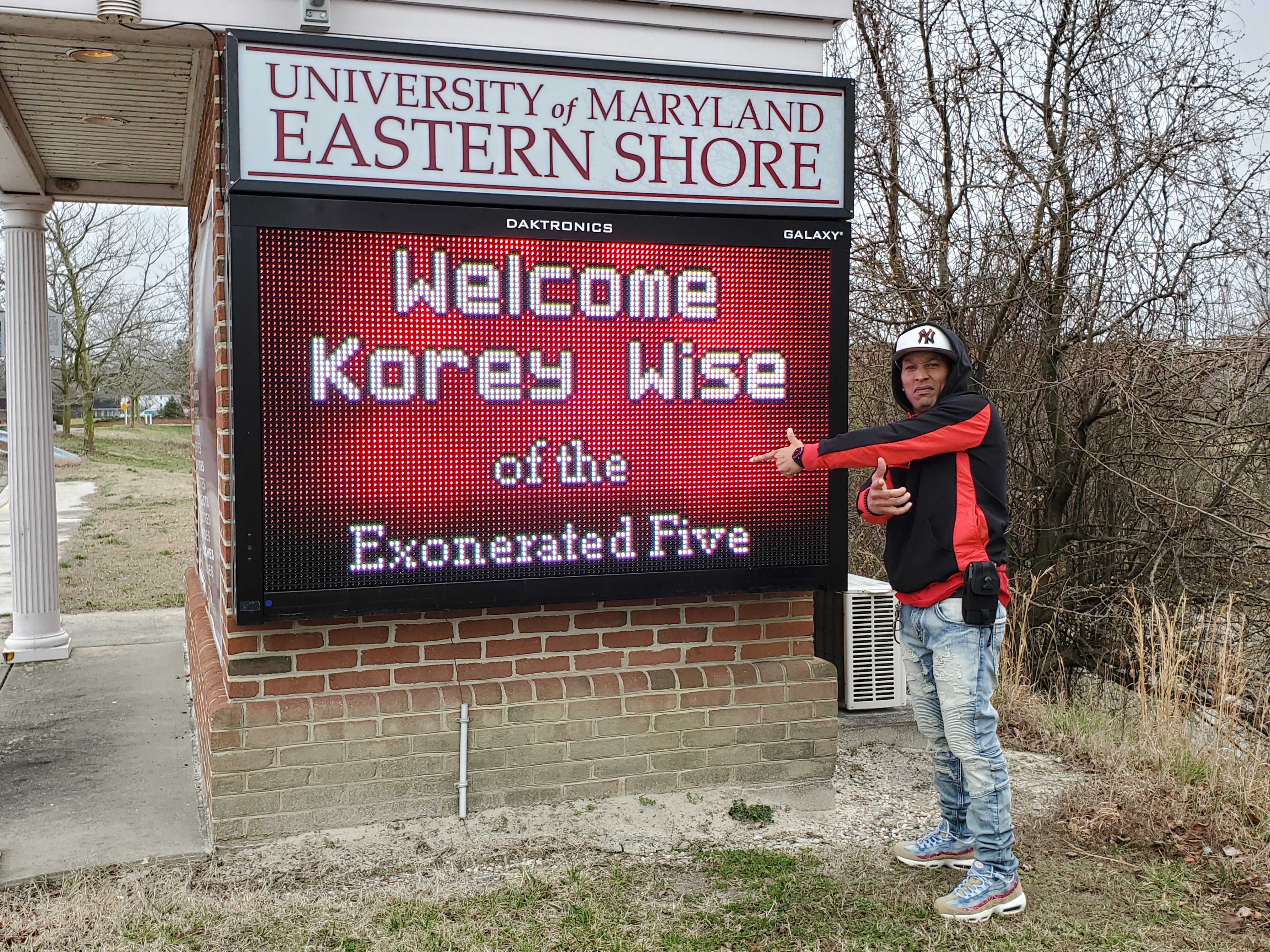
Life Lessons and Life Blessings: Korey Wise urges youth to “listen to your first voice”
The University of Maryland Eastern Shore’s Ella Fitzgerald Center for the Performing Arts held over 1,000 people who sat in piercing silence as Korey Wise of the Exonerated Five shared his painful and triumphant journey from wrongfully convicted child to exoneree with an Emmy-winning story on Feb. 20.
At the age of 16, Wise was one of five New York City teens wrongfully accused and convicted of the 1989 rape of a white female jogger in Central Park. He was the only teen sentenced as an adult to serve five-to-15 years in prison.
Wise, a criminal
justice reform advocate, visited the historically black university in
Princess Anne, Md. as the Black History Month guest speaker for the
event titled “Life After Injustice: A Conversation with Korey Wise.”
Following a student’s introduction, the night began with Wise’s surprise
entrance as he emerged from the audience although they were expecting
him to make a stage wing entrance. “I have to feel their energy,” he
said. Previously, he had been sitting among the crowd during a soulful
rendition of “Lift Ev’ry Voice and Sing,” the Black National Anthem.
“This
is a once in a lifetime event. His story is true. Him here at an HBCU,
we need more stuff like this,” Daronn Wright, an attendee, told local
media in anticipation of Wise’s message.
During the moderated conversation, Wise responded to questions that
were submitted by the audience. He began by thanking Matias Reyes, the
culprit of the near fatal attack, whose confession removed Wise from
nearly 14 years of daily torment.
“If he never said nothing to me, my five to 15 would have turned into 15 to Life,” said Wise.
The audience included local community groups, schools, attendees from
Maryland’s Department of Juvenile Services, Salisbury University, and
Wor-Wic Community College.
Luis Garcia
Social media overflowed with messages
of gratitude and excitement for the opportunity to hear from Wise.
“2.20.20 will go down in the books as one of the best,” said Dom Scott.
“I was so hyped that my question was chosen to ask Korey Wise,” said
Talonda Brown.
The question was “what would you say to your 16-year-old self?”
“Listen
to your first voice. Not your second voice, not your third voice.
Listen to your first voice,” Wise answered urging the youth in
attendance to be careful about decision making and knowing your
friends.
Read more via Tahja Cropper’s original story in the UMES Newsroom.
“In the interest of transparency,” writes Joseph Martin Stevenson of Jackson Free Press, ” I write this op-ed commentary with no personal or professional agenda; no acronyms, prefixes or hashtags behind or in front of my name; and no ulterior motives. I write because I love Jackson State University, both its past treasured history and its future potential trajectory. I have no interest in being considered as the next president at Jackson State, but I do have some constructive suggestions and formative recommendations for the Jacksonians who will hopefully be formidably, substantively, significantly, fairly, and actively engaged in selecting the next leader who manifests as the reckoned righteous one for JSU, Jacksonians, Jackson, Mississippi and the larger HBCU community.”
Stevenson continues, “As far as the current circumstances at JSU, let me say that he or she without mistake or misfortune please come forward as a paragon of perfected proclivity for the rest of humankind. I write this to not defend anyone but to encourage everyone to consider praying instead of placing judgement. That is not our place. Let me also define “reckoning” as it has both direct and indirect relevance and applicability to this op-ed. Reckoning is defined as a person’ s viewpoint or the process or action for calculating or estimating something. This column is not only about viewing others possibly placing judgment but about posing actions and processes to calculate the best outcome of optimal leadership at Jackson State.” Read his full story, originally shared via Jackson Free Press:
Pro-action vs. Reaction
Now is the time to be constructively, pointedly and formatively proactive. Much of the criticisms about the past presidential selections at JSU have been mostly afterward and not so much beforehand. Now that another search is being officially conducted, this is a crucial time to examine all the written, memorized, formal, and practiced policies, procedures, and protocols associated with the search and selection process. There will be an acute need to pay close attention to the specific details and probed questioning, especially to apparent ambiguity, potential misunderstanding, sequential process and unclear intent.
I encourage the analysis of “backward design theory.” I strongly encourage the employment and engagement of this theory as a anticipatory framework to make recommendations or suggestions to others of authority or control on how to improve and monitor promulgated policies and practices. This can make the process more inclusive, participatory, transparent, and representative of Jacksonian voices, convictions and values.
Governance and Mission
Although many leaders have developed tenets, pillars or constructs for their leadership strategy, look for those who remain committed to the foundational and fundamental pillars of modern higher education: teaching, research and service. Moreover, at some point, there should be serious discourse in Mississippi about governance. That is, centralized governance versus decentralized governance and state boards versus local boards.
In the three states where I
worked previously—New Jersey, Florida, and Tennessee—there has been very
successful movement from state boards to local boards. With regard to
JSU being a historically black university, I urge Jacksonians to look
for leaders who can document their commitment to JSU’s historical
foundation but also provide a measurable strategic plan and a way driven
by student learning outcomes to build future foundations. That includes
adding futurism to the mission to build on the institutional treasured
history, given that most companies, organizations, institutions and
sectors—where JSU graduates will land and start careers—study their
mission-positioning for “futuring” their bottom lines for progress,
profit, performance and productivity. JSU and other HBCUs need to add
studying futures to the curriculum and brand it as added-value to the
degree.
The future president must document how she or he will innovate degrees that are academically rigorous and relevant to today’s student, employer and graduate school interests, and responsive to the global marketplace and the accelerating competitive space that drives it. Read more via Jackson Free Press.
Joseph Martin Stevenson of Madison was the first named provost at JSU and also served as a provost at Mississippi Valley State University. Find his books on higher education here and read more about his provostial work at JSU here.