BIRMIGHAM, Ala.– The Southwestern Athletic Conference Council of Presidents and Chancellors has voted unanimously on a five-year contract extension for SWAC Commissioner Dr. Charles McClelland.
The extension which will run through 2025 academic year, was announced on Tuesday afternoon.
“In the past two years the Southwestern Athletic Conference has made
significant strides under the direction of SWAC Commissioner Dr. Charles
McClelland,” said SWAC Council of Presidents and Chancellors Chairman
Dr. Andrew Hugine Jr. “We could not be more excited about the future of
this historic conference, particularly during its Centennial under the
leadership of Dr. McClelland.”
“I’m extremely humbled to have the opportunity to serve as the Commissioner of the Southwestern Athletic Conference,” said McClelland. “I’m also very excited about the what the future holds for the Conference Office and our ten member institutions. As we’ve stated previously our overall objective is to make the SWAC one of the best conferences in the nation. Our membership has my unwavering commitment that we will leave no stone unturned as it relates to achieving that goal.”
About the SWAC
The Southwestern Athletic Conference (SWAC) is considered one of the
premier HBCU conferences in the country and currently ranks among the
elite in the nation in terms of HBCU alumni playing with professional
sports teams.
Current championship competition offered by the league includes
competition for men in Baseball, Basketball, Cross Country, Football,
Golf, Indoor Track and Field, Outdoor Track and Field and Tennis.
Women’s competition is offered in the sports of Basketball, Bowling,
Cross Country, Golf, Indoor Track and Field, Outdoor Track and Field,
Soccer, Softball, Tennis and Volleyball.
Follow the SWAC For complete coverage of the Southwestern Athletic Conference, please follow the SWAC on social media at @TheSWAC (Twitter), @TheSWAC (Facebook), and @TheSWAC (Instagram) or visit the official home of the Southwestern Athletic Conference at www.swac.org.
ANNAPOLIS – Kayla Moore testified Tuesday in Annapolis on how she participated in an exchange program while at Coppin State University in Baltimore with students at Frostburg State University.
Moore recalled that the state distributed more money to Frostburg to deal with pregnancy and opioid challenges in their respective communities.
William J. Ford/The Washington Informer
“Our state is struggling to fill our schools with qualified, diverse
educators, but we will never meet this need if we continue to
essentially divest from our four [historically Black colleges and
universities],” said Moore, 23, a second grade teacher at University
Park Elementary in Prince George’s County. “Doing so poses a negative
impact on graduating high school seniors who want to be educators in
Maryland, ultimately stunting the recruitment of diverse educators from
our state, for our state.”
Moore joined dozens of other alumni, students and other supporters to tell the House Appropriations Committee to fund Maryland’s four historically Black colleges and universities (HBCUs). Specifically, the group called for the committee to recommend legislation sponsored by House Speaker Adrienne Jones for the governor to include $57.7 million in the state’s operating budget beginning in fiscal 2022 for the state’s HBCUs.
Before testimony continued at the hearing, Del. Maggie McIntosh
(D-Baltimore City), who chairs the Appropriations Committee, praised
Moore.
“You are an example of what we want to move toward in Maryland,” she said to rousing applause.
The bill is one of the top priorities of the Legislative Black Caucus
of Maryland, which seeks to end the ongoing 13-year HBCU lawsuit.
The money would be designated this way: $24 million for Morgan State University, $16.7 million for Bowie State University, $9.6 million for the University of Maryland Eastern Shore and $7.2 million for Coppin State University. Read more via Washington Informer.
Claflin University is planning this year to launch a graduate nursing
program and a climate change focus for its graduate biotechnology
program.
The university also intends to introduce a graduate and undergraduate certificate program in a new center for artificial intelligence, according to university Provost and Chief Academic Officer Dr. Karl Wright.
Nursing students attending Claflin will be able to receive a master of science in nursing in fall 2020 as the university introduces the program into its degree portfolio, Wright told those gathered for the quarterly meeting of The One Orangeburg County Initiative.
“There is a great need for graduate-level nurses in South Carolina,”
Wright said, citing a university-commissioned research study. “They will
help meet the nursing needs in the rural communities that are
underserved by the health care profession.”
Wright said the program still needs to receive accrediting approval from the Southern Association of Colleges and Schools, which the university will hear from in June. If the program is OK’d, Claflin will be the only historically black college or university in the state to have a graduate nursing program. Less than a handful private colleges offer such a program.
Wright said the degree would have two tracks — nurse practitioner and nurse educator.
The graduate degree in nursing would follow on the heels of the university’s launch of a bachelor of science in nursing in 2016.
Claflin is the only HBCU in the state offering a BSN degree.
Since the program’s inception, 52 graduates have completed the 100%-online program.
Claflin’s
RN to BSN program is accredited by the Commission on Collegiate Nursing
Education Board of Commissioners, meaning that the nursing program
consistently demonstrates quality in mission and governance,
institutional commitment and resources, and curriculum and
teaching-learning practices.
The program was also awarded Best Nursing Program at the 2019 HBCU Awards ceremony this past August.
The university is also planning to re-engineer its master of science in biotechnology and turn it into an online delivery format focusing on climate change. The climate change track would include such courses as bio-mathematics, Wright said.
The track most likely will be unveiled after the 2020-21 academic year. Read more via Index Journal.
Dallas Weeklyshares, The Dallas Mavericks are proud to announce the unveiling of its newest basketball court at Paul Quinn College, the only Historically Black College in the City of Dallas and the first Urban Work College in the country.
The court dedication will take place on Wednesday, Feb. 26, 2020, at Paul Quinn College marking the 27th court donated back to the community by either the Dallas Mavericks or the Mavs Foundation.
Dallas Mavericks legends will join forces with Paul Quinn College leaders for this celebratory event to officially unveil the court, created to generate excitement for students and surrounding community.
Paul Quinn College president, Dr. Michael J. Sorrell, will attend along with Mavs special guests, Cedric Ceballos, Erick Strickland and Randy White.
The Paul Quinn College court is especially unique to the city because the design was inspired by renowned Dallas street artist, Tex Moton.
Sport Court® technology installed a professional-grade quality basketball court that is known around the world for its safety and performance. The surface is splashed with an abstract masterpiece designed by Moton that includes a one-of-a-kind custom mural painting. The university also received other cosmetic upgrades like new basketball goals and bleachers. Read more via Dallas Weekly.
Stephanie Farr of the Philadelphia Inquirershares a heartfelt article about one special man’s dedication to one of the nations oldest historically black colleges and universities:
JESSICA GRIFFIN / Philadelphia Inquirer Staff Photographer
Meet Michael Ruff, foster dad and boiler tech at Lincoln University, where he’s worked for 50 years.
• Retirement options: “I often think ‘What am I going to do if I retire?’” Ruff said. “I’d rather be working.”
• Foster care and concern:
Ruff and his longtime partner have fostered between 20 and 30 children.
“It’s exciting but it’s also scary,” he said. “You hope you get the
right kids to fit you.”
Michael Ruff was a senior at Avon Grove High School when he went to Lincoln University for the first time. It was a trip with his high school sweetheart to pick up her mom from work.
The university’s housekeeping foreman saw Ruff on campus and asked if he was looking for a job.
“Yes,” his girlfriend’s mother answered for him.
No matter that Ruff already had a job at a knitting mill in West Grove — his girlfriend’s mom obviously thought this one was better.
As it turned out, Ruff’s hours were getting cut back at the mill and he did need something more stable. So in December 1969, he took a job in housekeeping at Lincoln University — one of the country’s first Historically Black Colleges and Universities (HBCUs).
Ruff couldn’t have known then just how stable the job at Lincoln would be. He doesn’t have that girlfriend anymore, but 50 years later, he still has a job at the university, where he now works as a boiler tech. He is the longest-serving employee on Lincoln’s campus. Read more via Philadelphia Inquirer.
News One has the latest news from a black perspective with stories and opinions you would not read anywhere else — but should and it seems that they are always creating moments for the culture.
Yesterday, the black news site released a list of 20 HBCU graduates who are basically changing the world, celebrating the country’s historically black colleges and the professionals who have attended those institutions.
Stacey Abrams, Spelman College
2. Rev. William Barber II, N.C. Central University
3. Kenya Barris, Clark Atlanta University
4. Rosalind G. Brewer, Spelman College
5. Ruth Carter, Hampton University
6. Raashaun “DJ Envy” Casey, Hampton University
7. Louis Farrakhan, Sr., Winston-Salem State University
8. Andrew Gillum, Florida A&M University
9. Rep Al Green, Howard University, Texas Southern University, Tuskegee University
10. Kamala Harris, Howard University
11. Jesse Jackson, North Carolina A&T University
12. Samuel L. Jackson, Morehouse College
13. Letitia James, Howard University
14. Kweisi Mfume, Morgan State University
15. Marilyn Mosby, Tuskegee University
16. Bakari Sellers, Morehouse College
17. Ruth Simmons, Dillard University
18. Stephen A. Smith, Winston-Salem State University
19. Wanda Sykes, Hampton University
20. Oprah Winfrey, Tennessee State University
The list includes HBCU graduates from the arenas of politics to entertainment to corporate America and well beyond.
Katherine Johnson, a notable African American, NASA Mathematician, and one of the 3 legendary women depicted in film HiddenFigures, passes away at 101-years-old.
NASA / Getty Images file: Katherine Johnson at Langley Research Center in 1966
Johnson attended West Virginia State University (then WV State College), enrolling at the age of 15. Given her trailblazing legacy, it is unsurprising to learn how quickly she excelled, graduating summa cum laude in 1937 at 18-years-old with bachelor’s degrees in both mathematics and French. Johnson was a proud member of Alpha Kappa Alpha, Sorority, Inc.
“You got the best education there could be at the time (in Institute),” Johnson recalled recently in the documentary ‘Rise Up West Virginia.’ “You knew everybody. It was a small high school and it was pleasant to be there, but everybody knew you. Everybody in the high school knew everybody in the college and it was just like being at home.”
Patrick Wymore / ABC via Getty Images file
Notable moments on Johnson’s career include:
Becoming the first woman in the Flight Research Division to receive credit as an author of a research report for her work with Ted Skopinski on detailing the equations describing an orbital spaceflight
According to NASA, when Johnson was asked to discuss her greatest contribution to space exploration,she reflects on the calculations that helped synchronize Project Apollo’s Lunar Lander with the moon-orbiting Command and Service Module
Becoming one of the first African American women to work at National Advisory Committee for Aeronautics (NACA), calculating the trajectory for Alan Shepard, the first American in space
Being names Mathematician of the Year in 1997 by the National Technical Association.
Receiving an honorary Doctor of Law degree from the State University of New York and honorary Doctor of Science degrees from Capitol College in Maryland and Old Dominion University in Virginia
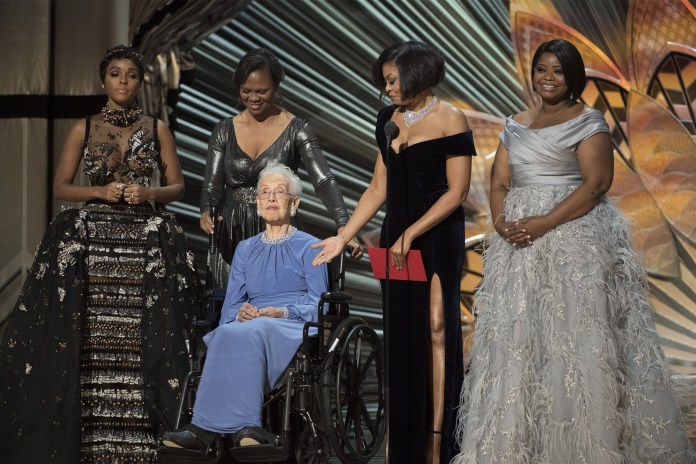
In the film HiddenFigures she was portrayed by fellow HBCU alumna, Taraji P. Henson. Actresses Octavia Spencer and Janelle Monae portrayed her trailblazing “co-legends,” Dorothy Vaughan and Mary Jackson, respectively. Henson shares,:
Thank you QUEEN #KatherineJohnson for sharing your intelligence, poise, grace and beauty with the world! Because of your hard work little girls EVERYWHERE can dream as big as the MOON!!! Your legacy will live on… https://t.co/sMv6kETbjV
When Johnson was honored by President Barack Obama in 2015, NASA shared:
WVSU shared, “In bestowing the award, President Barack Obama called Johnson, “a pioneer in American space history,” whose mathematical calculations “influenced every major space program from Mercury through the Shuttle program.”
NASA
Katherine Johnson was 5 years shy of being a 100-years-old when she was recognized by President Obama—some 30 years after she retired from NASA.
“The Presidential Medal of Freedom is the Nation’s highest civilian honor, presented to individuals who have made especially meritorious contributions to the security or national interests of the United States, to world peace, or to cultural or other significant public or private endeavors…” writes NASA.
In a statement released earlier this morning, NASA shares, “Our NASA family is sad to learn the news that Katherine Johnson passed away this morning at 101 years old,” NASA Administrator Jim Bridenstine posted to Twitter. “She was an American hero and her pioneering legacy will never be forgotten.”
One of Johnson’s wishes included educating those who come after her. Click “here for lessons Katherine would like to pass on to the next generation,” shares NASA.
Our heartfelt condolences to the Johnson family and her loved ones.
WILBERFORCE, OH—Over the next four years,academics and researchers from Nigeria seeking to enhance grant writing skills will attend week-long capacity building workshops at Central State University’s (CSU) newly established Cynthia Jackson-Hammond Institute for Professional Development.
The Institute, housed within the College of Engineering, Science, Technology, and Agriculture (CESTA), is named after Central State’s outgoing president, and will serve as an international leadership and professional development center. Through this collaboration with the Nigerian government, Central State University will officially begin training leaders on a global scale.
The first Capacity Building (CB) workshop is scheduled for Feb. 24-28, at the CSU’s Xenia facility, located at the Xenia YMCA, 336 Progress Dr, Xenia, OH 45385.
“This conference was organized for Research Academics in Nigerian Public Universities,” said Dr. Ibrahim Katampe, conference organizer and assistant director of Innovation and Technology Transfer for CESTA at Central State University. “The February event is the first of many that will take place over the course of the next four years and was designed specifically to train academicians in Nigerian Higher Educational Institutions (HEI’s) with current knowledge and skill required to write a fundable research proposal that meets international standards.”
The Tertiary Education Trust Fund (TETFund) was established by the Nigerian government as an intervention agency under the TETFund ACT – Tertiary Education Trust Fund Act, 2011.
The TETFund monies provide for the essential physical infrastructure for teaching and learning, instructional material and equipment, research and publication, academic staff training and development, and any other need that may be deemed critical and/or essential for the improvement of quality and maintenance of standards in the higher educational institutions.
Under its mandate of Research and Academic Staff Training and Development, a sub-committee of the TETFund was set up in May 2019. This committee was tasked with developing a framework for the strengthening and institutionalization of Research and Development in Tertiary Institutions in Nigerian Universities.
Co-chaired by Professors Placid Njoku and Tope Togunof Nigeria, along with Dr. Ibrahim Katampe serving as vice-chair, the committee developed a plan and made recommendations to Professor Suleiman Bogoro, Executive Secretary of the TETFund.
In June, Professor Bogoro and members of the committee, paid a visit to the U.S. as part of a global assessment of “best practices.” Stops included meetings with officials of the U.S. State Department, the National Science Foundation (NSF), GE Global Research Talent Center in New York, and Central State—an 1890 Land-Grant University.
“It was during that visit we began discussing the possibility of collaboration,” Dr. Katampe said. “Prof. Bogoro and the committee were warmly welcomed by President Cynthia Jackson-Hammond, Provost Pedro Martinez, and CSU CESTA Dean and Land-Grant Director Dr. Alton B. Johnson, they immediately welcomed the idea; and this partnership is a direct result of that initial conversation.”
Dr. Jackson-Hammond has been an ardent supporter of international engagement and is especially committed to partnerships with Nigeria. “This opportunity to support the TETFund program allows us to integrate Central State University’s scholarship and professional development with Nigeria’s influential and brightest minds,” said Dr. Hammond. “We are honored to be partners in this global expansion of connectivity.”
According to the National Universities Commission (NUC), Nigeria presently has 43 Federal Universities, 48 State Universities, and 79 Private Universities. About 120 Polytechnics and Colleges of Agriculture. There are 82Colleges of Education in Nigeria, consisting of 22 federal, 14 private and 46 that are collectively referred to as HEIs. The five-day workshop developed by CSU is designed to support TETFund in its Capacity Building Program (CBP) for enhancement of research activities in the Nigerian HEIs.
“This involves delivery of high-quality training in academic writing, research proposal writing and research management skills that meets international standards in research design, conduct, and management,” said Dean Johnson. The course content will be designed and delivered by highly experienced staff of Central State University.”
To learn more about the conference or the Cynthia Jackson-Hammond Institute for Professional Development, contact CESTA at 937-376-6677 or visit centralstate.edu online.
###
About Central State University
Central State University, located in Wilberforce, Ohio, is a regionally accredited 1890 Land-Grant University with a 133-year tradition of preparing students from diverse backgrounds and experiences for leadership, research, and service. The university, which was named 2017 HBCU of the Year by HBCU Digest, fosters academic excellence within a nurturing environment and provides a strong liberal arts foundation and STEM-Ag curriculum leading to professional careers and advanced studies globally.
Central State University, an 1890 Land-Grant Institution, is committed to the full inclusion of all people, and does not discriminate on the basis of age, ancestry, color, disability, gender identity or expression, genetic information, HIV/AIDS status, marital or family status, military status, national origin, political beliefs, race, religion, sex, sexual orientation, or veteran status. If reasonable accommodations are needed, please contact the Department of Human Resources at 937-376-6540. Affirmative Action/Equal Opportunity Institution.
Dr. Hadiyah-Nicole Green has become the first person to successfully cure cancer in mice using laser-activated nanoparticles, according to Black Culture News.
Unlike traditional cancer treatments, Green’s revolutionary and unique nanoparticle technology, which was found to successfully cure cancer after testing on mice within 15 days, does not require chemotherapy, radiation, or surgery. Green received a $1.1 million grant from the U.S. Department of Veterans Affairs to expand her nanoparticle cancer treatment research.
Green’s interest in cancer treatment stems from witnessing the death of her aunt, Ora Lee, who suffered from cancer, and her uncle, General Lee Smith, who also was diagnosed with cancer and experienced the negative side effects of chemotherapy treatment.
Green is, not surprisingly, highly educated. In her pursuit to fight cancer she obtained her bachelor’s degree in physics and optics from Alabama A&M University and later earned her master of science in physics from the University of Alabama at Birmingham, both of which she received full scholarships for. After earning her degrees, she transitioned to the Comprehensive Cancer Center for five years and the Department of Pathology for one year, according to afrotech.com.
Currently, Green’s Ora Lee Smith Cancer Research Foundation, the nonprofit she founded in memory of her aunt, is continuing to fight cancer using laser-activated nanoparticles and focusing on its mission to make cancer treatment accessible, affordable, and effective. She devotes time to helping young black students as well.
Strides in cancer treatments/cures are very important. According to the American Cancer Society, in the U.S. alone, an estimated 606,520 people will die from cancer in 2020. This equates to 1,660 people dying of cancer each day in 2020. Approximately 69% of people diagnosed with cancer between the years 2009 and 2015 were alive five years after their diagnosis. This is higher than people who were diagnosed with cancer between the years 1975 and 1977. Between these years, 49 out of 100 people, or 49%, were alive five years later.
This post was written by Cedric Roland Michel, a writer at Black Enterprise, where it was originally published. It is published here with permission.
Renewed attention is being directed to historically black colleges and universities (HBCUs), the slightly more than 100 public and private institutions of higher education established primarily for the purpose of serving the African American community.
The Higher Education Act of 1965 defines an HBCU as: “…any historically black college or university that was established prior to 1964, whose principal mission was, and is, the education of black Americans, and that is accredited by a nationally recognized accrediting agency or association determined by the Secretary [of Education] to be a reliable authority as to the quality of training offered or is, according to such an agency or association, making reasonable progress toward accreditation.”
HBCUs have long been a key source of access to postsecondary education, and not only for black students. They also have served a significant proportion of first-generation students and those from low-income families who struggle to afford college—a growing segment of students in the United States.
According to the American Council on Education, HBCUs represent just 3% of two-year and four-year public and private nonprofit institutions taking part in federal student financial aid programs, but they award 17% of all bachelor’s degrees earned by black students. With an overall enrollment of about 300,000 students, HBCUs also play a major role in graduating black students with bachelor’s degrees in STEM fields.
HBCUs have been battling strong headwinds. They are chronically underfunded compared to other public institutions. Their endowments are smaller than most private schools. And like many institutions, they are grappling with declining enrollments, although because the typical HBCU is relatively small, they often have little cushion to absorb decreased tuition revenue.
Nonetheless, the past couple of years have seen signs that HBCUs are beginning to receive the attention and respect they deserve from policy makers, and that focus is intensifying as we come closer to the national elections. One indication of this renaissance is the extent to which elected officials and candidates for the Presidency have drafted specific proposals for advancing HBCUs.
In 2017, President Trump signed an Executive Order establishing “The White House Initiative to Promote Excellence and Innovation at Historically Black College and Universities.” That action appears to have been mostly symbolic, moving the White House Initiative on HBCUs from the Department of Education to the White House from the Department of Education and designating a senior official to oversee the initiative.
Last December Trump signed the Future Act, a rare triumph of congressional bipartisanship that permanently provides more than $250 million a year to the nation’s HBCUs along with many other institutions serving large numbers of minority students. The bill restored the $255 million in annual funding that had lapsed earlier in the year. In addition to $85 million a year for HBCUs, it authorized $100 million for Hispanic-serving institutions, $30 million for tribal schools and $40 million for other minority-serving institutions. Lawmakers also added an amendment that simplifies the Free Application for Federal Student Aid, or FAFSA.
Each of the six leading candidates for the Democratic nomination for President has proposed investing more money in HBCUs along with plans for bolstering their mission.
The objective of the event was to expose Homestead students to the vast academic and athletic opportunities offered by institutions created to meet the higher education demands of African Americans, prior to the Civil Rights Act.
For a century following the abolishment of slavery in United States (in 1865), African Americans in the southern states were denied admission to postsecondary institutions for their education.
Similarly, several universities across the country adopted quota policies which restricted the enrollment number of Blacks to their institutions. Thus, colleges and universities created for students of African descent were founded to educate subsequent generations of black intellectuals and professionals of color.
Currently, there are over 100 HBCUs across the continental U.S. and Caribbean islands between the private and public sectors of education.
The college fair featured on-site admission and scholarship opportunities for qualified students to attend some of our nation’s top HBCUs.
Attendees received a Passport for Success which contained suggested questions for college admission officers, answered general questions on securing financial aid, and provide a comprehensive list of participating schools.
Students who visited all the suggested stops to college admission were eligible to participate in raffles for cash prizes, gift cards to local attractions, or college survival guide publication. By the fair’s completion, we were able to serve 1,000 students and award 60 college acceptance letters with scholarship offers during the event.
Several waves of over 300 students pack Homestead High’s gymnasium to attend HBCU Fair.
Participating HBCU’s
Thank you to the HBCU partners in attendance for helping to ensure the college fair’s success: Howard University, Philander Smith College, Florida Agricultural and Mechanical University, Shaw University, North Carolina Central University, Florida Memorial University, Morehouse College, Grambling State University, and Tennessee State University. Tougaloo College, Fort Valley State University, Albany State University, Savannah State University, Hampton University, University of Maryland- Eastern Shore, Benedict College, Fayetteville State University, North Carolina A&T University, Alabama State University, and Talladega College also provided collateral materials to support the activity.
The program helped to initiate a newly forged agreement between Homestead High School and its 30 HBCU Partners to recruit students from the area and offer them sufficient support and financial resources to attend their respective universities.
For the past 18 years, since my retirement as a superintendent of schools and college president, I worship on a rotating basis at five different churches in Daytona Beach (Fla.) for my community involvement.
I was baptized in 1953 at Ebenezer Missionary Baptist Church in Memphis, Tenn. God has been my spiritual guiding force daily. As a public servant, community leader and career educator, my life’s work has been to serve, to give, to support and to mentor our young people.
WHAT HAPPENED?
Sunday is still the most segregated day of the week. We African Americans were forced to create our own religious institutions and our Historically Black Colleges and Universities (HBCUs) because Whites refused to accept or allow Blacks to attend their churches and colleges.
Hundreds of years later, I ask the question, “What happened to our Black churches and HBCUs?”
My generation gave up most of the gains, sacrifices and struggles that our ancestors made to educate us and gave us a place to worship and to be liberated and educated as human beings.
In the past, many Black churches and HBCUs were open seven days a week. This was when they were a viable part of the daily life of the Black community. Today, many Black churches are only open three or four days a week. Our HBCUs close their doors on Friday and open back up on Monday.
There is a huge disconnect between my generation and two to three generations of young people. As a result, the survival of our Black churches and HBCUs is at a crisis stage. African Americans have retrogressed on every front: education, religion, politics, economics; not respecting our elders, not knowing and appreciating our history.
SPELMAN COLLEGE — Spelman College, in partnership with Columbia Theological Seminary and the Presbytery of Greater Atlanta, will host the Beyoncé Mass at 7 p.m., March 2, in Sisters Chapel.
Created and curated by Rev. Yolanda Norton, H. Eugene Farlough Chair of Black church studies and assistant professor of Hebrew Bible at San Francisco Theological Seminary, the Beyoncé Mass uses music from the Grammy-winning songstress to cultivate an empowering conversation about Black women.
“We’re honored to host the Beyoncé Mass. This event is a natural extension of what we stand for in Sisters Chapel, as the spiritual center of Spelman College,” said the Rev. Neichelle Guidry, Ph.D., dean of Sisters Chapel and director of the Women in Spiritual Discernment of Ministry Center. “In my role as dean, I recognize that a creative womanist approach to spirituality is necessary to sustain Black women.”
The Mass serves as the kickoff to Sisters Chapel’s Women’s Herstory Month.
“During
the month of March, we will honor the transformative contributions of
Black women to the world, particularly in the forms of liberating
spiritualties and theological conviction,” shared Dr. Guidry. “In so
doing, we will continue to position Spelman as a beacon, not only of the
mental development of Black women, but also for the nourishment of
their souls and their hearts.”
The inaugural Beyoncé Mass, held in April 2018 at San Francisco’s
historic Grace Cathedral, drew roughly 1,000 people. Since then, the
worship service has traveled across the globe to major cities, including
Los Angeles, New York City and Lisbon, Portugal.
“Beyoncé Mass, as a Christian worship experience that is open to all, is
not a ceremony deifying Beyoncé,” said Rev. Norton. “Our hope is to
glorify God, tell Black women’s stories, and give people healing space
to see how they are included in the divine narrative.”
The liturgy of Beyoncé Mass includes music from the artist’s vast discography, readings from womanist scholars and prominent Black female leaders, and a sermon from Rev. Norton.
“We, at Columbia Theological Seminary, are excited to partner with Rev. Norton and Spelman College to bring the Beyoncé Mass to Atlanta,” said the Rev. Brandon Maxwell, vice president of Student Affairs and Community Life at Columbia Theological. “It is a unique time at the seminary. We have the privilege of having four womanist scholars on our faculty across biblical studies, theology and ethics, and practical theology. It has really created a lively conversation among our students and in the community more broadly. We see this partnership as congruent with our deep commitment to 21st century church and liberation theology.”
The event is free and open to the public. Space is limited. To register visit here.
This press release was originally shared via Spelman College.
Welcome to the “First Ever Historically Black Colleges & Universities (HBCU) All-Star Game Experience” featuring our talented and hard-working men’s basketball student-athletes from the NCAA Division I Mid-Eastern Athletic Conference (MEAC) & Southwestern Athletic Conference (SWAC), Tennessee State & Hampton University and NCAA Division II Central Intercollegiate Athletic Association (CIAA) & Southern Intercollegiate Athletic Conference (SIAC)” at Morehouse College Forbes Arena on Friday, April 3rd in Atlanta, GA!
“The First Ever HBCU All-Star Game Experience” will be “THE GAME CHANGER NEEDED” and a great opportunity to showcase the best and brightest student-athletes and coaches in “Black College Basketball” on a national platform…a sport that we truly love…our African-American male student-athletes have dominated this “GREAT” game of basketball throughout the years, and have proved to be the very best on all levels across the country…around the world!
Atlanta…The City Too Busy Too Hate, HBCU alumni, fans, supporters, key stake-holders, Greek Organizations, All-Star Game Experience staff and volunteers, local business, sports, civic, and community leaders, NABC, NCAA & NAIA coaches, university colleagues, conference commissioners, and athletic administrators in the “Historically Black Colleges & Universities are truly looking forward to hosting the “First Ever HBCU All-Star Game Experience in Atlanta”.
The time is “NOW” to help us celebrate the “Proud and Rich History” of our “HBCU’s in the great city of Atlanta…the BLACK MECCA. “The HBCU All-Star Players” will be provided great exposure opportunities in front of NBA and G-league executives, scouts, coaches, personnel, as well as international teams, coaches, and scouts from around the world visiting Atlanta for College Basketball Biggest Game. This will be a “BIG-TIME” event for the City of Atlanta, HBCU’s in the metropolitan area of Atlanta University Center (AUC), across the state of Georgia, and HBCU’s nationally with the MEAC, SWAC, SIAC, CIAA schools, conference offices and commissioners, Director of Athletics, Athletic, Administration, students, fans, alumni, boosters, key-stake-holders, loyal and local HBCU community, business partners, and sponsors.
This is going to be an amazing, impactful, and life-changing moment for all of our ambitious HBCU student-athletes and brilliant coaches. What a “BIG-TIME EVENT FOR ATLANTA & THE WESTSIDE COMMUNITIES”. We will have media day, welcome reception, college admission fair, awards ceremony, legendary coaches & players’ recognition, pre-game “Battle of the Bands, Cheerleading & Dance Competitions, pre-game Fraternity & Sorority step-show, live music & DJ, food trucks and kids interactive play areas, face-painting, concessions, food trucks, HBCU merchandise, vendors, and special celebrity guests.
It’s very important to come out and show your HBCU pride with family, friends, and make an investment in these young men for “The First Ever HBCU All-Star Game Experience” celebrating “THE BEST IN BLACK COLLEGE BASKETBALL”. Your attendance, ticket purchase, donation, and sponsorship will help bring positive change and much-needed support for this worthy cause featuring the top HBCU student-athletes & coaches from across the country.
HBCU family, we all know that historically black colleges and universities, or HBCUs, have a lot of rich history and these institutions graduate a significant amount of black professionals across many fields like lawyers, doctors, engineering and entertainment.
On the surface, you would think that HBCUs do a great job at recording important events throughout the decades and have it archived, making it possible for those after us to witness a legacy that can never be undone. But that is not the case with many black colleges.
“I know we made recordings of Dr. Martin Luther King, Stokely Carmichael, James Farmer, Roy Wilkins, Ralph Abernathy and many others,” read Jocelyn Robinson from an email she had gotten from a school in North Carolina. “The library has since moved to a newer facility, and I don’t know if those tapes made the transition or if they were thrown away.”
Robinson revealed this fact during an interview with NPR where she spoke in regards to the email response she had received from the school. She is on a year-long project to find out if HBCUs have any recording and whether [or not] they have been properly achieved on campus in libraries.
NPR’s Sophia Alvarez Boyd said “Preservation is time-consuming and costly work. And HBCUs tend to have limited funding and much smaller endowments than non-HBCUs. In some places, Robinson has seen cassette tapes and floppy disks thrown into unlabeled boxes or bags, reel-to-reel tape that’s past repair. At one school, she says, there wasn’t anything saved from over 40 years of broadcasting. So Robinson is trying to get more schools at least thinking about preserving what they’ve got.”
Robinson responded, “I’ve come to find that very few radio stations have a relationship at all with the archivist on their campus.”
Bowie State University, an HBCU in Maryland, opened its new food pantry where students can shop for food for free. The food pantry and nutrition lounge was made possible through a new partnership with Capital Area Food Bank and Food Lion. The Food Lion Feeds program donated $10,000 to Maryland’s first HBCU to launch the pantry, according to WJLA. Students will be able to grab food items for free and Capital Area Food Bank will ensure that the pantry stays stocked. The university stated that many of its students only eat one meal per day, so having a food pantry with fresh produce will allow them to get a healthy alternative whenever they want one. The food pantry also includes a lounge with sofas and a television.
“When we talked about this concept with Food Lion we really wanted to attack the stigma and breakdown the stigma of people feeling like they didn’t want to come and get food because of the thought that there is something wrong with suffering from food insecurity,” Brent Swinton, Bowie State vice president for Institutional Advancement said in a statement sent to WJLA. “That’s a growing trend across the country and colleges are attacking that and Bowie State University is at the cutting edge. So we want people to feel welcome, to come in and realize that this is all about making sure nutrition is available so our students can achieve in the classroom.”
The stigma that college students mostly eat frozen pizza and ramen noodles stems from the fact that paying for food could be very costly. The average cost for an 8-month meal plan for an undergrad is roughly $4,500, although this number can vary greatly depending upon the school, according to edmit.me. An individual college-aged student will spend approximately $163–$367 monthly, according to a report. BSU started a great initiative and Swinton said this is just the beginning. He hopes to eventually stock the lounge with free toiletries for students, as well as food