Some unfortunate news has been released regarding one Tennessee State University‘s star basketball players: Hercy Miller is out for the rest of the season due to an injury. Get the full story from TMZ Sports below.
Credit: Getty
TMZ Sports spoke to Hercy Miller’s dad — AKA Master P — about his star freshman hoops playing son. P revealed Hercy had been dealing with the lower leg injury for some time … and tried to play through the pain.
Master P says HBCUs need more funding to bring their medical services up to par with powerhouse basketball programs across the country.
P also told us universities have been attempting to re-recruit Hercy now that he has been granted 4 years of college eligibility … despite playing in a handful of games for Tennessee State.
Sad news from Hercy Miller — Master P‘s Tennessee State hoops star son is out for the rest of the year after suffering a season-ending injury.
The freshman guard made the announcement on Tuesday … saying, “Due to a lower-body injury I’ll be out for the ’21-’22 season.”
But, don’t worry, Tigers fans … the 19-year-old says he’s already looking forward to his comeback campaign.
“I’ll be back next year for the show! Stronger and better,” he added.
The 6’3″ guard averaged 10 minutes in 6 appearances for the Tigers … scoring an overall total of 13 points. TSU is currently 1-5.
“THANK YOU, to all the fans,” Miller said, “and everyone who supported me this season.”
Miller — who was a 3-start recruit from Minnehaha Academy — picked the HBCU earlier this year over UCLA, LSU and other Power 5 programs.
As we previously reported, Hercy signed a multi-million dollar endorsement deal after the NIL policy change … telling us in July, he learned from his dad.
“I signed a deal with an American technology company. Like my dad said, it’s a blessing,” Miller said.
“I learned from my dad, I’m gonna start off by giving back to the community and everyone around me.”
Delaware StateUniversity has hit new enrollment records at rates that have never been seen before! Get the full story from the DSU release below.
In a continuation of the unrelenting growth trajectory that has seen the institution expand by 40% between 2009-2019, Delaware State University has once again established multiple enrollment records during the Fall 2021 Semester, including the largest student body ever (5,649), surpassing its previous record of 5,054 in 2019.
The University also achieved records in the categories of undergraduate students (4,848), graduate students (801), and online enrollment (317). The 9.7% rise in undergraduate enrollment (an increase of 429) was a major factor in achieving the record total enrollment figure.
The new Freshman class totals 1,023 students, including 445 in-state students, 298 of whom received the state-funded Inspire Scholarship. This represents a 67% increase in Inspire Scholars driven, according to school officials, by the expansion of the scholarship to cover full tuition for all four years of attendance. This undergraduate success has also been bolstered by a Freshman retention rate that has stayed above 70% for the past seven years, with the latest figure being a record-breaking 75.1%.
“We are thrilled to be bucking some major national trends,” said Antonio Boyle, Vice President for Strategic Enrollment Management. “According to the National Student Clearinghouse Research Center, higher education numbers around the country are down in all those categories this fall.”
Boyle noted that these increases also correspond with the expansion of the University’s footprint with the acquisition last summer of the former Wesley College, now renamed DSU Downtown and serving as the home of the Wesley College of Health and Behavioral Sciences. Wesley legacy undergraduates account for 334 new enrollees at Delaware State University, over two-thirds of those eligible to continue their progress toward degrees at significantly reduced tuition rates.
The graduate enrollment record – 193 students over the previous year – is largely a result of the University’s strengthened emphasis on its master’s and doctoral programs, which has accounted for enrollment increases over 20% for each of the last four years. Graduate Dean Dr. Patrice Gilliam-Johnson credited much of the growth to “everyone on the faculty and staff being personally engaged in recruiting and spreading the word about the tremendous value of our low-cost, high-quality degree programs.”
Gilliam-Johnson said that much of the enrollment growth could be attributed to the School of Graduate, Adult, and Extended Studies’ most popular majors, including Social Work (230 students), Educational Leadership (148 students), and the Master of Occupational Therapy (93 students), which came to Delaware State University this year from Wesley College. “Our MSW and MOT programs are unique in the state,” she said, “and have become major attractors for students interested in starting new careers with strong growth potential.”
Graduate enrollment also received a boost from the University’s international programs, where 108 students are now enrolled in new Educational Leadership degrees in Changchun, China, and in Jamaica.
The total international enrollment, either in residence in Delaware or offered through partner institutions abroad, rose by 173 to a record 623 students, with enrollment in the University’s Accounting and Computer Science programs at Ningbo University of Technology in China likewise hitting a new record with 449 students. This 38% growth stands in sharp contrast to a 21% average decline in international enrollment nationwide, which has suffered primarily due to travel restrictions resulting from the COVID-19 pandemic.
President Dr. Tony Allen emphasized that achieving such increases across the board during a global pandemic has required thoughtful planning, administrative flexibility, and careful marketing of the University’s value proposition.
“In so doing, we have had to grow responsibly and with clear intention. Investments like the Inspire Scholarship, the Early College High School, and the acquisition of Wesley College have helped us move the needle,” Allen said. “Still, execution is always at the forefront of our minds. Our students come to us not simply for quality education, but to literally change the trajectory of their lives for themselves, their families, and their communities. They deserve our very best in helping them do exactly that.”
Former Kentucky State University Regent Lester Mimms is being memorialized with a hiking trail in a historic state park! Get the beautiful full story from Madisonville, Kentucky’s The Messenger below.
Credit: Cherokee State Historic Park/Facebook
They called him “Professor.”
From the testimonials of his students, Lester Mimms earned the cognomen as more than just a sign of respect, but also as a term of endearment.
At the time of his death in October 1991, a former student who later worked with Mimms as a teacher, Marion Gill said, “He thought it was necessary for every boy and girl to have an education. He was always interested in his students. He was very good to his students, and his students loved him.
The long-time Hopkins County educator and civic leader was recognized Thursday as a hiking trail at Kenlake State Park was named for him in honor of his service to the young people of Earlington.
The two-mile long trail connects Cherokee State Park with Kenlake Campground in Marshall County.
The trail’s significance mirrors that of Mimm’s own career. Cherokee, now part of Kenlake State Park, was built in 1951 as the only segregated state park in the South, and one of only three such resorts in the entire country. The 300 acres housed a 200-seat dining hall—which was renovated in 2009—a restaurant, cottages, and a bath house. Upon the desegregation of travel and lodging in the 1960s, Cherokee became part of Kenlake. Most of the cabins at Cherokee were relocated and many other structures were abandoned.
Mimms guided the students of J. W. Million High School into the era of desegregation by becoming Kentucky’s first Black principal of an integrated school, Earlington High School, in 1967.
Credit: Kentucky State University/Twitter
The Professor was the third and final principal of Million, serving in that role from 1943 until its closure in 1965. He taught one year at Earlington before taking the administrative position from which he would retire in 1970.
Mimms was also an outstanding basketball coach.
Gill recalled the excitement the students felt for the Million team.
“”He kept everybody enthusiastic about basketball,” she said. “When we had a game you could hear us all the way to the company store.”
Nora McClain, another former teacher who worked alongside Mimms, recalled in 1989 just how exceptional a job Mimms did with the program.
“He never had more than twelve members on a team, and he never had a losing season,” she said.
She added that Mimms had led the Purple Waves to three appearances in the Kentucky state basketball tournament between 1935 to 1965.
Mimms was named Coach of the Year by The Messenger for the 1963-64 season.
In 1969, the educator was commissioned as a Kentucky Colonel by Gov. Louie Nunn, who also named Mimms to the Board of Regents of Kentucky State University in 1970. He served the Frankfort-based school from 1970 to 1974.
Mimms later became coordinator of Head Start in Hopkins and Muhlenberg counties, and opened several such centers. He also organized and developed the Senior Citizens Center for Hopkins County.
In 1978, Gov. Julian Carroll named him to the State Building and Housing programs.
Simmons Bible College in Louisville awarded Mimms an honorary doctorate in humanities in 1980.
Two HBCU bands will be getting their shine thanks to a new ad from Pepsi! The ad is a win not only for Florida A&M University‘s Marching 100 and for Jackson State University‘s Sonic Boom of the South, but for all HBCU bands. Get the full story from Garfield Hylton at the Orlando Sentinel below.
The FAMU and B-CU marching bands are part of the appeal of the annual Florida Classic at the Citrus Bowl. (Credit: Donald Montague/Orlando Sentinel)
Pepsi and FAMU worked together to shoot the first-ever ad highlighting HBCU band culture for one of the biggest college football games of the season.
The 60-second ad is called “The Halftime Game,” according to a PepsiCo press release.
HBCU album Alan Ferguson directed the ad in partnership with the Creators League, Pepsi’s in-house studio led by Lou Arbetter.
The ad features FAMU and Jackson State Unversity’s band while highlighting “the electricity and history they bring to game day,” according to the press release.
Pepsi spent more than $3 million on the ad, which is set to run across media for the Southwest Atlantic Conference (SWAC), ABC’s Celebration BOWL, and other national media outlets throughout the end of December.
“This ad campaign provides a fitting showcase for two exceptional music programs,” said Dr. Shelby Chipman, FAMU Director of Bands. “Our marching band students are committed to excellence in the classroom and performing on the field. This campaign celebrates their dedication and talent. Fans of the incomparable Marching ‘100′ will be pleased.”
PepsiCo says the ad illustrates their commitment to racial equality, according to the press release.
In 2020, as part of the company’s Racial Equality Journey, they announced a commitment of more than $570 million over the next five years to “elevate diverse voices within the company, supply chain partners, and communities, while helping to address issues of inequality and create opportunity,” according to the press release.
The Florida A&M “Marching 100” performs during the Battle of the Bands at the Amway Center on Friday, Nov. 19, 2021 in Orlando, Fla. (Credit: Chasity Maynard/Orlando Sentinel)
Dr. Roderick Little, JSU Director of Bands, called the ad “an outstanding opportunity for our students, band, and university, but I’d be remiss if I didn’t acknowledge what this affiliation means for all HBCU band programs regarding exposure that could garner the support of future donors and corporate sponsors.”
Dr. Little added his belief that the future was bright for HBCU band programs because of opportunities like Pepsi provided.
FAMU will play Jackson State University in the championship game at 4 p.m. Saturday in Mississippi Veterans Memorial Stadium in Jackson, Mississippi.
Tennessee State University alumnus S. Keith Hargrove is transferring HBCUs to become Tuskegee University’s new Provost & Vice President of Academic Affairs. Learn more about him and his previous work at his alma mater in the TU release below.
Tuskegee University has appointed S. Keith Hargrove, Ph.D., CMfgE, PE, MBA, as Provost & Vice President of Academic Affairs effective January 1, 2022. Hargrove currently serves as dean of the College of Engineering at Tennessee State University.
“I am deeply honored and humbled to return to Tuskegee University and serve in this leadership role that impacts academic programs, support faculty, and the engagement of students for success beyond their college experience,” said Dr. Hargrove. As Provost and Chief Academic Officer, he will be responsible for helping to implement the recently announced 5-Year Strategic Plan, supporting faculty, promoting continuous growth in research activity, and ensuring a rich student experience.
In his role as dean of the College of Engineering for over a decade, Hargrove has increased enrollment, research funding and implemented new academic programs to prepare students for industry, government, study abroad, and entrepreneurship. In 2017, his college was recognized as the Best HBCU STEM Program by HBCU Digest. He previously served as Chairperson of the Department of Industrial, Manufacturing & Information Engineering in the Clarence Mitchell, Jr. School of Engineering at Morgan State University in Baltimore, MD. Hargrove also completed a one-year Administrative Fellowship at Harvard University and was Assistant to the Dean and Associate Professor of Mechanical Engineering in the College of Engineering, Architecture & Physical Sciences at Tuskegee University, Tuskegee, Alabama.
Hargrove has worked for Boeing as a Welliver Fellow and General Electric upon completing the Manufacturing Management Program as a manufacturing engineer in the Electronic Systems Division and Transportation Systems. As a research engineer, he has worked for Battelle Pacific Northwest Laboratory, National Institute of Standards and Technology, and Y12/Oak Ridge Laboratory. He also worked as a research professor/post-doctoral at the University of Michigan for the NSF Engineering Research Center for Reconfigurable Manufacturing Systems.
Hargrove has received research funding from the National Science Foundation and conducted research projects with Lockheed Martin, Sikorsky Aircraft, Boeing, NASA, US Navy, and the US Army in systems engineering, design, virtual and augmented reality, advanced manufacturing, and minority engineering education, and has more than 100+ publications and presentations, and attracted more than $14M in external funding. He is the founding Director of the TIGER (TSU Interdisciplinary Graduate Engineering Research) Institute at Tennessee State University, a group of laboratories funded by external grants and contracts. The TIGER Institute has collaborated with other disciplines such as health sciences, psychology, and education. He has received several awards for teaching, research, and mentoring.
He is an Associate Member of the Society of Manufacturing Engineers, Institute of Industrial Engineers, American Society of Engineering Education, Tennessee Academy of Science, and the Tennessee Society of Professional Engineers. He is recognized as a Certified Manufacturing Engineer (CMfgE), registered professional engineer (PE), and recently certified as a Professional in Engineering Management (CPEM).
Hargrove received his Ph.D. from the University of Iowa as a CIC Fellow. He received his BS in Mechanical Engineering from Tennessee State University as a General Motors Fellow, MS from the Missouri University of Science & Technology in Rolla, MO, as a National GEM Consortium Fellow. He is recognized as the first GEM Fellow to obtain a Ph.D. He completed the Higher Education Leadership Foundation (HELF) program and the Becoming a Provost Academy, sponsored by the American Society of State Colleges and Universities (AACSCU).
A firm believer in K12 STEM education, he is a founding board member of STEM Preparatory Academy, a local charter school in Nashville, Board Member of Smithson Craighead Academy, Advisory Board in Engineering for Stratford STEM Magnet High School, and served on the advisory board of Union Elementary STEM School. At TSU, he received the Community Service Award for Administrators to engage with the local community and K12 schools. Dr. Hargrove is also a strong advocate for mentoring tenure-track and minority faculty throughout their academic careers, and Co-Editor and contributor of “Navigating Academia: A Guide for Women and Minority STEM Faculty,” published by Academic Press (Elsevier), and author of “In Search of Academic Leadership: A Primer for Faculty Development.”
Stacey Abrams launched a campaign for Georgia governor Wednesday with a pledge to fight for economic equality and expand health care access, setting up a potential rematch against Republican Gov. Brian Kemp in one of the nation’s most competitive political battlegrounds.
The Democrat announced her campaign with a video that highlighted her work in the state since her narrow 2018 defeat to Kemp, along with a message that “opportunity and success in Georgia shouldn’t be determined by your ZIP code, background or access to power.”
Her decision, long expected by local Democrats, clears the way for what could be a titanic showdown between two longtime political rivals. That is, if Kemp survives a fight for the GOP nomination first.
Abrams lost to Kemp by less than 1.4 percentage points in 2018, the closest Georgia gubernatorial election in decades, and her refusal to concede defeat because of what she called an “erosion” of voting rights made her an icon to many Democrats and a villain to conservatives.
If Abrams prevails, she would become the first Black governor in Georgia and the first Black woman elected governor in U.S. history. She would also end a string of Republican victories in gubernatorial contests dating to Sonny Perdue’s upset win in 2002 over Democratic Gov. Roy Barnes.
She’s running in a tough political environment. Despite statewide victories in the last election cycle, Georgia Democrats will be on the defensive during the 2022 midterms, when U.S. Sen. Raphael Warnock is also on the ballot. Abrams’ campaign countered by noting Democratic gains in this year’s mayoral elections, including flips of several Republican-held seats this week.
Kemp might as well have ripped a page from his 2018 playbook with his reaction to her announcement, which repeated a stark warning that Abrams’ “far-left agenda” doesn’t reflect Georgia’s values.
“Next November’s election for governor is a battle for the soul of our state,” he said. “I’m in the fight against Stacey Abrams, the failed Biden agenda and their woke allies to keep Georgia the best place to live, work and raise a family.”
‘One Georgia’
Abrams’ announcement ends a guessing game among some Georgians about what she would do next. A former Democratic leader in the Georgia House, Abrams is now a nationally known politician who has been talked about as a future White House contender.
But she’s also maintained a foothold in state politics, pummeling Kemp for his approach to combating the coronavirus pandemic, his support for an overhaul of the state’s voting laws and his refusal to expand Medicaid. Her campaign launch video emphasized her Georgia focus.
“Regardless of the pandemic or the storms, the obstacles in our way or the forces determined to divide us, my job has been to just put my head down and keep working toward one Georgia,” she said. “Because in the end, we are one Georgia.”
The campaign, which filed paperwork Wednesday, will be led by her longtime aide Lauren Groh-Wargo. A major statewide launch is in the works for next year, but Abrams’ initial steps are expected to involve small-scale meetings with Georgians and fundraising events.
Abrams can count on a unified Democratic Party behind her candidacy. No other credible Democratic contender has entered the race, and her fundraising record and visibility allowed her to wait until December to announce. The timing gives her a full month to raise funds in 2021.
There’s no doubt that Abrams and her allies also aim to exploit ongoing feuding among Georgia Republicans, who have been engaged in a yearslong battle between various pro-Trump factions.
Trump and his loyalists have vowed to exact revenge on Kemp after he refused to overturn 2020 election results in Georgia, and the former president suggested at a September rally that he would have preferred if Abrams was governor.
Former U.S. Sen. David Perdue is seriously considering a primary challenge against Kemp with Trump’s support. He’s told donors and activists that he’s tempted to enter the race because he fears Kemp will get trounced by Abrams next year.
Several other Republicans have already launched campaigns premised on their loyalty to Trump, including former Democratic state Rep. Vernon Jones.
An epic rematch
With her 2022 campaign, Abrams is hoping to harness a Democratic surge she helped engineer.
She and her allies spent most of the past decade mobilizing liberals with a campaign as an “unapologetic progressive” with vows to oppose abortion limits, support new gun restrictions and take other stances that many other statewide Democratic candidates avoided.
But she also embraced initiatives with more widespread public support, such as expanding the Medicaid program, a policy that Kemp and other Republican leaders have long opposed as too costly.
Her narrow 2018 defeat showed Democrats a new path to victory that relied on maximizing turnout among voters of color who often skipped midterm elections while also appealing to suburban voters alienated by Trump.
Biden captured the state in November, marking the first time Georgia voted Democratic in a presidential election since 1992. Nine weeks later, Jon Ossoff and Warnock ousted Sens. Perdue and Kelly Loeffler, flipping control of the chamber.
The victories were particularly sweet for Abrams, who passed on her own bid for the U.S. Senate and helped recruit Warnock to run instead. Back then, she said “Georgia will always be at the center of my plans” even as she was coy about her next step.
Still, there was little mystery among her closest friends about whether she’d mount another run for governor. She’s long been drawn toward executive office and often acknowledges that she wants to eventually run for president.
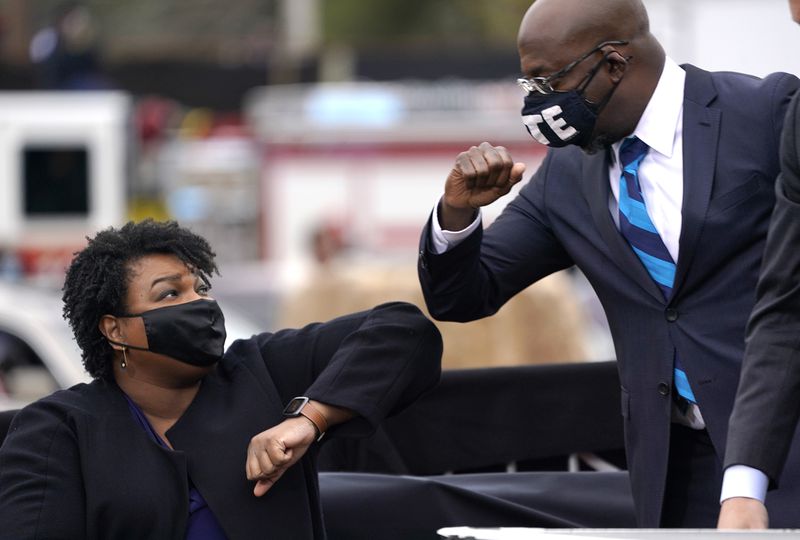
Stacey Abrams bumps elbows with Raphael Warnock during his campaign last year for the U.S. Senate. Abrams passed up her own opportunity to run for the seat and recruited Warnock as a candidate. (Credit: Drew Angerer/Getty Images/TNS)
An aide said that if she’s elected governor she will serve the full four-year term in office, adding that the buzz about a potential 2024 White House bid is “the talk of folks who don’t know her desire to lead Georgia.”
‘Unifying’
Her ambitions will also be used against her. Kemp and other Republicans have derided Abrams as a “celebrity” candidate with little long-term interest in Georgia. And Republicans have tried to blame her for Major League Baseball’s decision to yank the All-Star game from Atlanta, though she discouraged boycotts over the new voting law.
“Over the past four years, Gov. Kemp has exhibited courageous leadership for Georgians and guided his state through a turbulent time,” said Maddie Anderson of the Republican Governors Association. “Stacey Abrams spent her time touring the country in search of fame and fortune.”
She’s also been accused of hypocrisy for assailing Trump when he didn’t concede to Biden while she issued a nonconcession speech that criticized the “systemic disenfranchisement, disinvestment and incompetence” of Georgia’s election system under Kemp’s watch. Kemp has denied any wrongdoing when he was secretary of state.
Unlike Trump, Abrams never tried to reverse her election defeat and instead filed litigation seeking to expand access to the ballot. The Democrat also acknowledged that Kemp had won the election and that she was not the governor.
She settled another issue that dogged her during the 2018 campaign. Abrams paid off the roughly $54,000 she owed to the Internal Revenue Service, along with other credit card and student loan debt she reported during her first election run.
This campaign, Abrams would also be supported by the powerful Fair Fight political organization that she launched even as she ended her 2018 campaign.
The group has grown into a fundraising behemoth, collecting more than $100 million since its inception, and it has blitzed the airwaves with criticism of Kemp. It has become such a formidable force that Loeffler recently started her own group, Greater Georgia, to counteract its influence.
Gov. Brian Kemp, shown campaigning in 2018, responded to Democrat Stacey Abrams’ announcement that she will run next year for governor by saying her “far-left agenda” does not reflect the values of Georgians. “Next November’s election for governor is a battle for the soul of our state,” he said. (Credit: Ryon Horne, The Atlanta Journal-Constitution)
Many Republicans have eagerly expected Abrams’ entry, and some were running against her long before she announced. Candidates for obscure political offices have targeted her, and a group called Stop Stacey stocked with Kemp campaign strategists aims to keep her in front of a GOP battering ram.
No one, of course, mentions Abrams as often as Kemp, who essentially never stopped campaigning against her. He said Wednesday that every political step she takes is calculated “in service to her ultimate ambition of becoming president of the United States.”
Stephen Lawson, a veteran Republican strategist, is among the political foes who have long awaited her announcement. He said she offers the divided state GOP a common adversary.
“Never underestimate the unifying power Stacey Abrams can bring to Republicans in Georgia.”
Looking to relive the financial burdens of students this holiday season, Meharry Medical College sent nearly 1,000 medical students $10,000. Check out the incredible story from Jeffrey McKinney at Black Enterprise below.
Future medical professionals attending Meharry Medical College could have a merrier Christmas after receiving a $10,000 gift from the HBCU.
Presented unconditionally and aimed to ease financial hardship heading into the holiday season, Meharry President Dr. James E.K. Hildreth announced the Thanksgiving gift on Nov. 22 in a video shared with students at the historically Black college in Nashville, Tennessee.
According to the Tennessean, Meharry’s 956 students each received the donation. The money came from federal COVID relief funds sent to higher education institutions for financial aid.
The CARES Act dispersed some $14 billion to help schools handle the coronavirus pandemic’s financial strain. It also assisted students with academic debts and the clearing of tuition costs. Meharry landed a $20 million grant to be used partly to bolster its medical curriculum with virtual simulation and telemedicine training. The bounteous student gifts applied nearly $9.6 million of those funds.
“In the past year-and-a-half we’ve all had to learn as it says in scripture to give thanks in all circumstances and keep thankfulness in our hearts,” Hildreth reflected as part of a holiday message.
He added, “I’m thankful for you students and the future of healthcare, public health, and research that is entrusted to you. That future looks bright.”
Meharry’s medical professionals-in-training helped administer COVID-19 tests and provided information and strategies to mitigate further spread of the novel virus throughout 2020. “You heard me right. We’re making these gifts out of the Higher Education Emergency Relief Funds, which Meharry received as part of the CARES Act,” Hildreth explained.
The money was transferred into the bank accountants of students with direct deposit on Thanksgiving Eve. Others were able to pick up their check on campus. Hildreth advised students to use the money to pay costs tied to their education instead of being tempted to use it for Black Friday shopping.
Students completing up to four years of matriculation in the school of medicine or dentistry graduate with roughly over $280,000 in debt based on an analysis of tuition and fees for the 2021-2022 school year. Several other Black higher education institutions, such as Atlanta’s Morehouse College and Clark Atlanta University, sought to help students with their academic-related financial burdens by clearing debts.
Austin’s housing crisis is becoming a problem for college students across several colleges and universities. To counter that impact on students, 2 Huston-Tillotson University students are sitting on a student-led commission to fight against the pressing housing disparity. Get the full story from Daniel Martin at KXAN below.
As Austin’s city council prepares to talk housing affordability at a meeting Tuesday, a special commission is working to make sure college students who struggle with rent have a seat at the table, too.
Huston-Tillotson University students pose before getting ready to volunteer for EarthDay ATX 2017 (Credit: Julianne Hanckel)
The City of Austin’s College Student Commission is comprised of 15 members representing UT Austin, St. Edwards University, Huston-Tillotson University, Concordia University Texas, and Austin Community College. The Concordia seats are currently unfilled.
The group plans to finalize a list of affordable housing recommendations to pass along to city leaders, giving students a voice in the discussion.
Commissioner Edwin Bautista, a UT graduate student studying urban planning, told KXAN some of the commission’s ideas include creating student neighborhoods similar to UT’s West Campus around other local universities, but adding tight city rent control measures to keep costs down.
“One of the goals for the commission is to help push the city into kind of creating those residential districts,” Bautista said, adding that as a student, himself, he also struggles with rent.
“I work part-time, and I make a quarter of the median household income,” he said. “That forces me to live in a reality of low-income status while also having to find housing.”
After a year at a sorority house, UT student Kennedy Lightfoot told KXAN she’s moving to a new West Campus high-rise next year, where she’ll pay more than $1,200 per month for a bed in a shared unit.
“It’s ridiculous, I think my parking is like over $200 a month,” she said. “There are cheaper options, but a lot of times the cheaper options don’t feel safe.”
In East Austin, affordable housing options are quickly vanishing for students at Huston-Tillotson. The historically Black university has seen the neighborhood around it transform as pricey custom homes replace older houses, many of them rentals.
Austin City Council Member Greg Casar said he feels the city’s development code needs a refresh.
“Right now, what we really encourage is tearing down an existing apartment complex and building an expensive new one on top of it or tearing down a little old house and building one big one in its place,” he said. “That’s going to oftentimes lead to more expensive options.”
Meanwhile, students like Lighthouse are calling for middle ground.
“Something where you’re not worried the quality of the place in which you’re living, but you’re not worried about how much you’re paying,” she said.
Dr. Melissa N. Stuckey, an associate professor at Elizabeth City State University, has let her curiosity lead her down a new road of history and research. Learn more about her story from Lauren Howard at the Spectrum Local News article below.
From the 1930s to the 1960s The Negro Motorist Green Book became the go-to guide for African-American travelers across the country.
In a new exhibit called “Navigating Jim Crow: The Green Book and Oasis Spaces in North Carolina” at the Museum of the Albemarle explores what life was like for black travelers.
A group at Elizabeth Cty State University is revisiting those safe havens that were vital to the Black community.
Assistant professor Dr. Melissa N. Stuckey drove by countless abandoned buildings and vacant lots on her way to work and became curious about the history behind them.
“I drive a particular route down this road to my job every day at Elizabeth City State University, and I saw so many empty lots and so many older homes, and I just wanted to know the story,” Stuckey said.
She and her students began their research by looking up old city directories and the Green Book, which included two locations, The Blue Duck Inn and Mr. Overtone’s filling station.
The filling station no longer exists and The Blue Duck was torn down and replaced by a grocery store.
This is indicative of the way so much of Black history and Elizabeth City history have been forgotten.
“African-American men and women and men owned plenty of essential businesses in Elizabeth City. People had their churches, restaurants, their rooming houses, their businesses, everything was within walking distance, even their places of entertainment. So they were able to have a full life even in a segregated city,” Stuckey said.
The Gaiety Theatre is one of the only structures still standing. It was a Black-operated, white-owned cinema.
“The very idea that there’s an African American-operated cinema in your neighborhood walking distance, means it’s a place young people are going to gather, families are gonna come to. Whether it’s after church or on the weekends, it was a very popular place to be,” Stuckey said.
She said there’s so much rich history in the city, but it’s covered by new development and scattered. But with the help of her research she hopes to see the history commemorated for future generations.
“There’s a community that has substance that’s been in Elizabeth City for that long, and their stories are begging to be told. I want people to see the longer story of each building, of each dweller, of each resident. Even each empty lot, right? They all have a story,” Stuckey said.
Howard University alumna and successful actress Ashley Blaine Featherson-Jenkins has used her education to propel her career. A new interview she had with Ebony is explaining how. Get the full story from Kenya N. Byrd at Ebony below.
Don’t ever knock the hustle and grind of collegiate life. If you’re really about that life then understand this: institutions are mere microcosms of the real world—where the educated are groomed to accept societal prerequisites to work, live and socialize with people from diverse ethnic, cultural, economic, political and social backgrounds. Let’s keep it all-the-way real: it’s also the pivotal period that shapes and defines a scholar’s life and challenges who he or she might become through the development of critical thinking, creativity, interpersonal skills and a profound sense of social responsibility. For the last four years, Netflix’s Dear White People has depicted the college-bound in all its complexity and explored the blurred lines of demarcation between Blacks and Whites, the haves and the have-nots, racists and activists. There to breathe life into it all was actress Ashley Blaine Featherson-Jenkins who reprised her silver screen role as the frank yet loyal, pre-med radical Joelle Brooks.
EBONY caught up with Featherson-Jenkins who spoke candidly about offering graduating seniors of Howard University’s theater arts program a headstart, the role of HBCUs nurturing today’s new school of Black leaders and why Black folks need therapy.
EBONY: How did you relate and/or not relate to your character Joelle Brooks of Winchester University on Dear White People?
Ashley Blaine Featherson-Jenkins: From the beginning the character resonated with me. Embracing Joelle was easy because of her ambition, her Black [pride] and simply being a true naturalista.
I’m extremely proud of my character’s evolution because she found her voice, peace and love. By the end of the fourth season she’s fully [immersed] in her career. As an actor-stan of the show, I love what we all were able to [witness]. She’s one of my proudest accomplishments that I’ll always fondly keep in my heart.
Because you had a Black college experience did you ever feel awkward breathing life into Joelle Brooks?
Hmmmm….not really. In [the show], Joelle was a pre-med major and I studied musical theater at Howard so no comparison. In fact, the biggest challenge was learning the medical terms.
Is it true that one major difference between Black and White colleges is how fashion-forward the Black student body is at all times?
Yes! At Howard the students are always very well-dressed. Every day was like a walking fashion show. The the majority of us dress up all day, every day. The difference between [the fictional] Winchester and Howard universities is that there is more of a range and each character had its individual style that suited [him or her].
Undoubtedly, there are profound cultural differences in the way Blacks and Whites live either by choice or circumstance. How do you believe that race and/or even colorism has affected which opportunities you’ve been presented?
I can’t lie. I know I haven’t been afforded certain opportunities because of the color of my skin. Sometimes there’s a perception that I’m not as valuable as others. It’s harder for a magazine to put me on the cover or for a studio or network to believe that someone who looks like me can lead a show, film or even be portrayed as truly smart, powerful and beautiful. These are still tropes that we need to combat but I’m never tired of the battle. I will always fight for us to be seen and heard in the fullness of who we are—educated and innovative.
For the past 97 years, Howard homecoming festivities have always been legendary until last year’s cancellation due to COVID-19. Still, despite a global pandemic under the Ashley Blaine Featherson Early Grant you donated 25K to your alma mater. Why now?
Howard has so genuinely poured into me and given me so much. It was the place and time that shaped and molded me as I [pursued] my career. It’s the reason I chose to donate to an early-career grant for the [theater arts’ graduating seniors] who need [relocation funds] to pursue an acting career. This money will allow graduates to find their footing as they begin their careers. It’s extremely difficult to miss out on an audition because you need coins to do the laundry, or gas to drive to the audition or many other miscellaneous expenses. This grant will allow the recipients to have a little more stability as they pursue a fickle career that’s inconsistent and unforgiving. I hope this will make them feel a bit more confident and secure as they follow their [acting] dreams. I would have appreciated such a fund but it wasn’t available.
When jumpstarting your career, which hardships did you encounter?
I experienced Hard times where I thought, How can I do both—pursue this career and work a full-time job?That’s a hard place to be when you’re an artist. It’s very rare that an artist has the chance to start out [with no financial burdens]. In the early days, I was more worried about how much money was in my bank account and less about celebrating the small or large movements I made in my career. The reality is that when you’re in survival mode it’s an everyday struggle. I realize I don’t want to fight for survival. I want to fight to live the life I want to live happily and not be contemplating, Ok maybe I can stay in this apartment one more month before I have to move? I understand it’s part of the game, but again why this fund is so important because if there is any way for me to alleviate even a little of that burden from a young actor beginning their career I’m happy to help.
What do HBCUs offer Black students that white institutions simply can’t?
Culture. For me one of the most amazing parts of attending Howard was that I was able to be surrounded by successful, brilliant, ambitious, beautiful, fun, cool and successful multi-faceted people who looked like me. Even the attention given to Black history and learning the resiliency of our people is [unique]. That sense of Black pride can only be found at an HBCU.
How essential are HBCU’s in shaping the next generation of Black leaders?
Extremely. My mother, sister, nana and great aunt all attended HBCUs. We all found it to be essential in our growth as Black women and as Black people. Black universities were created because there was a time that we didn’t have another place to go [for our education]. Today, HBCUs are still be thriving and producing the most influential Black leaders today.
As an advocate for women’s mental health awareness why does this issue hit home for you?
It’s a near and dear issue to me because in a lot of ways therapy saved my life. I know its power to change lives if people are given proper and reasonable access to it. I think Black and Brown people specifically are dealing with a lot of generational trauma that we don’t even know how we’re dealing with it. For all the trauma we endured in this country, we deserve access to free mental healthcare which should be a part of our reparations.
What advice would you give someone who proclaims “Black folk don’t do therapy”?
Don’t let a myth disrupt your life and prevent you from taking charge and healing. Seeking therapy is not showing weakness but strength in reclaiming your power and controlling your life’s narrative. In recent years, the perception surrounding seizing control of one’s mental health has become relatively more common in our community.
Agreed. When were you introduced to therapy for better self-understanding and healing?
Eight years ago, I was talking to a friend and she mentioned talking to a therapist. It was rare because nobody was talking about [therapy]. Seeking [a therapist] changed my life for the better. When all is said and done I want to leave an imprint and always be a source of inspiration and I hope people will say that in some small way I made the world abetter place.
Thanks to a new partnership, undergraduate students at Harris-Stowe State University will be able to enjoy a bioinformatics program! Get the full story from the HSSU release below.
The United Health Foundation, the philanthropic foundation of UnitedHealth Group (NYSE: UNH), has awarded a $2 million, three-year grant to Harris-Stowe State University (HSSU) to create a bioinformatics program for undergraduate students at the historically Black university located in St. Louis. Bioinformatics is an emerging field that combines science, physics, math, and biology to aid in the diagnosis, treatment, and discovery of new therapeutic advancements. An example of bioinformatics is the use of computer analysis on the Human Genome Project, which has recorded the three billion basic pairs of the human DNA system.
HSSU will develop a new undergraduate program to train students for careers as bioinformatics professionals. HSSU will use the support to:
· Develop new curricula combining coursework and experiential learning opportunities;
· Expose high school students in surrounding school districts to the field of bioinformatics through a summer bioinformatics “boot camp” program; and
· Offer academic scholarships for up to 25 students each year.
“In the past decade, Harris-Stowe State University has emerged as a leader in training students for high-tech careers. This new program will help us to build on that important work, as well as continue to fulfill our mission of serving historically underrepresented students,” said Dr. Latonia Collins Smith, Interim President of HSSU. “Bioinformatics is a rapidly growing field of study, and it is vital for all people to play a role in its advancement.”
Studies have shown that there is a substantial gap in the number of diverse college students trained in biomedical sciences. Black, Hispanic, and Native American people account for only 7.1% of the employed biological/biomedical and life sciences workforce. A diverse health workforce is needed to provide personalized, culturally competent care to the diverse populations served.
“The United Health Foundation is honored to collaborate with Harris-Stowe State University to increase the diversity of the life sciences workforce. We are excited about HSSU training students who will make discoveries, develop therapies, and advance health care for all,” said Patrick Quinn, CEO of UnitedHealthcare Missouri, a UnitedHealth Group company. “This partnership illustrates UnitedHealth Group’s commitment to health equity and to building a diverse health workforce reflective of our society.”
The commitment in Missouri is one of many ways UnitedHealth Group is working to advance health equity by diversifying the health workforce of the future. The United Health Foundation’s Diverse Scholars Initiative, for example, partners with nine nonprofit and civic organizations and has provided over 3,000 scholarships to diverse students studying medicine and public health across the U.S. since 2007. Optum Technology, a UnitedHealth Group Company, offers a mentor-led STEM program that has provided science, technology, engineering, and mathematics training to over 7,000 diverse and underrepresented students at 103 middle and high schools since 2019.
Football at Lincoln University of Missouri will receive new leadership thanks to the selection of a new head coach! Get the full story from the Lincoln release below.
Credit: Lincoln University of Missouri
The Lincoln Athletic Department announced on Monday (Nov. 29) that Jermaine Gales will be the next head coach of the Blue Tiger football program.
“Coach Gales is the right leader to move LU Football forward,” said Kevin Wilson, Vice President of Advancement, Athletics, and Campus Recreation. “Despite limited resources, he’s recruited high-level student-athletes who became alumni and productive citizens, maximized talent to achieve what others thought to be improbable, and engineered successful programs. I look forward to celebrating many milestones with Coach Gales at the helm.”
Gales, who has nearly 20 years of experience as an assistant coach at the NCAA Division I and Division II levels, has established a proven track record of building and developing successful programs. Gales was hired in November of 2020 as the Associate Head Coach, Offensive Coordinator and Quarterbacks Coach at Bluefield State, a school that had discontinued its football program in 1981. This past fall, in the Big Blue’s first football season in 40 years, Gales helped lead the program to a 4-3 record.
“I am beyond excited about joining the Ambush,” Gales said. “The opportunity to impact the lives of young men as a head football coach has been a dream of mine since blowing my whistle for the first time. This is an opportunity to build something special and do something that has never been done before, in a community like Jefferson City, with an athletic director and president who are committed to developing our young men. I couldn’t be more excited to become the leader of the Blue Tigers. My family and I look forward to sharing the journey with the Lincoln University community, alumni, and fans.”
Before building the program at Bluefield State, Gales spent two seasons at Arkansas-Pine Bluff, where, as the offensive coordinator, he took a team that hadn’t won more than two games in a season since 2014 and helped lead it to a winning record in 2019. That season, Gales directed an offense that averaged 443.4 yards per game, the third-most in the Southwestern Athletic Conference and the 17th-most in NCAA Division I FCS. In his first year with the team in 2018, Gales devised an offense that ranked third in the SWAC with 423.5 yards per game, an improvement of over 100 yards per contest from the previous season.
In 2016 and 2017, Gales was the wide receivers coach at North Carolina Central and helped the Eagles win 17 games in that span. In 2016, Gales directed a receiving corps that scored 19 touchdowns, finished 18thin the FCS in yards per completion. The Eagles went undefeated in conference play that season and played in the Air Force Reserve Celebration Bowl. NCCU again posted a winning record in 2017 and ranked fourth in the Mid-Eastern Athletic Conference in total offense, with Jacen Murphy leading the league in receptions per game while finishing third in total receiving yards.
Gales worked as the wide receivers coach at Mars Hill from 2006-09 and again from 2013-15. In between those stints, Gales served as the offensive coordinator and coached the running backs and receivers at Saint Augustine’s, helping the program twice break season records for points per game. In 2010, Gales helped lead the Falcons to a win in the Pioneer Bowl, marking the first postseason victory in program history.
Jermaine Gales (second from right) was introduced as Lincoln’s new football head coach during a press conference Monday morning in the President’s Suite at The Linc. Also pictured are his wife, Kizzy Gales (second from left), Lincoln vice president of advancement, athletics and campus recreation Kevin Wilson (far left) and Lincoln interim president John Moseley (far right). (Credit: Greg Jackson/News Tribune).
Gales graduated from Southern Arkansas in 2002 with a bachelor of science degree in biology and a minor in human performance and recreation. He later earned a master of education degree in kinesiology from SAU in 2005.
Before entering the coaching ranks, Gales spent two seasons playing at Mt. San Antonio as a receiver before transferring to Southern Arkansas, where he helped the Muleriders win the 1997 Gulf South Conference championship. Gales served as an assistant at SAU from 2003-05, helping develop the program’s receivers.
Gales and his wife, Kizzy, have been married for 17 years and have six children: Devaughn, Kassidy, Braeden, Tailagua, Ettastajia, and Darius. Gales also has three grandchildren: Jhase, De’Mauri and Ava.
What Others Are Saying About Coach Jermaine Gales
“Jermaine was a key component of us building a championship caliber program and culture at North Carolina Central. His Offensive Coordinator & Associate Head Coach experience helped me tremendously. He has always put the student-athlete first and looked at programs from a 10,000 feet perspective. I’m excited to see his vision, leadership, and exciting offense for Lincoln.” – Jerry Mack, Running Backs Coach, Tennessee
“Coach Gales’ energy, coaching success, and passion for turning a program around makes him an excellent choice to lead the Lincoln University football program. Across the country, he is recognized as one of the top up-and-coming coaches in the nation. Gales is someone who is a relentless, proven recruiter who has seen remarkable success. On top of that, he places a high value on culture and developing student-athletes.” – Christopher Robinson, Athletic Director, Arkansas-Pine Bluff
“Jermaine and I have been friends for well over a decade, and it was a blessing to have him as our offensive coordinator & associate head coach. Outside of his proven skills as an OC, we could not have accomplished the things we did here. He was invaluable to me as a confidant in my first year as a head coach and will always be a great friend! Coach Gales truly cares about the development of young men off the field as well as on it. Lincoln University is getting a great one and he is ready for this opportunity! It is long overdue!” – Tony Coaxum, Head Coach, Bluefield State
“There is no doubt Coach Gales will be successful and amazing as the leader of the Lincoln football program. He is a relentless recruiter and has an outstanding offensive mind that will bring relevance and credibility to this football program. The future looks very bright.” – Toriano Morgan, Head Coach, Edward Waters
“Jermaine Gales is an excellent football coach and a great leader of men. Lincoln University is fortunate to have a man of Coach Gales’ character to lead their football program. Lincoln’s program will improve the moment he steps foot on campus.” – Tim Clifton, Head Coach, Mars Hill
The National Football League (NFL) announced its 2nd annual Madden NFL 22 x HBCU Tournament with EA to celebrate the impact of HBCUs headlined with a competitive tournament and career development opportunities both on and off the field. The goal is to inspire students at all Historically Black Colleges and Universities to get involved and represent their schools with competition and networking.
Registration officially is open through Dec. 3, 2021, with limited slots for an online single elimination qualifier tournament on December 5, 2021 with the top 16 finalists advancing to compete in the NFL Madden x HBCU Showcase during Super Bowl Week in Los Angeles. Players can register to compete in the tournament here.
The 16 finalists will also participate in an “experienceship” by spending time with the EA staff to engage them in various departments, and they will tour the NFL’s new west coast headquarters and shadow NFL leaders for a day to provide development and networking experiences to the students.
The top two finalists will be playing for cash prizes at the NFL’s west coast headquarters located next to SoFi Stadium in Hollywood Park, home of Super Bowl LVI. Their match up will be available to watch on both the NFL YouTube and Twitch channels on February 12, 2022.
“We are so thrilled to bring back this tournament for HBCU students and offer a once-in-a-lifetime experience to come to Los Angeles during Super Bowl LVI Week,” said Natara Holloway, Vice President, Football Strategy at the NFL. “We want to expand the League’s efforts to create inclusive opportunities for the next generation of talent with partners like EA providing not only a chance for students to compete, but also the chance to learn the business of football through practical learning and shadowing experiences.”
The NFL will partner with GCN, Inc. (Gaming Community Network), part of the GameSquare Esports group of companies, who will manage all operations including registration, online tournament execution, player communications, competitive integrity and a professional broadcast during the week of Super Bowl LVI.
“We are so honored to be working with the NFL on this incredibly important initiative to capture the passion of gaming among HBCU students,” said Chris Kindt, CMO for GCN. “We are confident our team with deep roots in esports and gaming will deliver an exciting tournament capped off by the exhilaration of competing during Super Bowl LVI.”
About the NFL HBCU Initiative
In May 2016, the NFL launched Strength of HBCUs, Impacting Pro Football Since 1948 in partnership with two prominent HBCU athletic conferences — the Mid-Eastern Athletic Conference (MEAC) and Southwestern Athletic Conference (SWAC). The initiative has since expanded to also include other conferences and schools to recognize and strengthen its relationships with HBCUs across the country. Through these relationships, the NFL has developed several HBCU-focused programs to educate and connect students to careers in football administration and the sports industry at large.
About Gaming Community Network: GCN, Inc. (Gaming Community Network) is the only independent media group completely dedicated to gaming and esports across community sites, content producers, influencers and tournament/event operators. Bridging the gap between traditional media and gaming with a “Gamer First” promise, GCN’s aggregated & integrated proprietary media network reaches 65M+ MAU’s in the US (115M+ MAUs globally) driving scale for premium content designed to provoke and share conversations. GCN builds bespoke strategy solutions from content creation to full-scale tournaments for any endpoint be it social, broadcast TV or live stream. As a GameSquare Esports Inc. (stock: GSQ, Canadian Stock Exchange) subsidiary, GCN collaborates with its partners to deliver memorable experiences for gamers and brands.To learn more, visit GCN.gg or follow on LinkedIn: www.linkedin.com/company/GamingCommunityNetwork/
About GameSquare Esports Inc. GameSquare Esports Inc. is an international gaming and esports company headquartered in Toronto,Canada. The Company is seeking to acquire additional assets and entities serving the gaming and esports markets and, more broadly, in sports and entertainment. GameSquare’s acquisition of Code Red Esports Ltd. (“Code Red”), an esports talent agency, provided an initial foothold in Europe through its UKoperations. Code Red represents leading on-screen talent, players and influencers and works with leading global brands to develop influencer campaigns and esports marketing strategies. The Company’s second acquisition of Reciprocity Corp. provides access to Asia, Latin America and North America. Its gaming and esports assets include: a CrossFire franchise in China that it owns with its partner LGD Gaming, a 40% interest in a League of Legends team that competes in Latin America, and its wholly owned subsidiary corporation, GCN, a digital media company focusing on the gaming and esports audience based in Los Angeles. GameSquare continued building a global esports powerhouse when it acquired Complexity Gaming, one of America’s premier and longest standing esports organizations. With access to GameSquare’s content creation, sales, marketing, and branding expertise, Complexity will be able to expand the franchise’s international footprint.
For the first time ever, the Hampton University Marching Force band will perform at the legendary Macy’s Thanksgiving Day Parade in New York! The band will not only be repping its HBCU, but the state of Virginia as well. Get the full story from the official Hampton release below.
Source: Hampton University
The Hampton University Marching Force will perform in a spectacle like no other when the Macy’s Thanksgiving Day Parade® returns this Thanksgiving to usher in the start of the holiday season as performers from across the country take to the streets of New York City. On Thursday, November 25 at 9:00 A.M., the 95th march of the world-famous Parade of Magic will bring the nation together in celebration featuring Macy’s signature mix of giant character helium balloons, fantastic floats, incredible marching bands, jubilant performance groups, whimsical clowns, music stars and the one-and-only Santa Claus.
“For more than nine decades, the Macy’s Thanksgiving Day Parade has brought joy to millions who gather with friends and family to experience this one-of-a-kind holiday celebration along the streets of New York City and in homes nationwide,” said Will Coss, Executive Producer of Macy’s Thanksgiving Day Parade. “For our 95th celebration, Macy’s has created a spectacle to remember, featuring a dazzling array of high-flying balloons, animated floats and incredible performers. We can’t wait to help New York City and the nation kick-off the holiday season with the return of this cherished tradition.”
Each year, the Macy’s Parade Band Committee looks for bands that have the stage presence, as well as musical and marching abilities, to captivate millions of spectators in New York City and across the country. Hampton was selected from more than 100 applicants as one of nine selected bands to march in the 94th edition of the annual holiday spectacle. Unfortunately, that invitation was deferred to 2021 due to the COVID-19 pandemic. This will mark the first Parade appearance by the Marching Force, which will also represent the state of Virginia.
“Rooted in tradition and with explosive energy, the Hampton University Marching Force delivers outstanding, entertaining shows that time and time again bring the crowd to their feet,” said Wesley Whatley, creative producer Macy’s Thanksgiving Day Parade. “We look forward to introducing the talented students of Hampton University to our Parade audience for the band’s debut in the 2021 Macy’s Thanksgiving Day Parade!”
“‘The Marching Force is an elite group of talented, young musicians and dancers who are academically accomplished. This opportunity will allow Hampton University to once again shine on the world-wide stage in front of the millions in attendance and others watching from across the globe,” said Hampton University President, Dr. William R. Harvey. “Under the direction of Dr. Thomas Jones, The Marching Forcecontinues to uphold THE Standard of Excellence as being one of the best marching bands in the nation.”
The Hampton University Marching Force has spent a significant amount of time planning for its Parade appearance. In addition to rehearsing, they have hosted creative fundraising events that not only brought the school and the community closer, but also prepared the students for the march of a lifetime.
For more than ninety years, Macy’s Thanksgiving Day Parade has given thanks to what Macy’s values most –- its loyal fans. More than 5,000 Macy’s employees and dedicated volunteers work tirelessly to create a spectacular event that entertains the cheerful crowds and provides joy to millions at home watching on Thanksgiving Day. Stretching down a more than two-mile-long route in New York City, the spectacle is alive with gleaming color, music and smiles.
Performing at the Macy’s Day Thanksgiving Day Parade is the latest accolade for The Marching Force. The band performed in the 2020 Rome New Year’s Day Parade in Rome, Italy. The Marching Force drumline performed in the 2019 Tournament of Roses Parade in Pasadena, California, prior to the Rose Bowl. In 2018, The Marching Force performed at the 16th Annual Honda Battle of the Bands while over 62,000 fans filled the Mercedes-Benz Stadium in Atlanta, Georgia. The Marching Force also performed in President Obama’s Inauguration Parade in 2009.
“In a normal year, preparing a band for the Macy’s Parade is stressful and daunting. To do so in the midst of a global pandemic—the challenge is insurmountable. Despite that, we are prepared to not only meet that challenge head-on, but to also excel and make our Hampton University family proud. It is a testament to the hard work of our students and staff, through the support of our fellow faculty and administrators under Dr. Harvey’s unwavering leadership and commitment to excellence,” said Hampton University Director of Bands, Dr. Thomas Jones.
Pepsi Stronger Together – the Brand’s series of grassroots initiatives bringing tailored programming support to communities across the country – is helping to bring Hampton University’s award-winning band to NYC to perform in the annual Macy’s Thanksgiving Day Parade. Through a $100,000 donation, Pepsi Stronger Together is providing transportation to and from NYC and practice uniforms for the band.
“I’m so excited Pepsi Stronger Together was able to help make this journey happen for the incredibly talented Hampton Marching Force as they head to perform at this iconic stage,” said Derek Lewis, President, South Division, PepsiCo Beverages North America (PBNA). “From our ‘She Got Now’ internship program to other HBCU-specific donations, and as a Hampton alum myself, I’m so proud to see another piece of PepsiCo’s commitment to supporting HBCUs come to life.”
Attending the Parade
For spectators wishing to enjoy the spectacle live, the 95th Macy’s Thanksgiving Day Parade begins at 9:00 A.M., kicking off from its traditional starting line at 77th Street and Central Park West. From there the procession will march down its signature 2.5-mile route from Central Park West to Columbus Circle, turning onto Central Park South and then marching down 6th Avenue/Avenue of the Americas. At 34th Street, the Parade will make its final turn west and end at 7th Avenue in front of Macy’s Herald Square.
Public viewing will be set up along designated portions of the route and managed by the NYPD. Spectators should avoid bringing large bags, umbrellas, backpacks and strollers. The public entering viewing streets may be subject to a security search. For additional viewing information, please visit macys.com/parade.
Watching the Parade
For decades, the Macy’s Thanksgiving Day Parade has been one of the nation’s most anticipated and watched holiday celebrations. Viewers nationwide can catch all the action via the special broadcasts on NBC and Telemundo from 9:00 A.M. to 12:00 P.M. in all time zones. For the first time, fans can also stream the broadcast on Peacock. The TODAY Show’s Savannah Guthrie, Hoda Kotb and Al Roker will host the three-hour telecast for NBC and Peacock. The Spanish language simulcast on Telemundo will be hosted by Ana Jurka and Carlos Adyan, accompanied by Freddy Lomelí reporting live from Sixth Avenue. It will also feature a special appearance by Miss Universe® Andrea Meza.
The newly inaugurated Claflin University president Dr. Dwaun J. Warmack is determined to find innovative ways to bring student engagement to its peak at the university. And he’s only getting started! Get the full story from Times and Democrat staff writer Dionne Gleaton below.
Dr. Dwaun J. Warmack has an unwavering goal to continue the mission of the state’s oldest HBCU to not just survive but thrive even amid the challenges of a global coronavirus pandemic.
Warmack was inaugurated as Claflin University’s ninth president on Nov. 19, more than two years after he began his tenure in August 2019.
It was an occasion delayed by the pandemic, but Warmack said the university has continued to find success despite the array of changes that caused “one of the worst times that I’ve seen in higher education in my 23-plus years.”
Dr. Dwaun J. Warmack was inaugurated as Claflin University’s ninth president on Nov. 19, more than two years after he began his tenure in August 2019. (Credit: Larry Hardy, T&D)
“We’ve been very fortunate the past two years of managing through a global pandemic … when you think about the unprecedented things that hit our colleges and universities across the country, that forced us to shut down, forced us to send a lot of first-generation college students from low socioeconomic backgrounds back to environments that probably weren’t as conducive to their success.
“For us, that made it slightly challenging to say the least. But in spite of that, we said from the beginning our goal wasn’t just to survive, but it was to thrive, and we have indeed been able to do that during that time,” Warmack said.
He recalled students not being able to return back to campus following their spring break in March 2020, something which he said he had never experienced. It caused the university to have to pivot the way it served its students’ needs, including those without broadband access.
“For us to have to pivot immediately to go to 100% online instruction, when you think about one of the top 10 HBCUs in the country, top liberal arts college in the South. We are known for our liberal arts, high-touch environment. When you lose that to a 100% virtual environment, it transforms pedagogy for faculty and teaching, it transforms students from a distance-learning perspective and the ability to be able to have resources to be able to do the things that they need to do to be successful,” he said.
The university succeeded in providing students with the resources they needed in their new academic environment.
“We were able to provide them with adequate resources by request. There were a lot of multiple hot spots, multiple laptops and multiple other devices to ensure our students were able to be successful,” Warmack said, noting that it was eye-opening to realize the broadband challenges many students faced in some areas.
“I did not know the magnitude of the bandwidth challenges in the rural parts of this country. I had my own privilege coming from urban communities. To get here to see students who are less than 20 miles from here and the entire town not having bandwidth,” he said, was mind-blowing.
The president said the university not only had to adjust to broadband challenges but ensure that faculty had the resources needed to teach in the changed environment. He said the university’s faculty “did an amazing job of being not just passionate about a quality education but compassionate for those outstanding scholars.”
Future goals
The Detroit native said his immediate plans for the future will be guided by the university’s strategic plan, but will include the promotion of cutting-edge academic enterprise, continued improvement in student success and student engagement, creative technological and global strategies, and consistent fundraising.
“We have been able to in the midst of a global pandemic not just balance a budget but right-size a budget. We have almost doubled our endowment. We have almost doubled our net assets. We’ve have record fundraising. We’ve had multiple largest gifts in institutional history,” Warmack said.
The president, for example, announced a $20 million gift the university received from billionaire author and philanthropist MacKenzie Scott on Dec. 16, 2020, the largest gift in Claflin’s 151-year history.
Warmack has said there are plans to use it to continue the university’s transformational work in a few specific areas, including academic enterprise, the endowment and strengthening student success and retention.
Claflin plans, for example, include construction of a new state-of-the-art student center.
“Hopefully we’ll break ground in January or February,” Warmack said.
He said the university has also stabilized its enrollment during the pandemic.
“So we have had a lot of success during this time. So for the future, we’re looking to continue to build on the outstanding legacy while we transcend into the future,” the president said.
The 2019-21 President’s Report reveals the university, which has enrollment of roughly 2,000 students, has an endowment of $53 million and has seen increases in several areas, including its total assets, net assets, grants and unrestricted contributions.
The university’s retention rate stands at 76%, with total assets equaling $147,853,775. Net assets stand at $123,271,133, while grants total $19,102,550. Unrestricted contributions stand at $22,273,552.
Warmack said the university’s endowment has grown substantially since his arrival at the university, but work continues to bolster it for the college’s long-term sustainability.
Buildings and fundraising
Warmack has a laser focus on incorporating the community’s success with the university’s success because he said the two are interchangeable.
He said the development of the university’s $23 million student center at the corner of Magnolia Street and Goff Avene will be a place not just for the students, but the community at large.
Its first floor will include a food court and entertainment area with amenities such as an auditorium/movie theater. The second floor will include offices for areas to include, but not be limited to, career services, student activities, residential life and student government. The third floor will include an arcade, E-sports room and a ballroom with a seating capacity of 800.
“We’re part of the community. We have been a pillar in this community for a very long time. If Orangeburg’s successful, Claflin will be successful. So I think we play a dual role in that process. Also, too, our students deserve it (the new student center),” Warmack said.
He said the university recruits students from multiple countries and states who deserve a creative college life experience, particularly since students spend 78 to 82% of their time outside of the classroom.
“If we don’t give them a co-curriculum experience outside of class, then we’ve missed the boat. … We want to invest in the community that we live. We opened our Center for Social Justice downtown. We wanted to make sure that we invested in the community that we live and work. So the Center for Social Justice in downtown Orangeburg is a community-based center providing access and opportunities to individuals,” Warmack said.
He continued, “We’re looking to open up a new building in downtown Orangeburg as well. I’m not at liberty to discuss what that is, but it’s coming very soon, probably the largest building in downtown Orangeburg.”
Academics
Warmack said the quality of faculty and instruction at the university is also noteworthy, with Claflin being home to several amenities, including a one-of-a-kind DNA forensics lab. It was in 2004 when Orangeburg and Claflin University forged a partnership to improve forensic laboratory services in the hope of reducing crime in the area.
“We have quite a few students out of our biotech program that serve as researchers in that space. It is a state-of-the-art lab, and it’s a great collaboration and partnership that’s on this campus,” Warmack said.
He said the college will continue its outstanding work in STEM education.
It was in 2020, for example, that the college and ZOOM announced a commitment to a five-year strategic partnership, with the video communications provider and historically Black university developing a multifaceted foundational program that represents $1.2 million in educational and financial investments.
Program components include, but are not limited to, paid internships during the school year and paid internships as part of Zoom’s summer internship program, along with merit- and need-based scholarships for selected students.
“You’ve seen in the past few years the partnership we announced with Zoom, with Google, with all of these other tech companies. Our students are going out and getting phenomenal jobs within those places. Not just internships, they’re being gainfully employed to go out to do transformational work in society,” Warmack said.
“It just speaks to the volume and the quality of instruction and the faculty and the staff that we have here at Claflin University,” he said.
Warmack said course offerings will increasingly be tailored more to the needs of industry.
“In today’s time, you have to really create your curriculum to industry. What is industry looking for? How do we get students gainfully employed? One thing is recruiting them to being here, but that’s not enough. You recruit students on this continuum: recruitment, matriculation, graduation and then gainful employment. We want every one of our visionaries to be gainfully employed,” the president said.
He continued, “We were the first official Zoom partnership in the country no matter what type of institution. When I went out and had conversations with their COO and the CEO, I said, ‘Hey, you need computer scientists. We have one of the best computer science programs, I would argue, in the country. We will develop our computer science program to have tracks that fit exactly what you’re looking for.’”
He said university’s longtime teacher education program is also noteworthy.
“There’s a need for quality teachers. So we just had the largest induction into our teacher education program. … So it just gives me hope about why it’s important. You can’t have engineers, you can’t have doctors if you don’t have quality teachers. You think about rural South Carolina and what that means. So we continue to have an outstanding teacher education program and the work that comes behind it,” Warmack said.
Going forward, the president said the university will continue its focus on developing a strong Science, Technology, Engineering, Art, Math, or STEAM, agenda.
Building a foundation
Warmack replaced longtime President Dr. Henry N. Tisdale, a 1965 Claflin honor graduate who retired in 2019 after 25 years of service at his alma mater. Warmack and his wife, LaKisha, have one daughter, Morgan.
The family came to Orangeburg after Warmack served five years as president at Harris-Stowe University in St. Louis.
Prior to his years at Harris-Stowe, Warmack served as the senior vice president of administration and student services at Bethune-Cookman University.
Warmack also served as associate dean of students at Rhodes College in Memphis, Tennessee, and held positions at Western Carolina University in Cullowhee, North Carolina, and Delta State University in Cleveland, Mississippi, his alma mater.
He said he realizes he is standing on the “shoulders of giants” as president of Claflin University.
“There were eight folks that came before me that laid that foundation, and what I’m doing is trying to build on it. Dr. Tisdale was an amazing leader, and the presidents before Dr. Tisdale did great work. All of us have a role to continue to build on the legacy that will transcend into the future,” he said.
U.S. News and World Report has ranked Claflin among the top 10 on its list of the nation’s “best historically Black colleges/universities” for the 11th consecutive year this year, but Warmack said his goal is to move it into the top five.
“I want to be in that top five in the country among HBCUs, but also top five in the region among all institutions no matter what type. Within that same vein, you have a very aggressive growth strategy. It may just not be residential because we’re land-locked in a lot of ways. So we have done an amazing job with our online platform,” Warmack said.
He said there is focus on providing the Claflin experience worldwide without students necessarily having to set foot on campus.
“How do we provide classes in the Caribbean locations? How do we provide it on the continent of Africa? … We’ve just created a new partnership with our biotech program that will be announced. … We’ll announce the notion of a climate change (concentration) in biotechnology and with Africa University in providing that opportunity for scholars all over the world,” Warmack said.
He said the university will still continue to expand its footprint locally.
“I’m not a liberty to discuss that, but we’ve bought a variety of parcels in this community to allow us to have long-term growth within that space as we develop a master plan,” Warmack said.
He said the college will also be announcing an upcoming capital campaign focusing on five areas, including building the university’s new student center, as well as a new innovative and interdisciplinary academic building.
“That building will focus on, I’m thinking, reimagining higher education. So if I’m a biology major and I’m a mass comm major, how do we do collaborative research to come up with this project that changes the world? So most times in academy we are very departmental focused,” Warmack said.
He said building the university’s endowment, building upon its history in social justice and creating need-based scholarships will be other focuses of the capital campaign.
Warmack said it was Claflin’s rich history that attracted him to the university.
“Claflin has an amazing history, and it has a track record of success. … The white noise didn’t matter to me. I knew I had the capability to work, but (I was) coming to an institution that was solid, that was on stable ground and that had a rich history of alums committed to this institution,” he said.
He said he and his wife soon came to the conclusion that they were in the right place.
“This is our ministry. This is where God has us to serve now. I tell people when you’re obedient to what God says, everything else manifests. All of the success we’ve had is because we were obedient to listen to what God told us,” Warmack said.
While the 44-year-old knows God is in ultimate control of his destiny, his plan is to retire after seven more years, which would mark his 30th year in higher education.
“I want to be able to enjoy life. That’s why I’m working so hard right now. I’ve worked my whole life. I started working at 14,” he said, noting that, in the meantime, he’s “grateful I’m able to do God’s work.”
In a close showdown between Central Intercollegiate Athletic Association (CIAA) rivals, Virginia Union took home the early-season victory, defeating reigning CIAA champion Winston-Salem State 59-55 to win the inaugural Chris Paul HBCU Tip-Off.
As the final buzzer sounded on Tuesday, text messages flooded Virginia Union coach Jay Butler’s phone to congratulate him on the victory. Although he didn’t have an opportunity to respond to the messages, he knows his Panthers made the Virginia Union community and Basketball Hall of Famer Ben Wallace proud.
“I’m pretty sure I got a couple of text messages already. I know [Ben] probably watched [the game]. I tried to get him to come up, but we’ll probably celebrate when we get back to Richmond,” Butler said with a smile. “It feels great. First, I got to hand it to [coach] Cleo [Hill Jr.] and Winston-Salem. They’re a great basketball team. You see why they are the defending champs. They played hard for 40 minutes, and they’re not gonna let up. They’re gonna play to the end, but our guys, we fought. Defensively, we were awesome, [but] tonight’s defense kind of let up when they made a run back at us. But we kept fighting. We rebounded the basketball [and] made plays when we needed to. All these guys were great [and] played a good basketball game.”
Although a rarity for Division II historically Black colleges and universities (HBCUs) to play on national television, Virginia Union capitalized on the opportunity.
“We definitely want to come back. If they make the call and say the champions get to come back and defend [the title], we’ll be there. [This classic] is good because it prepares you for the CIAA. It prepares you for conference play,” Butler said. ”This is an awesome event. CP3, Boost Mobile, everybody has been involved. It’s been an amazing tournament. We had gifts and a locker room and they fed us well every day. From top to bottom, this is first-class.
“It’s definitely something we can get accustomed to as a Division II [school]. Sometimes you [are] kind of limited on resources, but they had an opportunity to play on ESPN+ on a national level, [play at] the Mohegan Sun. We were held at the same hotel with North Carolina, Purdue and Villanova, those top teams in Division I. Just to see those guys, how they operate. It was easy for us to see and embrace the moment. Everything’s been awesome.”
Early on in the planning, the tournament was scheduled to host Division I HBCU teams only. At the urging of Paul’s elder brother, Charles “C.J.” Paul, who attended then-Division II South Carolina-Upstate for three years, a Division II tournament was added.
Credit: Basketball HOF/Twitter
“It’s great to see them play. It’s crazy because while this started out as a Division I tournament, which we have next week, I wanted to do something for the Division II schools. I played Division II, and we wanted to show them love,” C.J. Paul said. “My whole thing was I wanted [Division II HBCUs] to get an opportunity that not even the predominantly white institution Division II [schools get]. The only time these [Division II] teams go to tournaments is usually the CIAA or SIAC tournament. So we’re just starting something new just for HBCUs.
“People are talking about it. Every college coach has reached out to me at some point, like, can we get in next year. Just creating a buzz and setting the groundwork for what hopefully the future looks like. I definitely want this to be an every-year thing for Division II schools, as well as Division I schools.”
Paul’s inaugural Boost Mobile HBCU Challenge for Division I schools will air on ESPN platforms on Sunday and Monday, featuring Grambling, Hampton University, Morgan State and Norfolk State.
MOREHOUSE MAN MAKES HISTORY
While the tournament weekend offered HBCU players a chance to see the jerseys of legendary basketball contributors, Morehouse sophomore center Kalin Bennett went to view his own jersey, which hangs in the Basketball Hall of Fame. His No. 50 Kent State jersey is displayed in the “Underdogs” section of the museum, next to the clipboard used during UMBC’s upset over No. 1 seed Virginia in the 2018 NCAA tournament.
Bennett made history in 2018 as the first student-athlete with autism to sign a national letter with a Division I university when he signed with Kent State. He was diagnosed with autism at 9 months old. Bennett was the first autistic student-athlete to score in a Division I game on Nov. 6, 2019, in Kent State’s season-opening win over Hiram College.
“I’m not going to lie, it was kind of breathtaking to see that I’m in the Hall of Fame at such a young age, which is really not heard of,” Bennett said of seeing his jersey for the first time. “It was kind of amazing and understanding how big of a blessing that is to be able to help some other kids and help people understand that they can achieve their dreams no matter what they have. It’s pretty life changing.”
Bennett’s teammates, who affectionately call him “K.B.” and “Big Cheese” because of his gigantic smile and jovial nature, were excited to share and document his special moment.
“Our big guy,” said freshman Amahn Decker with a smile at the mention of his teammate’s name. “I love him. He’s like, I’m just [shorter]. It’s all love over here. We got to record him. It was a fun experience, plus he’s big-time. He’s in the Hall of Fame!”
Kalin Bennett stands in front of the display case containing his Kent State jersey at the Basketball Hall of Fame. (Credit: Morehouse Athletic Department)
Bennett, a 6-foot-10 center, played 17 games that 2019-20 season, finishing with 11 total points. He transferred to Morehouse in February before then-coach Grady Brewer died in May. Described by Morehouse interim head coach Douglas Whittler as a leader and coachable player, Bennett is excited to play for the Maroon Tigers and is prepared to bring his experience playing in the Division I Mid-American Conference to the Division II Southern Intercollegiate Athletic Conference.
“My time at Kent State was short, but I learned a lot. Everything I learned and everything I’ve seen, I tried to bring it with me here to Morehouse. I came here for Coach Whittler and Coach Brewer. I know who I came here for. I know who I know who’s going to stick by me, and I’m just here to win. I’m here to do whatever I can to win,” Bennett said.
“Being able to play such a prestigious tournament has been nothing short of a blessing,” Bennett said. “Shout-out to Chris Paul for having such a great idea about this tournament [and] shedding light on the other HBCUs and overlooked HBCUs, especially Morehouse. So being able to be here at this time and represent Morehouse with the M on my chest is really a sense of pride and sense of joy, and I’m glad to be here.”
In 2018, he founded his nonprofit foundation, SpeKTrum50, which he hopes offers inspiration and eventually programs for children with autism and parents of children diagnosed with autism.
“The SpeKTrum50 Foundation is built on helping kids on the autism spectrum feel encouraged and feel as if they can make it throughout the world and also help them, you know, seeing more opportunities,” Bennett said. “It also helps the parents, because when you have an autistic child, it’s not easy because you feel like you’re battling in a fight by yourself. So it’s awesome to help the parents understand like, ‘Hey, we’re here for you. We need somebody to talk to here.’ It’s just community outreach. It’s a dream that I’ve had since I was first able to talk. So being able to do that is really, really awesome.”
Bennett scored six combined points in the two games played at the HBCU Tip-Off. He started his first game of the season in Morehouse’s 71-66 loss to West Virginia State on Tuesday, scoring four points.
“Kalin’s amazing. He’s one of the smartest players that we have. We got to figure out how to get him the ball … we’re trying to feed him. We just got to figure out how to get him the ball,” Whittler said. “We actually [saw] his jersey when we did the Hall of Fame tour. So it’s been a blessing for us to get that guy because he knows what he’s doing. He can play. He’s a big body. I know that once we get to the conference that he’s going to dominate.”