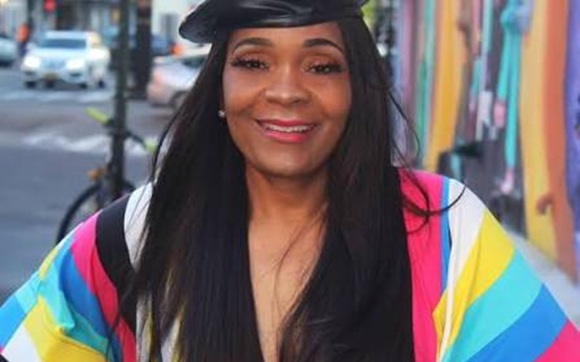
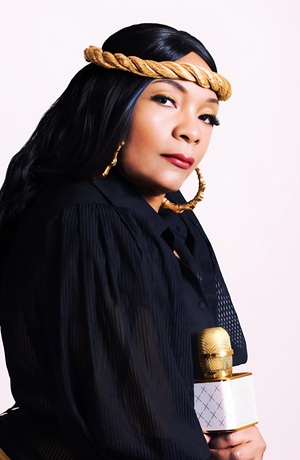
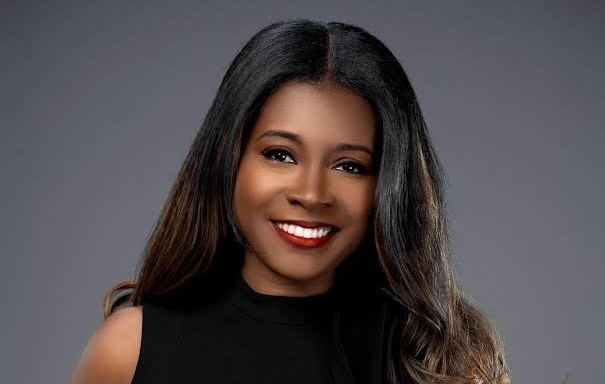
MC SHA-ROCK teaches at Bowie State University — and her students are learning hip-hop history from someone who actually built it.
Sharon Jackson, known worldwide as hip-hop’s legendary first female MC, serves as an adjunct professor in the Visual Communication & Digital Media Arts program within Bowie State University’s Department of Fine & Performing Arts. She is not a guest lecturer trading on old fame. Rather, she is a working architect of the university’s Hip-Hop Studies & Visual Culture minor — the first program of its kind at any HBCU in the nation. This fall, that work is being recognized on a national stage: Jackson will be inducted into the North Carolina Music Hall of Fame’s class of 2026.
From Wilmington to Hip-Hop History
Long before she became MC SHA-ROCK, Sharon Jackson was a kid from Wilmington, North Carolina, experiencing the birth of a culture in real time. She did not know then that she was making history. She simply loved the microphone.
As a founding member of Funky 4 + 1, Jackson helped define the elements that became hip-hop’s DNA — microphone technique, lyrical delivery, and the art of commanding a room with nothing but rhythm and voice. In 1981, her group made history as the first hip-hop act to perform on national television, appearing on Saturday Night Live and introducing an underground culture to living rooms across America. That performance changed the trajectory of American music forever. Now, that same history walks into a Bowie State classroom every week.
What MC SHA-ROCK Actually Teaches at Bowie State
Bowie State launched its Hip-Hop Studies & Visual Culture minor in 2016. Since then, the university has grown its hip-hop scholarship across multiple disciplines, cementing its role as a national leader in treating hip-hop not simply as entertainment, but as a legitimate field of academic inquiry, artistic expression, and social change.
Jackson is central to that mission. As the department’s resident MC, hip-hop pioneer, and historian, she gives students something no textbook can replicate — direct access to someone who lived the culture’s founding moments. Consequently, her classroom becomes a living archive as much as an academic course.
Tewodross Williams, professor and program coordinator of the VCDMA program, described her impact directly. “As a pioneer, educator and mentor, she has been instrumental in shaping our Hip-Hop Studies & Visual Culture program and inspiring the next generation of artists and scholars,” Williams said. “We are honored to have her as part of the Bowie State family.”
A National Honor That Validates the Work
This fall’s North Carolina Music Hall of Fame induction places Jackson alongside an extraordinary class of honorees — go-go pioneer Sugar Bear, jazz composer Billy Strayhorn, and Lifetime Achievement recipient George Clinton. Moreover, it reflects recognition that extends well beyond a single performer’s career.
“My induction into the North Carolina Music Hall of Fame is more than a personal honor,” Jackson said. “It is recognition of a history that helped shape a culture heard and felt around the world. As the first female MC of hip-hop culture, I have dedicated my life to preserving the truth about our beginnings and ensuring that the pioneers who built this movement are never forgotten.”
That mission — preserving the truth and protecting the record — is exactly what she brings into every Bowie State classroom.
Her Influence Extends Beyond the Classroom
Jackson’s teaching is only one part of how she keeps hip-hop’s history alive. She hosts a daily hip-hop show, “That’s the Joint,” on LL Cool J’s Rock the Bells Radio channel on SiriusXM, alongside fellow pioneer Grandmaster Caz.
Additionally, Jackson has used her platform to advance conversations about entrepreneurship and economic empowerment in Black communities. She participated as a distinguished panelist during the 2023 HBCU + Entrepreneurship Conference, contributing to a session on building generational wealth through hip-hop’s fifty-year legacy. There, she shared insights on ownership, intellectual property, and sustainable wealth-building — themes she brings directly back into her Bowie State teaching.
Why Her Presence at an HBCU Matters
For all her accolades, Jackson consistently redirects credit away from herself. “Hip-hop has become a global language, yet its roots remain grounded in the communities, voices and innovators who dared to create something the world had never seen before,” she said. “This recognition honors not only my journey, but the countless women and pioneers whose contributions shaped the foundation of this culture.”
That humility shapes how she teaches. Rather than centering her own legacy, she uses her classroom to ensure hip-hop’s origin story — and the women who built it — never gets erased.
What Bowie State Students Are Really Getting
Students in Jackson’s classroom are not learning hip-hop history from a textbook. Instead, they are learning it from someone who lived it, shaped it, and has now dedicated her next chapter to making sure they carry it forward.
“It reminds us that history is something we must protect, document and pass forward,” Jackson said, “and that true innovation belongs to those willing to challenge expectations and move the culture forward.”
That is the lesson Bowie State students get — not from a lecture slide, but from the woman who was there when hip-hop began.
The MEAC-SWAC Challenge ESPN partnership just got a major long-term extension — and HBCU football’s national stage has never looked more secure.
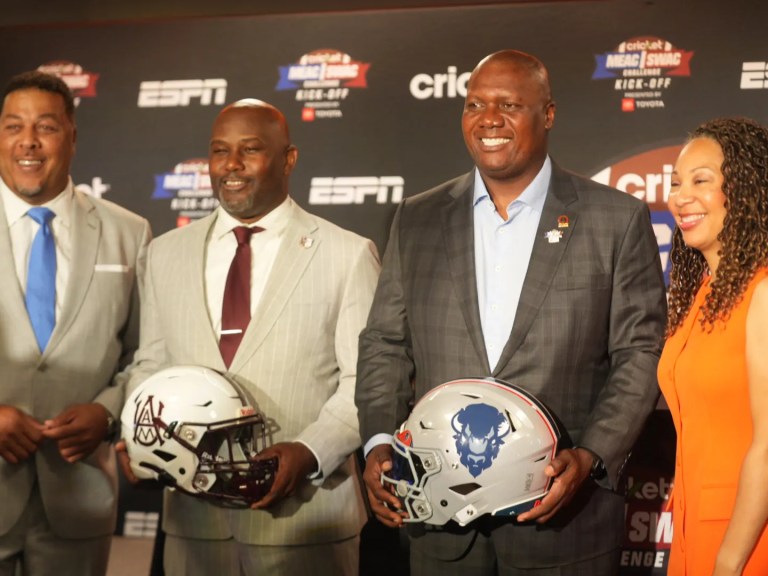
ESPN Events and the SWAC announced a six-year agreement Wednesday in Atlanta, extending the conference’s participation in both the Cricket MEAC-SWAC Challenge and the Cricket Celebration Bowl through 2032. The announcement came during a press conference at Center Parc Stadium in Atlanta, where coaches, athletic directors, band directors, and conference officials gathered to preview the August 29 season opener between Howard University and Alabama A&M University. Moreover, a MEAC extension is expected to be announced next week — setting up the possibility that HBCU football’s two most prominent showcase events will have guaranteed national television homes well into the next decade.
What the Six-Year Extension Actually Means
The MEAC-SWAC Challenge ESPN partnership has helped reshape how the country thinks about HBCU football. Furthermore, locking it in through 2032 removes uncertainty that has historically complicated long-term planning for HBCU athletic departments.
John T. Grant, executive director of the Cricket MEAC-SWAC Challenge and Cricket Celebration Bowl, framed the significance of the deal directly. “Together, these events represent more than football games and competition,” Grant said. “They are national platforms that elevate institutions, showcase excellence and drive economic impact. They create opportunities for students and connect generations of alumni and fans.”
The extension also brings a significant new commercial partner into the fold. Toyota joins as the presenting sponsor of both events and the Red Lobster Band of the Year competition in a multi-year deal. Additionally, Cricket Wireless continues its investment in HBCU athletics — a partnership Grant praised specifically. “You can have no better partner than Cricket Wireless,” Grant said. “They saw the vision. They invested in the vision, not just with us, but they make investments directly into the conferences.”
Howard and Alabama A&M Step Into the Spotlight
The 2026 MEAC-SWAC Challenge kicks off August 29 at 7:30 p.m. ET at Center Parc Stadium. The game airs nationally on ABC — putting two HBCU programs in front of one of the largest audiences in college football’s opening weekend.
Howard’s first-year head coach Ted White used his press conference time to do something unexpected. Rather than talk about X’s and O’s, he spoke about what his program has spent the offseason building — and why Howard University made him the leader he is today.
“It gives you an opportunity to sit in any room and feel confident about what you’re talking about and not fearful of anybody,” White said. “Howard University gave me that.”
He added that his program’s summer included media training, financial literacy sessions, résumé workshops, and interview preparation alongside football work. That combination of preparation reflects exactly what HBCU programs have always done — developing whole people, not just athletes.
Alabama A&M head coach Sam Shade struck a similar tone. “It’s not just the teams on the field,” Shade said. “It’s the fans, it’s the alums, it’s the bands. I’ve coached at a lot of places, but the excitement that I know I get, my coaching staff and players get on Saturdays in HBCU football is just very special.”
The Bands Are Part of the Story Too
No MEAC-SWAC Challenge press conference is complete without acknowledging the halftime show — and Wednesday’s event made room for that too.
Alabama A&M Director of Bands William J. Young and Howard Associate Director of Bands Clifford S. Southern both attended. Young set the standard simply. “If the crowd’s not staying on their feet, we didn’t do our jobs,” Young said.
That philosophy reflects the broader truth about what makes this event different from any other Week Zero college football game in the country. Furthermore, the band showcase element is now formalized through the Red Lobster Band of the Year competition — giving HBCU band programs a competitive platform tied directly to one of the season’s highest-profile games.
Why This Moment Matters for HBCU Football
The MEAC-SWAC Challenge ESPN partnership extension through 2032 arrives at a moment when HBCU football is experiencing genuine national momentum. Recruit interest is growing. Attendance is climbing. Brand partnerships are expanding. Consequently, a six-year television commitment from ESPN is not just a contract renewal — it is a statement about the commercial and cultural value the network sees in HBCU football going forward.
For the conferences, the extension provides financial predictability that makes long-term athletic planning possible in ways that were harder to guarantee before. For the programs competing in Atlanta each August and December, it means a guaranteed national audience for years to come. For the fans who fill Center Parc Stadium every season — and the millions more watching at home — it means this platform is not going anywhere.
August 29 is right around the corner. Howard and Alabama A&M will open the HBCU football season on ABC. Moreover, they will do it knowing the stage they are standing on has been secured through 2032.
Lindsey Graham’s HBCU legacy is more complicated than his politics — and South Carolina’s historically Black institutions are making sure that legacy gets told accurately.
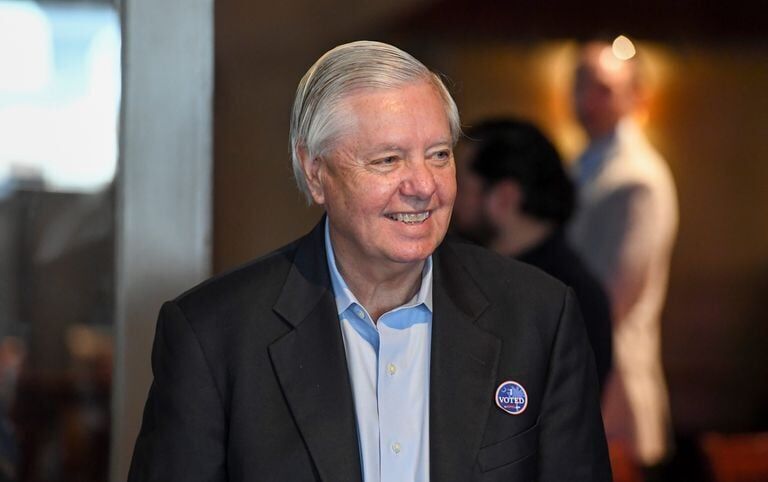
Graham, the longtime U.S. Senator from South Carolina, died Saturday night, July 11, 2026, at his home in Washington, D.C. He was 71. His family announced his death the following day. While Graham built his national reputation on military, judicial, and foreign policy matters, his relationship with South Carolina State University, Benedict College, and other HBCUs in his home state ran deeper than many outside the state realized. Moreover, the institutions he supported most directly did not hesitate to honor him publicly — even as tributes from across the political spectrum reflected the complicated nature of his career.
South Carolina State University Recalls a Personal and Institutional Bond
South Carolina State was among the first institutions to release a formal statement. President Alexander Conyers and Board of Trustees Chairman Douglas D. Gantt issued a joint response honoring the senator and acknowledging a bond that went beyond appropriations.
“Sen. Graham understood that higher education is an investment in South Carolina’s future, creating opportunities, strengthening the workforce and preparing the next generation of leaders,” the statement read.
That bond carried a personal dimension as well. Graham’s sister, Darline Graham Nordone, earned a master’s degree in rehabilitation counseling from South Carolina State in 2009. Furthermore, she has since been appointed to temporarily fill her brother’s Senate seat — connecting the Graham family to SCSU in a way that extends beyond his death.
During his Senate career, Graham helped secure federal funding for South Carolina State on multiple occasions. Those investments supported STEM research, health initiatives, scientific equipment, and a significant project documenting the history of the Montford Point Marines — the nation’s first Black Marines. Additionally, he applauded a federal climate-smart agriculture initiative that included South Carolina State, and the university awarded him an honorary Doctor of Laws degree during his tenure.
Benedict College and Morris College Also Recognized His Support
Benedict College joined South Carolina State in honoring Graham’s memory. His ties to the Columbia campus were not as extensive, but they were meaningful nonetheless.
Graham’s office announced federal funding for community development initiatives benefiting both Benedict and Morris College during his Senate career. Furthermore, he requested congressionally directed spending for a learning hub at Benedict. In 2019, Graham visited the Benedict campus alongside then-President Donald Trump for a criminal justice reform forum — an event that drew national attention and placed the HBCU squarely in a major political conversation.
A Record of Appropriations That Mattered
Graham was not widely viewed as Congress’ most vocal HBCU champion. However, his appropriations record consistently included investments in South Carolina’s historically Black institutions over more than two decades in the Senate.
In 2005, he announced more than $7 million in federal grants for scientific and technical programs at six HBCUs. He also supported Senate recognition of National Historically Black Colleges and Universities Week. Later, he voted for legislation establishing permanent federal funding for HBCUs and other minority-serving institutions — a structural investment that extended well beyond any single appropriation.
That pattern of support did not make Graham a consistent ally on every issue the HBCU community cared about. Rather, it made him a senator who showed up when federal dollars were on the table and whose home-state relationships with Black institutions were genuine, even if complicated by the broader arc of his political career.
Why the Statements From SCSU and Benedict Matter
The tributes from South Carolina State and Benedict College carry a specific weight. Both institutions chose to focus on shared history and documented investment rather than on Graham’s political profile. That choice reflects something important about how HBCUs engage with power — they recognize allies where they find them, hold those relationships with appropriate complexity, and focus on what was actually built.
For South Carolina’s HBCUs, Graham’s legacy includes STEM research funding, community development investments, campus visits, and a personal family connection to South Carolina State that will now continue through his sister’s appointment to his seat. Consequently, his death leaves a gap in a set of relationships that took decades to build.
South Carolina State University lost an honorary alumnus. Benedict College lost a senator who showed up on campus. The HBCU community in South Carolina lost a complicated but documented source of federal investment.
As the state mourns, its historically Black institutions are doing what they have always done — finding the good in a complicated story and making sure it is part of the record.
Dr. Albert Mosley’s Bethune-Cookman presidency has done something no interim leader could accomplish — it has given the university its momentum back.
When the Bethune-Cookman University Board of Trustees selected Mosley as the institution’s eighth president on June 20, 2025, the announcement ended 1,574 days without permanent leadership. That is more than four years of interim presidents, board tensions, alumni frustration, and institutional uncertainty. Moreover, it is four years during which one of the most historic HBCUs in the country operated without a consistent compass at the top. Mosley officially assumed the presidency on July 7, 2025, arriving in Daytona Beach ready to lead. One year later, the evidence suggests Bethune-Cookman University made the right call.
Understanding the Legacy Before Shaping the Future
One of Mosley’s first moves was to immerse himself in the story of the university’s founder, Dr. Mary McLeod Bethune. That choice was intentional — and it set the tone for everything that followed.
“Before women could vote — and before even white women could vote — before women could own property, you had a Black woman in the South, in the state of Florida, who dared to buy property and declare, ‘I’m going to start a school,’ initially for Black girls,” Mosley said. “That kind of courage and vision continues to inspire everything we do today.”
That framing matters. Bethune-Cookman is not simply an institution with a history. Rather, it is an institution whose very existence is a defiant act — and Mosley leads it with that understanding front and center.
Academic Growth Is at the Center of His Vision
Mosley has not waited to build. During his first year, Bethune-Cookman launched B-CU Futures — a suite of eight new academic programs designed to prepare students for high-demand careers in rapidly growing industries.
“This is a suite of eight new degree programs that are designed to prepare our students for high-demand careers,” Mosley said. “Those programs began this year, and we’re anticipating even greater growth as prospective students recognize these disciplines because they’re fields where graduates can immediately find opportunities.”
Furthermore, the university expanded its online learning portfolio during the same period. As a result, B-CU is now reaching students beyond its Daytona Beach campus and growing its academic footprint in both directions — more programs and more access to them.
Athletics Are Rising Alongside Academics
A strong presidency lifts every department — and Bethune-Cookman’s athletic program felt that lift almost immediately.
During the 2025-26 season, the Wildcats captured the SWAC men’s cross country championship in Tallahassee. Athletic Director and men’s basketball coach Reggie Theus guided the basketball program to the SWAC regular-season title. Additionally, the baseball team claimed a SWAC regular-season championship of its own. Three conference titles in one year is not a coincidence — it reflects a program operating with renewed energy and institutional support.
Mosley is not satisfied. He is already looking ahead. “I’m looking forward to this being another strong year for us in athletics,” he said. “We’ve got some good recruits that I’m excited about in basketball and football. We’ve got a new women’s basketball coach, Demetria Frank. I’m extremely excited about her because she’s coming home. I think we’re going to have a very good year. I’m looking at about four or five regular-season championships.”
Dr. Mosley’s Bethune-Cookman Presidency Goes Beyond the Campus
As part of his inauguration, nearly 2,500 students, faculty, and staff participated in community service projects throughout Daytona Beach. That number is not symbolic. It reflects a president who believes Bethune-Cookman’s responsibility extends beyond its gates.
Mosley has also embraced one of HBCU athletics’ most important traditions quickly. He attended the Florida Blue Florida Classic Kickoff Luncheon and experienced the fierce rivalry between Bethune-Cookman and Florida A&M University firsthand. He praised the cooperative Florida Classic Consortium model — a joint business arrangement through which both schools maximize revenue together while putting two of the nation’s most recognizable HBCUs on the same national stage.
For Mosley, that partnership is both a financial asset and a cultural statement. Consequently, he has signaled his intention to protect and grow it.
What One Year Tells Us
One year of any presidency is too short to fully judge. However, Mosley has given Bethune-Cookman’s community something it has not had in a long time — a reason to stop looking backward and start looking forward.
Eight new academic programs. An expanded online platform. Three conference athletic titles. Community service at scale. A deepening connection to Dr. Bethune’s founding legacy. And a leader who shows up not just at board meetings but at rivalry game kickoff luncheons.
The Wildcat community spent 1,574 days waiting for the right leader. Based on year one, it appears the wait was worth it.
Two new arrests in the SC State University shooting cases are bringing the HBCU community closer to answers — but the pain of these losses has not faded.
South Carolina’s State Law Enforcement Division announced on July 15, 2026, the arrests of Deon David Savage, 19, and Khamanti Lytrel Kennedy, 18, in connection with two separate fatal shootings at South Carolina State University in Orangeburg. Moreover, SLED had previously arrested Darrell Lee Gross Jr. on May 28 in connection with the October shooting. Together, these three arrests represent the most significant law enforcement action taken since gun violence struck the historically Black campus twice within five months — once in October 2025 and again in February 2026.
What Happened on October 4, 2025
The first incident took place outside the Hugine Suites dormitories on SC State’s campus during the fall semester.
Arrest warrants allege that Gross pointed and fired a gun into a crowd in the parking lot outside Hugine Suites on October 4, 2025. Furthermore, warrants allege that Savage also presented and recklessly discharged a firearm into that same crowd on the same day. One woman was killed in the shooting. Both Gross and Savage now face charges including possession of a firearm on school property, breach of peace (aggravated in nature), and pointing a firearm at a person. The charges against both men are allegations. Neither has been convicted.
What Happened on February 17, 2026
The second incident struck the same campus just over four months later — and the results were even more devastating.
SLED arrest warrants allege that Kennedy arrived on SC State’s campus on February 12, 2026, with three other people in his vehicle. Surveillance footage showed Kennedy and the group entering Hugine Suites together and later leaving before returning to the building. Three people were shot inside shortly afterward. Two of them died.
Investigators allege the incident began with the purchase of a “green leafy substance” that led to an attempted armed robbery and the subsequent shooting. Additionally, surveillance video shows Kennedy allegedly fleeing the scene on foot in the moments after the shooting. Kennedy now faces a charge of murder. That charge is an allegation. He has not been convicted.
A Campus That Has Carried Enormous Weight
The two shootings at SC State University represent something the HBCU community should not have to absorb — but has. Three people killed. One injured. Two separate incidents at the same dormitory complex within five months. A campus community forced to grieve, process, and show up for classes while investigations slowly moved forward.
SC State, founded in 1896, is the only public HBCU in South Carolina. The university serves nearly 3,000 students and sits in Orangeburg — a city that has carried its own weight of racial and historical trauma for generations. Consequently, the impact of these shootings extends beyond any criminal case. They land inside a community that has always been asked to do more with less and that now must also hold space for grief and anger alongside the daily work of education.
Gun violence on HBCU campuses is not new. Moreover, it is not unique to SC State. However, each incident demands the same response — transparency, accountability, and a community that refuses to let victims be reduced to statistics in a criminal docket.
What the SLED Investigations Show
The progression of arrests in both cases reflects a methodical investigative approach from SLED. Gross was arrested first, on May 28, in connection with the October shooting. Now, roughly six weeks later, Savage’s arrest closes another piece of that case. Meanwhile, Kennedy’s arrest ties the February incident to a specific individual and a specific chain of events that investigators say began with a drug transaction gone wrong.
All three arrests involve charges that are allegations under the law. All three defendants are presumed innocent until proven guilty. The cases will now move through the South Carolina court system.
What the SC State Community Deserves
Three arrests do not bring back three lives. They do not undo the fear that settled over the Hugine Suites parking lot, or the grief that followed the February shooting, or the sense of vulnerability that students felt returning to campus after each incident.
What these arrests do provide is a measure of accountability — and a signal that investigators have not moved on from what happened at SC State. The HBCU community deserves both justice and safety. South Carolina State University deserves both. Furthermore, the families of the three people who lost their lives deserve every legal process to run its full course.
The Texas Southern University stadium plan is the most ambitious infrastructure vision in the school’s history — and it signals a new era for HBCU athletics in Houston.
Texas Southern University unveiled a sweeping $1.7 billion campus master plan on July 11, 2026, placing a brand new on-campus football stadium at the center of a 10-year vision to completely transform the university’s physical footprint. The proposed stadium would seat approximately 10,000 fans and anchor a newly redesigned athletics district on TSU’s Houston campus. Moreover, the plan stretches far beyond football — encompassing new academic buildings, updated student housing, improved infrastructure, and a campus experience designed to compete with any institution in Texas.
Why TSU Is Playing Games 2.7 Miles From Campus Right Now
To understand what this plan means, you first have to understand where Texas Southern football currently stands.
The Tigers have played their home games at Shell Energy Stadium in downtown Houston since 2012 — roughly 2.7 miles from the TSU campus. That arrangement has served the program, but it has also come with real costs. Playing off-campus disconnects the game-day experience from the energy of student life. It limits the organic fan engagement that comes when thousands of students can walk across the yard to watch their team play. Furthermore, it sends a message — intentional or not — that the university’s athletic infrastructure is not yet ready to host at its own front door.
TSU President J.W. Crawford III addressed that reality directly. “If you continue to have outdated, unused facilities on your campus, you’re sending a message,” Crawford said. He emphasized that upgraded facilities are not simply a luxury — they are a critical tool for attracting students, athletes, partners, and resources to the institution.
What the Texas Southern University Stadium Plan Actually Includes
The stadium is the centerpiece of Phase Two of the master plan, scheduled for development between years three and five. However, the full plan goes well beyond one venue.
Phase One focuses on immediate infrastructure improvements — including a health and wellness center that has already secured targeted funding, signaling that this plan is not just a vision document. Phase Two introduces the football stadium alongside a new athletics recruiting center and expanded student housing. Phase Three completes the long-term campus transformation with additional academic and community-facing facilities.
The stadium design will include enhancements to the broader game-day experience. Plans call for improved campus access, expanded parking, and an extended Tiger Walk — one of TSU’s most cherished campus traditions. As a result, the new facility will not simply be a football stadium. It will be a destination that anchors HBCU culture on TSU’s campus in a way that Shell Energy Stadium simply cannot replicate.
Track-and-field facilities will also relocate as part of the redesign, creating a more cohesive athletics district that serves multiple programs simultaneously.
Funding Is the Next Mountain to Climb
The $1.7 billion vision is ambitious — and university officials are clear-eyed about what it will take to get there.
Funding will come through a combination of private partnerships, donor contributions, and state support. No single source will carry the weight alone. Consequently, TSU’s ability to execute on this plan depends on building the kind of institutional momentum that attracts major donors and philanthropic partners over time.
That is not a small ask. However, it is also not without precedent. HBCU institutions have secured transformative investments in recent years — from MacKenzie Scott’s hundreds of millions in unrestricted gifts to state-level funding packages like the nearly $45 million North Carolina just committed to Winston-Salem State. The appetite to invest in HBCUs is real. TSU is now making the case that Houston’s HBCU deserves its share of that momentum.
A Statement About What HBCUs Deserve
The Texas Southern University stadium plan is about more than concrete and turf. Rather, it is a statement about what HBCUs deserve and what TSU intends to become.
TSU has faced the same infrastructure challenges that have held back many historically Black institutions — challenges rooted not in a lack of vision but in decades of underfunding relative to predominantly white peers. Crawford’s administration is choosing to respond to that history not by managing it, but by building past it.
A 10,000-seat on-campus stadium. A redesigned athletics district. New academic buildings. Modern student housing. All of it connected by the Tiger Walk and anchored by the kind of game-day energy that turns casual fans into lifelong alumni donors.
That is not just a construction plan. Moreover, it is a recruiting pitch, a fundraising argument, and a declaration of institutional ambition that the entire HBCU community should be watching.
The plan is in motion. The vision is set. Now it is time to build.
Drew Williamson’s Dallas Mavericks opportunity is proof that the HBCU coaching pipeline runs all the way to the NBA.
Williamson, a former assistant coach at Virginia State University, is joining the Dallas Mavericks after spending the past two seasons at the University of Michigan. The Mavericks hired Michigan head coach Dusty May following the Wolverines’ 2026 national championship — and Williamson is making the jump with him. His path from a Division II HBCU program to one of the NBA’s most recognizable franchises is not a coincidence. It is the result of years of deliberate, disciplined work that started on an HBCU sideline.
Seven Seasons That Built a Foundation
Before Michigan. Before the national title. Before the NBA. There was Virginia State.
Williamson spent seven seasons with the Trojans — one of the most important stretches of his career. During that time, Virginia State went 87-26 in CIAA play and captured six straight CIAA Northern Division titles. The program also won CIAA Tournament championships in 2016 and 2019 and made four NCAA Division II Tournament appearances during his tenure.
Those results didn’t happen by accident. HBCU basketball demands a different kind of resourcefulness. Recruiting pipelines look different. Budgets are tighter. Player development has to be real because there is no margin for shortcuts. Williamson built his coaching identity inside that environment — and consequently came out of it sharper, more creative, and better prepared for bigger stages.
“HBCU basketball can test a coach quickly,” observers noted when Williamson’s Michigan hire was announced. “Resources are not always the same. Exposure is not always easy. Recruiting takes creativity.”
After Virginia State, Williamson followed Dusty May to Florida Atlantic University. Furthermore, when May landed the Michigan job — one of the most high-profile positions in college basketball — Williamson went with him.
At Michigan, he served as assistant coach and recruiting coordinator. As a result, his fingerprints were on both the talent acquisition and the day-to-day development that powered the Wolverines’ run to the 2026 national championship. That title run put the entire Michigan staff on NBA radar — and the Dallas Mavericks moved quickly.
The Mavericks hired May as head coach following the championship, and Williamson joined him as part of the new staff. Moreover, the move gives the Mavericks an assistant coach who has operated at every level of basketball — from Division II HBCUs to Power conference championship programs to the NBA.
What This Means for HBCU Basketball
The story of Drew Williamson joining the Dallas Mavericks carries a message that goes well beyond one coaching hire.
HBCUs are often celebrated as launching pads for players. Stories like this one prove they launch coaches just as effectively. Williamson didn’t arrive at Michigan because someone handed him an opportunity. He built his reputation brick by brick at Virginia State — a Division II HBCU in Petersburg, Virginia — and made himself impossible to overlook.
That is how the HBCU coaching pipeline actually works. It is not about waiting for the right moment. Rather, it is about doing the work in the rooms where you are until the bigger rooms start calling. Williamson did exactly that.
He joins a list of coaches with HBCU roots who have found their way to professional basketball sidelines — and his presence in Dallas makes that list harder to ignore. For every assistant coach grinding at an HBCU program right now, Williamson’s name is worth knowing. His path is a blueprint.
What Comes Next
The Dallas Mavericks begin their 2026-27 NBA season this fall with Dusty May leading the way and Drew Williamson on staff. Furthermore, the Mavericks are a franchise with championship aspirations — giving Williamson a chance to contribute to winning at the highest level of basketball almost immediately.
Virginia State gave Drew Williamson the foundation. Michigan gave him the national stage. Now the Dallas Mavericks are giving him the NBA. The HBCU community produced all of that.
Homecoming at an HBCU is more than a weekend — it’s a cultural institution. The bands, the step shows, the tailgates, and the reunion energy make it one of the most anticipated events on any campus calendar. But something is shifting in how students and alumni actually plan and budget for the occasion, and the change is worth paying attention to.
Rising costs across virtually every spending category are putting real pressure on discretionary budgets. Students are still showing up, still celebrating, still deeply invested in the tradition — but they’re making smarter, more deliberate choices about where their dollars go. That recalibration is reshaping the homecoming weekend experience from the ground up.
Homecoming Budgets Are Getting Creative
Travel, tickets, hotel stays, and outfits add up faster than most people expect. Students coming from out of town face the same transportation squeeze affecting everyone — and that pressure to budget more carefully is very real. With those realities in play, many attendees are prioritizing the events that matter most and skipping the ones that feel like obligation spending.
The result is a more selective homecoming experience. Rather than buying every wristband and attending every afterparty, students are making calculated decisions. Tailgates on campus, free community events, and streaming homecoming-adjacent content have all become viable parts of the weekend itinerary for those watching their spending closely.
Where Students Are Spending Their Time
On-campus events still anchor the weekend. The football game, the yard, the battle of the bands — these remain non-negotiable for most attendees. But the hours between official programming are increasingly filled with informal gatherings, off-campus dinners, and digital entertainment that doesn’t require a cover charge or a reservation.
Morgan State’s homecoming alone demonstrated the scale of HBCU spending power, with the event generating nearly $19 million for Baltimore in regional economic output — a figure that underscores just how seriously homecoming moves culture and commerce.
Digital Entertainment Joins the Weekend Mix
Digital entertainment has moved from a niche supplement to a genuine part of how people spend free time during long event weekends. Streaming, gaming, and mobile-first platforms are all competing for the hours that used to default to a club or a late-night event. What’s more, sports events take a fair share of students’ time. Analytics, stats and insights are integral part of this folklore, including offshore sportsbooks for players who wish to place a bet with flexible rules or just analyze data relevant for those events. That shift reflects broader changes in how this generation organizes leisure time — especially when budgets are tight.
Digital entertainment habits among US college students tell a striking story. A fall 2025 survey by Echelon Insights found that 54 percent of US students spend five hours or more on recreational screen time daily — streaming, gaming, or scrolling social media — with 18 percent spending over six hours on non-coursework activities, according to Inside Higher Ed. That scale of digital consumption shapes expectations: students carry the same frictionless standards into every platform they use, including financial services and payment tools
What This Shift Means for HBCU Culture
None of this signals that homecoming is losing its meaning. If anything, the fact that students are making more intentional spending decisions suggests a growing maturity in how HBCU culture is lived and managed. The traditions aren’t being abandoned — they’re being curated. Attending fewer events with more focus is a different mode, not a lesser one.
What matters is that institutions and organizers pay attention to these shifts. When Texas Southern restructured its homecoming programming in response to safety concerns, it sparked real conversation among alumni about how the weekend’s shape affects where people spend time and money — and coverage in outlets like the Defender Network showed just how passionately the community engages with those decisions. HBCU homecoming will keep evolving, and that’s not a threat to the tradition — it’s proof that the tradition is alive enough to adapt. The core of it, community and cultural pride, isn’t going anywhere.
Bowie State University’s Japan partnership just got official funding — and students across multiple disciplines are about to benefit.
Bowie State University received a $10,000 planning grant from the Japan-U.S. Friendship Commission to develop a new institutional partnership and expand global engagement opportunities for students. The Bowie State University Japan partnership will support the university’s efforts to collaborate with the Commission’s Summer Institute while strengthening academic and cultural exchanges between the United States and Japan. Moreover, it builds directly on a foundation that Bowie State has been quietly constructing for years.
A Relationship That Started in 2022
This is not Bowie State’s first investment from the Japan-U.S. Friendship Commission. Rather, it is their second.
An initial seed grant awarded in 2022 helped establish the university’s Japanese language curriculum. As a result, students can now complete the full four-course modern languages sequence in Japanese — a pathway that simply did not exist at the university before that first grant. That foundational work created the conditions for this new and larger collaboration to take root.
Furthermore, the initiative is already designed to reach broadly across the university. Students in business, education, technology, and the humanities will all have access to the programs and opportunities that flow from this partnership. Consequently, the Bowie State University Japan partnership is not a niche initiative for language students alone. It is a campuswide investment in global readiness.
What Students Can Expect This Year
Bowie State will launch a series of Japanese culture appreciation programs during the fall 2026 and spring 2027 semesters. These programs will connect students with international scholars, cultural leaders, and professionals while introducing academic and career pathways tied to global engagement.
The programming lineup is substantive. Guest speakers from the Embassy of Japan, the Japan Exchange and Teaching Program, and national organizations focused on strengthening Black engagement with Asia will all participate. Additionally, workshops and hands-on activities will offer students immersive experiences in language, culture, and global career development — with a specific focus on preparing students to compete for and participate in future Summer Institute programs.
One event stands out in particular. A Japanese Culture Appreciation Day is scheduled for October 28 and is open to the public. That event will feature a presentation by Hiroshi Ando, education counselor at the Embassy of Japan, alongside a JET Program presentation, origami and haiku workshops, a traditional Japanese music performance, and student presentations. Therefore, even community members beyond the Bowie State campus will have an opportunity to engage with the initiative.
Why This Matters for HBCU Students
Dr. Horacio Sierra, project director and professor in Bowie State’s College of Arts and Sciences, put the significance of this grant in plain terms.
“This partnership reflects Bowie State University’s commitment to preparing students to succeed in a global workforce,” Sierra said. “By expanding opportunities for international collaboration and cross-cultural learning, we are equipping our students with the knowledge, perspective and leadership skills needed to thrive in an increasingly interconnected world.”
That framing matters because it points to a gap that this investment directly addresses. HBCU students have historically had less access to international programming, global exchange opportunities, and language curricula that open doors to careers in diplomacy, international business, and global education. Moreover, they have had less representation in programs like the JET Program, which places participants in schools across Japan as assistant language teachers and cultural ambassadors.
Bowie State is working to change that equation. Furthermore, the university is doing so by building real infrastructure — language courses, cultural programming, institutional partnerships — rather than simply declaring an interest in global engagement without the resources to back it up.
What Comes Next
The grant project will continue through July 1, 2027. Outcomes from this planning phase will directly inform the next stage of collaboration between Bowie State and the Japan-U.S. Friendship Commission. As a result, the programming launched this academic year is not a one-time event. Instead, it is the foundation for a longer and more expansive partnership that could eventually include student exchange programs, research collaborations, and expanded language offerings.
For Bowie State, founded in 1865 as the first HBCU in Maryland, the Japan partnership represents another dimension of a university that continues to expand what it offers its students — and what it expects of them.
The world is the classroom. Bowie State is making sure its students are ready for it.
North Carolina just made one of the largest state investments in Winston-Salem State University history — and the impact will be felt across the campus, the classroom, and the healthcare workforce for years to come.
The 2026 North Carolina State Budget allocates nearly $45 million to Winston-Salem State University, funding a sweeping set of priorities that include capital improvements, scholarship expansion, nursing workforce development, and employee compensation increases. The Winston-Salem State University state budget investment covers multiple areas simultaneously. Moreover, it reflects a growing recognition of WSSU’s role as one of North Carolina’s most important engines of student success and economic opportunity.
Nearly $40 Million for Campus Modernization
The largest portion of the investment — nearly $40 million over two fiscal years — goes directly toward capital improvements on campus.
The centerpiece of that spending is the long-awaited completion of K.R. Williams Auditorium. The budget releases the remaining $14.65 million needed to finish the renovation and modernization of the facility. Furthermore, continued funding supports renovations to both Eller Hall and Pegram Hall. Together, these projects will modernize key academic and cultural spaces that serve thousands of WSSU students each year.
For a campus committed to the motto “Enter to Learn. Depart to Serve,” investing in the physical environment where that learning happens matters deeply. Additionally, upgraded facilities send a clear message to prospective students and faculty: Winston-Salem State is building for the future.
Cheatham-White Scholarship Program Gets a Major Expansion
Beyond the capital investments, the budget also significantly expands one of WSSU’s most prestigious academic programs.
Starting in the 2027-2028 academic year, the Cheatham-White Scholarship Program will grow to award up to 50 merit-based scholarships annually. As a result, WSSU becomes one of only three historically Black universities in North Carolina authorized to award scholarships at that scale. That distinction carries real recruiting power. Moreover, it reinforces WSSU’s commitment to making high-quality education accessible to the state’s top students.
The Cheatham-White program has long been a cornerstone of WSSU’s academic identity. Therefore, its expansion represents not just more funding — it represents a deeper investment in the kind of merit-based excellence that defines the university’s “We Are Rising” strategic plan.
WSSU Joins Statewide Nursing Workforce Initiative
North Carolina is facing a significant healthcare workforce shortage — and WSSU will now play a direct role in solving it.
The budget establishes WSSU as a key partner in the new Nursing Fellows Forgivable Education Loan Pilot Program, a statewide initiative designed to address the state’s nursing shortage by making education more financially accessible for students entering the profession. Under the program, nursing students who commit to working in North Carolina after graduation can receive forgivable education loans — reducing the financial burden of entering healthcare while simultaneously filling critical workforce gaps across the state.
For WSSU, participation in this program is a natural fit. The university has built a strong reputation in health sciences education, and its location in the Piedmont Triad places it at the center of a region with significant healthcare workforce needs. As a result, WSSU graduates will directly serve the communities that surround them.
Employees Also See Meaningful Gains
The investment in WSSU’s workforce extends beyond students. The budget includes a 3% salary increase for eligible SHRA and EHRA employees, one-time bonuses, and additional compensation for sworn law enforcement officers on campus.
Those increases matter. Consequently, they help WSSU retain the faculty and staff who make the university’s mission possible. Chancellor Bonita J. Brown addressed the significance of that piece directly.
“This budget represents more than an investment in Winston-Salem State University; it is an investment in North Carolina’s future,” Brown said. “These strategic investments expand opportunity for our students, strengthen our ability to prepare the workforce our state needs, support the outstanding employees who make our mission possible and position WSSU to build on the momentum of our ‘We Are Rising’ strategic plan.”
What This Means for HBCU Funding in North Carolina
Investments of this scale in an HBCU are still rare enough to be worth noting explicitly. WSSU is a constituent institution of the University of North Carolina System and home to nearly 5,000 students. Furthermore, it holds the Carnegie/American Council on Education Opportunity College designation — the only university in North Carolina to do so — recognizing its outsized impact on student access and social mobility.
The nearly $45 million investment signals that state leaders understand what WSSU represents: not just a university, but a proven engine of opportunity for students who might not otherwise access higher education at all.
Brown reflected on the milestone with characteristic clarity. “At WSSU, we believe higher education should transform lives while strengthening communities,” she said. “This investment allows us to accelerate that work and deepen our impact across North Carolina.”
Homecoming week has a rhythm you can feel before you see it. The band section starts running cadences, the group chats fill with tailgate plans, and half the timeline turns into an argument about which team is really carrying the conference this year. Somewhere between the highlight clips and the meme reposts, a different kind of message keeps showing up: an ad promising free spins, no deposit needed, on a slot game you have never heard of. For a lot of students watching an HBCU football Saturday from a dorm common room, that ad is the first time online casino promotions feel aimed directly at them.
The pitch sounds simple, which is exactly why it deserves a second look. That is where a plain-language reference helps. Bonus.com keeps a rundown of complimentary spins without deposit that explains how these offers are built, what the fine print usually asks for, and why the word free rarely means free of conditions. Reading it before you tap accept is the difference between treating an offer as entertainment and mistaking it for a plan.
This guide takes a student budget seriously. It walks through what these offers actually are, how to read the terms, why they are landing with sports-minded HBCU crowds right now, and how to keep curiosity from turning into a bill you did not sign up for. The goal is not to sell you on anything. It is to help you make an informed call.
What “Free Spins, No Deposit” Actually Means
The phrase gets used loosely, so start with definitions. A no-deposit free-spins offer lets you play a set number of spins on specific slot titles without funding an account first. If those spins produce a win, that money usually lands as bonus credit rather than cash you can withdraw right away. The offer is a marketing tool. Its job is to get you to open an account and stay long enough to make a real deposit later.
There is also a hard line most ads skip past. These promotions live inside licensed real-money online casinos, and that category is legal in only a small number of US states. Where it is legal, you generally have to be 21 or older and physically located in that state to play for real money. Plenty of students reading this will be under 21, in a state without legal online casinos, or both. In that case the real-money version is not an option, full stop.
That does not mean every slot you see is a real-money product. Free-to-play demo modes, social casinos, and sweepstakes-style games are a separate model that runs on virtual coins rather than cash. Telling the two apart is the first budgeting skill this whole topic requires, and it matters more than any single offer.
It also helps to understand why a casino would give anything away. A no-deposit offer is a customer acquisition cost, the same way a first-order discount is for a food app. The company is betting that a slice of the people who claim free spins will later deposit real money and stay. Seen that way, the offer is an invitation into a business relationship, not a gift, and knowing that reframes the whole thing from luck to marketing.
Reading the Fine Print Before You Tap Claim
The value of a no-deposit offer is almost never the number in the headline. It sits in the terms underneath. A promotion advertising 50 free spins can be generous or nearly worthless depending on the wagering requirement, the withdrawal cap, and which games qualify. Learning to scan those terms in under a minute protects both your time and your money.
Wagering requirements are the biggest catch. If an offer attaches a 30x requirement to winnings, you have to place bets totaling 30 times that amount before any of it can be withdrawn. Small print like a maximum cashout can quietly limit your keepable winnings to a fixed figure no matter how well the spins go. Add expiry windows and game restrictions, and the picture changes fast.
Image by Hugo Holloway
Here is a quick reference for the terms you are most likely to meet, and what each one means for someone counting every dollar.
Term you will see
What it actually means
Why it matters on a student budget
No deposit
You do not fund the account to receive the spins
Nothing leaves your bank up front, but the offer still ties to a real-money account
Wagering requirement
Winnings must be bet a set number of times before any withdrawal
A 30x rule on a 20 dollar win means 600 dollars in bets before you can cash out
Maximum cashout
A cap on how much of the winnings you may keep
You can win more than you are allowed to withdraw
Eligible games
Only certain slots count toward the offer
Playing the wrong title can void the whole bonus
Expiry window
Spins and winnings expire after a set time
Miss the window and the value simply disappears
Age and location check
Real-money play verifies 21 and up in a legal state
Many students will not qualify to begin with
If an offer hides these details or buries them three taps deep, treat that as information too. Clear operators tend to show the terms up front.
Why the Offers Are Landing With HBCU Sports Fans
Marketing follows attention, and HBCU sports command a lot of it. Classic rivalry weekends, packed basketball gyms, and battle-of-the-bands showdowns pull huge second-screen audiences who are already on their phones between plays. That is a natural moment for a slot ad to appear, and advertisers know it.
There is also a cultural fit worth naming honestly. Campus life runs on shared experiences, from watch parties to the group chat that never sleeps during a close game. A free-spins offer slots into that same social space, framed as a low-stakes way to pass time during halftime or a rain delay. The framing is deliberate, and it works because it borrows the energy of an environment students already love.
The ambition around HBCU sports culture matters here too. Look at HBCU students winning national sports-media grants and you see a generation treating sports as a career runway, not just a pastime. That drive is a strength. It also means the same students are prime targets for any product that wraps itself in sports culture, which is all the more reason to read these offers with clear eyes rather than caught-up-in-the-moment enthusiasm.
A Student Budget Is Different: The Real Cost of Free
Money math looks different when your income is a part-time job, a refund check, and whatever a summer internship left over. A twenty dollar loss that a working adult shrugs off can be a week of groceries or a chunk of a book you still need. That gap is the whole reason to treat casino promotions as entertainment spending and nothing else.
The trap in the word free is that it hides opportunity cost. The spins themselves cost nothing, but the account they open, the deposit they nudge you toward, and the hours they pull from studying or a shift all carry a price. A free offer that leads to a hundred dollar deposit you did not plan is not free in any way that matters to your balance.
Image by Hugo Holloway
A simple rule keeps this in check: only ever consider real-money play with money you have already labeled as fun spending, the same category as a concert ticket or a night out. If the dollars have any other job, tuition, rent, a phone bill, they are off limits. Framing it that way turns a fuzzy temptation into a clear yes or no.
A Decision Checklist Before You Opt In
Turning all of this into a habit means having a short list you run every time an offer appears. None of these steps take more than a moment, and together they filter out most of the offers that were never worth your attention.
First, confirm eligibility. Are you 21 or older and in a state where real-money online casinos are legal? If not, the real-money offer is not for you, and the honest move is to close the ad. Second, find the wagering requirement and the maximum cashout before anything else. If either is buried or extreme, that alone is a reason to pass.
Third, set your number before you play, not after. Decide the most you are willing to spend if the free portion runs out, and treat that as a hard ceiling. Fourth, check the clock and the game list so an expiry window or a title restriction does not surprise you. Fifth, ask yourself the plain question: am I doing this for fun, or because I am hoping it pays off? If the answer is the second one, that is your signal to step away. The offer will always be there next weekend.
Free Play vs Real Money: Keeping the Line Clear
One of the most useful things a student can understand is that not all slots involve real money at all. Free-to-play demo versions let you spin purely for entertainment with no cash in or out. Social and sweepstakes-style casinos use virtual currencies, and while some let you redeem prizes under specific rules, they are a distinct model from a licensed real-money casino.
That distinction is getting more attention from regulators, not less. California, for example, passed AB 831, which restricts the dual-currency sweepstakes model as of January 1, 2026. The details vary by state and keep shifting, so the practical takeaway is to know which type of product you are actually using rather than assuming they all work the same way.
For most students, free-to-play is the version that fits both a budget and the law. It delivers the same visual experience, the same themes tied to sports and music and pop culture, without touching your bank account. If the entertainment is the point, the free-play route gives you that with none of the financial exposure. Reserving real money for the narrow case where you are of age, in a legal state, and spending clearly labeled fun money keeps the line from blurring.
Setting Limits That Fit Campus Life
Even when someone is fully eligible and playing responsibly, limits are what keep it that way. The tools exist for a reason. Licensed real-money platforms are generally required to offer deposit limits, time reminders, cooling-off periods, and self-exclusion options. Setting those before you play, rather than in a stressful moment, is the version of responsible play that actually holds up.
Campus life adds its own pressures that make limits smart. Finals stress, a tough loss on a big game night, or a slow week with too much free time can all push casual play toward something heavier. A deposit cap you set in a calm moment protects the version of you having a rough Tuesday. Time reminders do the same for the hours you meant to spend on a paper.
Image by Hugo Holloway
It also helps to treat this like any other budget line. If you would track what you spend on food delivery or streaming, track what you spend here with the same honesty. The number tells you quickly whether an occasional bit of entertainment has drifted into something you would rather it did not. Limits are not a lecture. They are the same self-management that keeps the rest of a college budget standing.
A useful trick is to build the limit into your calendar rather than your willpower. Willpower fades late at night, after a loss, or during a stressful stretch of the semester, which is exactly when overspending happens. A deposit cap and a time reminder set in advance keep working when your resolve does not. Some students find it easier to leave payment details off the account entirely, so that any real-money play takes a deliberate extra step instead of a quick tap. Small friction like that turns an impulse into a decision.
When Curiosity Turns Into a Problem
Most people who try a free-spins offer will treat it as a passing curiosity and move on. A meaningful minority will not, and college-age players carry particular risk. Research summarized by campus health experts estimates that roughly 6 percent of US college students have a serious gambling problem, one serious enough to affect their grades, their debt, and their mental health. That number is small in percentage terms and large in real lives.
The warning signs are worth knowing before you need them. Chasing losses, spending more than you planned, hiding how much you play, or feeling anxious when you cannot get to a game are all signals to take seriously. So is borrowing money to keep playing, or letting play cut into class, sleep, or friendships. These patterns rarely announce themselves. They build quietly.
If any of that sounds familiar, for you or a friend, there is campus guidance built specifically for students that lays out warning signs, prevention steps, and where to find help. Campus counseling centers, resident advisors, and peer support programs are equipped for this, and reaching out early is far easier than untangling a deeper problem later. There is no shame in checking. The strongest financial decision a student can make is knowing when a form of entertainment has stopped being one.
Frequently Asked Questions
Are free spins no-deposit offers something HBCU students can legally use?
It depends entirely on age and location. Real-money free spins live inside licensed online casinos that are legal in only a handful of US states, and they require players to be 21 or older and inside that state. Many students will not qualify, in which case free-to-play demo and social versions are the lawful alternative.
Do I really have to be 21 to claim real-money free spins?
Yes. In every state where real-money online casinos are legal, the minimum age is 21, and platforms verify both age and location before you can play. Free-to-play slots and many social casino games have lower age thresholds, but they do not pay out real cash the way a licensed casino can.
Can free spins actually help my budget or cover a bill?
No, and treating them that way is the fastest route to trouble. Wagering requirements and cashout caps mean the odds and the terms favor the house, so these offers should be counted as entertainment spending, never as income or a fix for tuition, rent, or a shortfall. If money is tight, campus financial aid and emergency funds are the real resources.
What is the difference between free-to-play slots and no-deposit spins?
Free-to-play slots use virtual coins with no real money involved and no cash payout. No-deposit spins sit inside real-money casinos, so any winnings come with wagering rules, withdrawal limits, and eligibility checks. They can look identical on screen, which is exactly why knowing which one you are using matters.
Where can I turn if gambling starts affecting my studies or money?
Start on campus. Counseling centers, health services, and resident advisors are trained to help, and student-focused resources online lay out warning signs and next steps. Reaching out early, before debt or missed classes pile up, keeps a manageable situation from becoming a serious one.
The first real budget I ever wrote was not for a vacation or a car. It was a single index card taped to the inside of a dorm closet, splitting a part-time paycheck and a refund check into rent, groceries, a bus pass, and a tiny line at the bottom labeled “fun.” That bottom line was the point. It was small, it was fixed, and once it ran out, it ran out. Years later I still think about that card whenever a new kind of spending shows up and tries to talk its way past the limit. Online casinos are one of those new arrivals, and Alberta is about to become a textbook example of how the category presents itself to people who are still learning to read it.
I am not here to tell anyone to play or not to play. I am here to walk through how a person who counts every dollar should evaluate a regulated online casino market before deciding anything at all. The skill is not really about gambling. It is about reading an offer designed to look generous, finding the number that matters, and refusing to move it. When I want to understand what is actually opening in a market like Alberta, I start with neutral comparison references rather than an operator’s own pitch, and the Alberta-focused Lineups guides are the kind of resource I read first because they describe the field instead of selling a seat at it.
This piece uses Alberta because it is fresh and well documented, but the habits travel. Read one regulated market with a budget in your hand and you can read the next one, which is why a student audience should care even if Alberta itself feels far away.
Why Alberta Makes a Clean Case Study
Alberta is useful precisely because the rollout is on the public record. The legal foundation is Bill 48, the iGaming Alberta Act, which passed in the spring of 2025 and set up the structure for licensed private operators. Before that, the only regulated online casino and sportsbook in the province was Play Alberta, run by the provincial body that handles gaming, liquor, and cannabis. The new model cracks the door open so private brands can compete alongside the government option, which is exactly when advertising tends to get loud.
The province set a launch date of July 13, 2026, for licensed private operators to start offering real-money games to Alberta residents. Registration for operators opened in January of 2026, and reporting since then has described dozens of brands lining up. Two separate steps gate each one. A brand has to register with the provincial regulator, then reach a commercial agreement with the Alberta iGaming Corporation, the conduct-and-manage body that holds the contracts operators need before they can take a single bet. A name on a flashy site means nothing until both boxes are checked.
A few public-interest details are worth holding onto, because they show the framework was built with harm in mind, not just revenue. Alberta plans to keep a share of iGaming revenue, with portions earmarked to support First Nations and to fund social responsibility work. The framework also includes a centralized self-exclusion system and advertising rules meant to keep targeted ads away from high-risk individuals and minors. The legal age to play is 18.
Start With the Number You Can Lose, Not the Bonus
Every casino leads with the upside: a welcome offer, a matched deposit, a set of free spins. The budget-first move is to ignore all of it on the first pass and answer one question instead. What is the most I am willing to lose this month and never see again? Not win, not risk and recover. Lose. If that number makes you flinch, it is too high, and the bonus on the other side of it does not change the math.
This reframing matters because the whole presentation is built to make you think in gains. A budget thinks in terms of what is already gone the moment you deposit it. Treat the deposit like a movie ticket you already paid for. The money buys an evening of entertainment, and the entertainment is the product. A person who treats anything that comes back as a plan has stopped budgeting and started hoping, and hope is not a line item.
For a student or anyone on a tight income, the honest version of that number is often zero, and zero is a valid answer. There is no rule that a newly legal market requires your participation, and the July launch is not a deadline. The market will still be there next month, and the smartest read of a brand-new category is sometimes to watch it for a while first.
The Bankroll Math a Budget Can Actually Run
If the entertainment number is more than zero, the next habit is turning it into rules a tired brain can follow at eleven at night, because vague intentions lose to a flashing screen and hard numbers do not. Say you decide the month’s line for this is forty dollars. That is not a starting balance to grow. It is a ceiling, and the math underneath it is simple on purpose.
Break the ceiling into sessions before you ever log in. Forty dollars might be four sessions of ten, spread across the month, with a firm rule that one session never borrows from another. If a ten-dollar session is gone in fifteen minutes, the session is over, even though it feels early. The discomfort of stopping is the budget working, not failing.
The other half of the math is the part the marketing hides. The house keeps an edge on every game, and over enough time that edge wins. It means the expected direction of a long-run bankroll is down, slowly and reliably, which is why a fixed loss limit is the only honest way to engage. Anyone who pitches this as an income stream is either confused or selling something, and a budget-minded reader should treat that pitch as a reason to close the tab.
One money trap deserves a name: chasing. You set ten dollars, you lose it, and a voice says one more deposit will make it back. That single move is where a forty-dollar month becomes a four-hundred-dollar month. The defense is mechanical, not emotional. The session limit and the loss limit are set in advance and treated as non-negotiable, so the decision is already made before the urge arrives. You do not argue with the urge. You point to the rule.
Checking That a Site Is Actually Licensed
The single most useful skill in this whole area is verifying a licence, and almost nobody does it. In Alberta, a legitimate private operator after launch has to be registered with the provincial regulator and hold an agreement with the Alberta iGaming Corporation. That means there is something to check, and a careful person checks it instead of trusting a logo. A real licence is verifiable through official channels. A fake one is just a picture.
In practice that means finding the regulator’s own registry rather than relying on a badge in the casino’s footer, which anyone can copy. If a site cannot point you to its registration in the province where you live, that absence is the answer. Unregulated offshore sites will happily take a deposit and may later make a withdrawal feel impossible, with no provincial body to call.
Geography matters here for a student audience. Many readers are in the United States, where the legal picture is entirely different and varies by state. A market being legal in one province of Canada says nothing about whether anything is legal where you actually sit. The verification habit is the same everywhere, though. Find the real regulator for your own location, confirm the operator appears in its records, and treat any site that dodges that question as a site that has answered it. Online casinos are not legal everywhere, and assuming they are because an ad appeared on your phone is exactly the mistake a budget-first reader avoids.
A Budget Checklist Before You Ever Deposit
Habits work best when they are written down where you can see them. The same instinct that makes a student compare aid packages line by line, the kind of careful reading behind a rundown of major HBCU scholarship sources, is the one this checklist borrows. Each row is a decision to make before money moves, a setting to lock in, and the warning sign that should stop you.
Factor
What to set
Red flag
Monthly cap
A fixed dollar figure drawn only from leftover money
Telling yourself you will “see how it goes”
Deposit limit
Lock it in the account settings on day one
The site buries the control or delays the change
Loss limit
A point where the month is simply over
Adding a bigger deposit to win a loss back
Session time
A timer started before you log in
Looking up and not knowing how long it has been
Funding source
Discretionary cash you already counted as gone
Reaching for tuition, rent, or a credit line
Licence check
Confirmed with the regulator and the provincial body
No verifiable registration details anywhere
Withdrawal test
Pull a small amount early to prove it works
Cashouts stall or sprout new conditions
The withdrawal test in the last row is underrated. Before you trust a platform with real money, deposit a small amount, play briefly, and try to withdraw what is left. A legitimate site processes it within its stated window. A bad one invents verification steps, minimums, or delays that did not appear during the deposit. You learn more from one small withdrawal than from a hundred reviews.
Reading the Fine Print Without Getting Lost
Bonus terms are written by people who are very good at making restrictions sound like gifts. The phrase to find is the wagering requirement, sometimes shown as a number followed by an x. A hundred-dollar bonus with a thirty-times requirement means you have to wager three thousand dollars before the bonus or anything won from it can be withdrawn. Once you see that math, most welcome offers look less like free money than like a reason to keep playing.
You do not need a finance degree to read these terms, just a habit of finding three things. The wagering requirement. The expiry window, since many bonuses vanish if not cleared in days. And the game weighting, because slots often count fully toward the requirement while table games count for a fraction or not at all. Treat a bonus as a constraint that pulls you toward more play, not as value, and decide whether to opt in only after the underlying entertainment number is already set. The bonus never sets the budget.
Time Is Part of the Budget Too
Money is the obvious resource, but time runs out the same way and is easier to lose track of. A session meant to be twenty minutes can quietly become two hours, and those hours have a cost even when the dollar limit holds. For a student during exam season the time cost can be steeper than the money, because it is the assignment that did not get written or the sleep that did not happen. A real budget for this category has a clock in it, not just a wallet.
The practical tool is a timer you start before you log in, set on your phone and placed across the room so stopping it means standing up. Most regulated platforms also let you set session reminders or time limits directly in the account, and turning those on during setup costs nothing. The point is to make the passage of time visible, because the experience is engineered to make it disappear. Lights, sounds, and near-misses are all tuned to keep you in the chair, and a timer is a simple counterweight.
Image by Farrah Donnelly
There is a sleep-and-money overlap worth saying plainly. Decisions made late at night, tired, after a few losses, are the worst decisions a person makes about this. The budget you wrote in daylight exists to protect you from the budget you would write at one in the morning. If you find yourself negotiating with the rules after midnight, that is not a sign to renegotiate. It is the sign the session should have ended already.
When It Stops Being Entertainment
Every honest discussion of this category has to include the line where it stops being a hobby, and the warning signs are worth knowing before you play, not after. Spending more than you set. Hiding how much or how often you play from people close to you. Borrowing to keep going. Chasing losses with bigger deposits. None of these is a moral failing. They are signals, the same way a check-engine light is a signal, and the right response is to act rather than explain it away.
This is where the regulated framework earns its keep. Alberta’s model includes a centralized self-exclusion system, which lets a person bar themselves across regulated options rather than relying on willpower one site at a time. Deposit, loss, and session limits exist on regulated platforms so a person can build guardrails while still in control, before a problem hardens. Using them early is not an admission of weakness. It is the same instinct as automatic savings, moving a decision away from your future, tired self.
For a plain, non-commercial explanation of these protections and where to find help, the responsible-gambling resources published by iGaming Ontario and its regulatory partners lay out self-exclusion, limit-setting, and self-assessment tools in language that is not trying to sell anything. It describes a different Canadian province than Alberta, but the tools and the thinking carry over. If you or someone you know is sliding from entertainment into something heavier, a confidential help line in your own region is the right call, and those lines are free.
Carrying the Habit Past One Market
The reason I started with an index card instead of Alberta is that the card is the part you keep. Markets open and close and the marketing keeps evolving, but what does not change is the value of deciding your loss number in advance, funding only from money you already counted as spent, verifying a licence instead of trusting a logo, and putting a clock on the whole thing. Those four moves work in Alberta in July, and they will work in whatever market opens next.
That same budgeting muscle is the one HBCU students already flex against tuition, textbook prices, and the gap financial aid does not always close. The discipline that makes you read a scholarship deadline carefully or compare aid packages line by line is the exact discipline that lets you read a casino offer without getting pulled in. It is all one skill: see the real number, ignore the dressing around it, and protect the line at the bottom of the card. Treat a newly legal market the way you would treat any sales pitch aimed at your wallet, with the number you can afford to lose written down before you arrive. The house has an edge on the games. A budget-first reader keeps an edge on the decision, and that is the only edge that reliably belongs to you.
Frequently Asked Questions
When does Alberta’s private online casino market actually open?
Licensed private operators are set to go live on July 13, 2026, under the framework created by the iGaming Alberta Act, with operator registration having opened in January of 2026. Before that date, the only regulated online option in the province is Play Alberta, run by the provincial gaming body, so any private brand claiming to be live earlier deserves a hard second look.
How do I check whether an Alberta online casino is legitimate?
After launch, a legitimate private operator has to be registered with the provincial regulator and hold an agreement with the Alberta iGaming Corporation. Confirm both through official channels rather than trusting a badge on the casino’s own page, since footer logos can be copied. If a site cannot point you to verifiable registration in your jurisdiction, treat that gap as your answer and stop there.
What is a realistic gambling budget for a student?
For many students the honest figure is zero, and zero is a complete answer. If it is more than that, it should be a small, fixed amount drawn only from money you already counted as entertainment spending, never from tuition, rent, or borrowed funds. Decide the figure before you deposit, split it into separate sessions, and treat it as gone the moment it leaves your account.
Are online casino bonuses actually worth taking?
Usually less than they look. The wagering requirement, often shown as a number with an x, tells you how much you must bet before a bonus can be withdrawn, and it is frequently large enough to keep you playing well past your plan. Read the requirement, the expiry window, and the game weighting first, and only consider a bonus after your own entertainment budget is set.
Where can I find help if gambling stops feeling fun?
Regulated markets include self-exclusion systems that let a person opt out across options at once, plus deposit, loss, and time limits you can set early. Neutral regulator resources explain these tools without selling anything, and confidential help lines operate in most regions at no cost. Reaching out early, at the first warning sign rather than after a crisis, protects both your finances and your peace of mind.
Reginald Ruffin, Tuskegee University’s Vice President for Intercollegiate Athletics, just added another line to an already stacked resume. He’s been named the 2025-26 NACDA NCAA Division II Athletic Director of the Year. The honor comes from the National Association of Collegiate Directors of Athletics. It recognizes leadership, integrity, and service across collegiate athletics.
Ruffin stood as the only HBCU recipient among this year’s national award winners. He was formally recognized at the NACDA Convention in Las Vegas. He’d actually learned of the honor earlier this year. Still, receiving it in front of his peers from across the country made it hit differently.
How Reginald Ruffin Built This Résumé
Ruffin didn’t just inherit a strong program. Since fully stepping into the AD role in 2023, he’s overseen serious growth across the department. Tuskegee softball captured both the SIAC regular-season and conference titles under his watch. Men’s basketball won an SIAC regular-season title too, and reached the SIAC Championship Game in both 2025 and 2026. Women’s basketball also reached the championship game in 2025, which speaks to depth across marquee sports.
The success runs beyond the revenue sports as well. Women’s track and field captured three straight SIAC championships — the 2025 indoor title, the 2025 outdoor title, and the 2026 indoor title. Women’s tennis added back-to-back SIAC titles in 2024 and 2025. That kind of across-the-board consistency is exactly what an Athletics Director of the Year award is built to recognize.
A Career That Started With Football
Before athletics administration, Ruffin built his name on the field. He’s a 1998 graduate of the University of North Alabama, where he became a two-time All-American at two different positions. He played defensive end in 1995 and 1996, then linebacker in 1997. During his UNA career, the Lions won two Division II National Championships and went 43-9 overall. He still holds the school’s career sack record with 34, along with the single-season mark of 11.
That playing career fed directly into his coaching path. Ruffin later served as athletic director and head football coach at Miles College. Over nine seasons there, he led the Golden Bears to four SIAC championships. He also picked up an additional SIAC Championship Game appearance along the way. That track record is part of why Tuskegee brought him back for a second stint leading its own athletics department.
What This Means for Tuskegee
The NACDA award is now in its 28th year, and it spans seven divisions across collegiate athletics. Winning it isn’t about one big moment. Instead, it rewards administrators who build sustained success across an entire department, year after year.
Tuskegee president Dr. Mark A. Brown praised Ruffin’s commitment to the university, calling his dedication to student-athletes limitless. The celebration also drew support from Tuskegee stakeholders, including Board of Trustees member Jonathan Porter and Tuskegee University National Athletic Association President Dale Powell. Their presence reflected how much respect Ruffin has built, both within the HBCU space and across national athletics circles more broadly.
Ruffin, for his part, kept the focus on the people around him rather than the individual honor. “We have been able to do some great work, none of which could be accomplished without all of the stakeholders invested in Tuskegee,” he said. Even mid-celebration, he was already looking ahead to what comes next for the department.
For HBCU athletics as a whole, moments like this matter. National awards rarely single out HBCU administrators, so Reginald Ruffin’s recognition puts a spotlight on the kind of leadership happening at Tuskegee. It’s the sort of validation that can help with recruiting, fundraising, and simply getting HBCU programs taken seriously on a national stage.
Building Toward What’s Next
Ruffin’s tenure hasn’t just been about championships already won. Under his leadership, Tuskegee also launched its first-ever men’s and women’s soccer programs, set to begin competition in late August. That expansion reflects a broader philosophy: growing opportunities for student-athletes rather than simply managing what already exists. Because Tuskegee already fields strong programs in basketball, softball, track, and tennis, adding soccer signals real ambition for the department’s future.
Tuskegee student-athletes have also earned recognition beyond the scoreboard during Ruffin’s time as AD. The university was named among 26 finalists nationally for the NCAA Division II Award of Excellence, a recognition tied to community engagement and student-athlete leadership. Programs like the Macon County Helping Hands Food Drive gave student-athletes real-world experience serving their community, on top of their athletic and academic commitments. Together, these efforts show a department building success on multiple fronts at once, not just chasing wins.
That range is likely part of why NACDA chose Ruffin for this honor. Athletic directors are typically judged on wins and titles alone. Instead, this award weighs the full picture: competitive success, institutional growth, and genuine investment in student-athletes’ lives beyond their sport. Tuskegee’s trajectory under Ruffin checks every one of those boxes.
Looking ahead, Ruffin has made clear he isn’t finished building. With new sports launching, a stacked list of recent championships, and a department earning attention on the national stage, Tuskegee’s athletics program looks positioned for continued growth. For now, though, this award gives the Tuskegee community a well-earned moment to celebrate the man leading that charge.
Eric Washington, a Grambling State alum and Alpha Phi Alpha member, is being mourned across the HBCU community after his death this week. He was a public servant known to friends as “E. Wash.” Washington was killed in a shooting in Compton early Saturday morning. He was one of two people who died at the New Wilmington Arms Apartments. Three others were injured in the same incident.
Washington spent his career in public service. Most recently, he worked as a field deputy for California Assemblymember Mike Gipson’s office. He was also an active member of the Watts Gang Task Force. There, he focused on community engagement and violence intervention. That work put him directly in the neighborhoods he was trying to protect, day after day.
Eric Washington’s Path to Grambling State
Washington’s academic journey ran through several schools before Grambling. He earned an associate’s degree in political science from El Camino Compton College. From there, he picked up a bachelor’s degree from the University of North Texas, focused on constitutional law. His path wound through multiple campuses before he landed at Grambling State. That arrival meant something specific, since he chose graduate school deliberately.
At Grambling, Washington completed a Master of Public Administration. That program sharpened the policy and leadership skills he later used in government roles. While there, he also crossed into Alpha Phi Alpha Fraternity, Inc. That brotherhood is built around scholarship and service, and it traces back over a century. His Instagram bio still listed all three schools alongside the Greek letters. It’s a small marker of how much that education shaped his identity.
Friends who knew him on campus remember someone who took the MPA program seriously from day one. Grambling’s program exists to prepare graduates for administrative careers in government. Washington’s resume later read almost like a checklist pulled from that mission.
Colleagues and community members describe Washington as someone who showed up. Indeed, his LinkedIn described over four years of “government agency advocacy on both the city and state levels.” He also called himself a “campaign agent for social justice, public safety, and democracy.” Beyond that, he worked with the Watts Rising Collaborative. There, he led street-team outreach meant to connect residents with resources instead of just enforcement.
That kind of work rarely makes headlines while someone is alive to do it. Public safety advocates in high-violence neighborhoods often work without much recognition. Even so, their presence shapes outcomes for entire blocks. Washington’s death puts a spotlight on that work now, though it’s a spotlight nobody wanted.
HBCU Ties Run Deep in Public Service
Washington’s story fits a pattern that HBCU alumni networks know well. Grambling State, like many HBCUs, has long produced graduates who move into public administration and community organizing. Those careers rarely come with much visibility. The MPA program he completed exists specifically to train people for that kind of government and nonprofit work.
A Loss Felt Beyond Compton
Alpha Phi Alpha, meanwhile, centers its founding mission on scholarship, fellowship, and service. That framework shows up directly in how Washington approached his career. Fraternity brothers across chapters have already started sharing tributes online. They remember him as someone who lived those values out in practice, not just in ceremony.
The shooting remains under investigation. So far, authorities haven’t released information about a motive or suspects. What’s clear is that Eric Washington’s death removes an experienced voice from violence-intervention efforts in Watts and Compton. Additionally, those communities depend heavily on trusted messengers who understand the terrain from the inside.
For the HBCU community specifically, losing a Grambling State alum like Washington is a reminder of how far the university’s reach extends. Graduates carry that education into city halls, nonprofits, and neighborhoods across the country. Often, that work doesn’t get celebrated until it’s gone. Washington’s combination of Compton College, University of North Texas, and Grambling State credentials reflects a life built deliberately around service.
Assemblymember Gipson’s office hasn’t released a public statement yet. Former colleagues are expected to speak on his years of work in the coming days. Congressional candidate Shonique Williams was among those who paid tribute publicly. She wrote that Washington “devoted his life to pouring into his community” and noted he had hoped to run for elected office himself one day. Friends and fraternity brothers have started organizing tributes of their own. More details will likely emerge as the Grambling and Alpha Phi Alpha communities process the loss together.
Our condolences go out to Washington’s family, friends, and everyone who worked alongside him in service to Watts and Compton.
Dr. Joycelyn Hill Alabama State dissertation dissertation win is more than an academic honor — it is the foundation of a new educational pathway connecting two historically Black institutions.
Hill, a Valley, Alabama native and double Alabama State University alumna, won the 2026 Dissertation of the Year award in the Qualitative-Based Method track at Alabama State for her doctoral research on Black women leaders working in institutional research, assessment, and accreditation at HBCUs. Her win directly inspired a formal memorandum of understanding between Alabama State and Morris Brown College in Atlanta — where Hill now serves as director of institutional effectiveness — creating a streamlined graduate school pipeline between the two HBCU institutions. That pipeline is already open and accepting students.
A Journey That Started at Alabama State
Hill’s academic story is one of persistence, reinvention, and homecoming.
She graduated from Valley High School in 2009, then earned her bachelor’s degree in psychology and social work from Alabama State in 2013. Moreover, she continued her family’s legacy at ASU — her mother graduated from the university back in 1986. After earning a master’s degree in counseling and psychology from Troy University in 2018, Hill found herself working at the Alabama State Bar and contemplating law school.
Then, someone gave her advice that changed her trajectory entirely. Rather than starting over in a new field, she was encouraged to build higher in the one she already knew. As a result, she returned to Alabama State in 2022 to pursue her doctorate in educational leadership, policy, and law — completing the degree online while working full-time in Atlanta.
That return brought Hill full circle. The same institution that shaped her undergraduate years became the place where she produced the most significant academic work of her career.
The Research That Won the Award
Hill’s dissertation focused on the lived experiences of Black women working in institutional research, assessment, and accreditation at HBCUs — a subject that grew directly from her own professional life.
The research was both personal and urgent. Black women in higher education administration often navigate spaces with little formal research documenting their experiences. Furthermore, institutional research and accreditation roles sit at the structural heart of what keeps an HBCU functioning and compliant. Hill’s work shed light on the people doing that critical work while largely operating out of the public eye.
Her dissertation earned the Dissertation of the Year recognition in the Qualitative-Based Method track at Alabama State University for 2026 — a distinction that validates not just her academic rigor but the importance of the subject matter itself.
Building a Bridge Between Two HBCUs
The most tangible outcome of Hill’s work is the partnership it helped create. Her success at Morris Brown College — combined with her doctoral achievement at Alabama State — positioned her to connect the two institutions in a meaningful way.
The memorandum of understanding between Alabama State and Morris Brown establishes a direct pipeline allowing Morris Brown undergraduates to enroll in Alabama State graduate programs. Many of those courses are offered online, meaning students can stay in Atlanta while earning a graduate degree from a nationally recognized HBCU doctoral program. The pathway gives Morris Brown students access to master’s programs they might not otherwise have been able to pursue.
“I think the program, Alabama State, allows them to get a quality education as well as stay where they want to be and be in the city of Atlanta,” Hill said. “Knowing that they have a community with them at Alabama State University that’s going to support them educationally as well as socially — it helps the students transition between different states for programs. I think it’s just the start of something very new and very transformative.”
Why This Partnership Matters for HBCU Education
For the HBCU community, this kind of inter-institutional partnership represents exactly the kind of collaboration that strengthens the ecosystem as a whole. Morris Brown has spent the last several years rebuilding after losing and regaining accreditation. Alabama State brings a robust doctoral program with a 100% employment rate for graduates within six months of completing their degrees. Together, they offer something neither could build alone.
“Bridging the gap is why this partnership is so important,” Hill said. “It eliminates barriers. It demonstrates the impact of creating clear pathways for Morris Brown students to continue their educational journeys.”
Additionally, the partnership carries a personal dimension that makes it more than a bureaucratic agreement. Hill is a product of both worlds — an ASU alumna now serving Morris Brown. Her dissertation examined the very kind of leadership work she does every day. Consequently, the pipeline she helped build is not a theoretical construct. It is a direct extension of her own story.
A Valley Girl Who Never Forgot Home
Throughout all of it, Hill has remained grounded in where she started. She credits her hometown of Valley, Alabama for shaping everything she became professionally.
“It shaped me in every single way,” Hill said. “I always come home. Everything that I started with in Valley made me the professional that I am, so I can’t ever forget Valley.”
That rootedness — combined with academic excellence, professional impact, and a commitment to building pathways for others — makes Dr. Joycelyn Hill’s story one worth telling across every HBCU campus in the country.
Grambling State Essence Fest 2026 is putting HBCU culture in front of one of the largest Black audiences in the country — and the World Famed Tiger Marching Band is leading the way.
Coca-Cola announced its full entertainment and cultural programming for the 2026 ESSENCE Festival of Culture, scheduled for July 3-5 in New Orleans, with a major HBCU component at its center. The activation features Eva Marcille and a live performance by Grambling State University’s World Famed Tiger Marching Band as part of Coca-Cola’s “The World Is My Yard” platform. Moreover, 15 HBCU representatives will hold office hours for prospective students and families throughout the weekend. This is more than a performance — it is a full cultural and recruiting moment for the HBCU community on a national stage.
The World Famed Takes New Orleans
Grambling State’s Tiger Marching Band needs no introduction. The program is one of the most recognized names in HBCU marching band culture — a brand built on decades of precision, showmanship, and a standard of excellence that has made it a symbol of what HBCU band culture represents at its highest level.
Their appearance at Essence Fest gives Grambling State another major national platform. Furthermore, it puts HBCU band culture directly in front of the hundreds of thousands of people who descend on New Orleans every July for one of the most important Black cultural gatherings in the country. Essence Fest generated more than $321 million in economic impact for New Orleans in 2025 alone, supported 2,436 jobs, and produced more than $103 million in income for local workers and businesses. That is the scale of the stage Grambling is stepping onto.
Eva Marcille, the actress, model, and entrepreneur, hosts the activation alongside the band. Her presence connects the entertainment world directly to the HBCU cultural moment Coca-Cola is building around the event.
The Grambling State Essence Fest 2026 activation is not limited to a performance. Rather, it also functions as one of the most unique HBCU recruiting events of the summer.
Representatives from 15 HBCUs will hold office hours throughout the weekend, giving prospective students and their families direct access to information about admissions, academic programs, campus life, and financial aid pathways. That kind of access matters enormously. Essence Fest draws a demographic that overlaps almost perfectly with the families HBCUs most want to reach — and meeting them in that environment, during a moment of cultural celebration, carries a different weight than a college fair in a convention center.
For many attendees, a conversation with an HBCU representative at Essence Fest could be the moment that changes the direction of a student’s life. That is not an exaggeration — it is exactly the kind of organic connection that has always defined how HBCUs grow their communities.
Coca-Cola’s 31st Year at Essence Fest
This is not Coca-Cola’s first time centering HBCU culture at Essence Fest. In fact, 2026 marks the brand’s 31st consecutive year as a partner of the ESSENCE Festival of Culture — a relationship that has consistently included programming designed to celebrate and invest in Black communities.
This year’s festival platform, “Every Side Shines,” is built around music, wellness, culture, and connection. Stephanie Eaddy, senior director of cultural marketing for The Coca-Cola Company, captured the intent directly. “ESSENCE Festival of Culture has always been more than a cultural moment — it is a powerful platform for connection, community, and impact,” Eaddy said. “We are proud to stand with ESSENCE while celebrating the voices, stories, and experiences that shape culture.”
Additionally, the Coca-Cola Stage will feature performances from Destin Conrad, Coi Leray, and Mario throughout the festival weekend, giving the activation a full entertainment lineup alongside the HBCU programming.
Why This Moment Matters for HBCU Culture
The presence of HBCU bands and representatives at mainstream cultural events like Essence Fest is part of a broader pattern of visibility that has accelerated significantly in recent years. From NFL halftime shows to BET Awards red carpets to Beyoncé’s “Homecoming,” HBCU culture has been steadily reclaiming its place at the center of Black American life — not as a niche interest, but as a mainstream cultural force.
Grambling State’s World Famed Tiger Marching Band performing at Essence Fest 2026 is another data point in that story. Moreover, the combination of live performance, celebrity hosting, and real recruiting access makes this activation one of the most complete HBCU cultural moments of the summer.
New Orleans, July 3-5. The World Famed is in the building.